Within Nuclear UFOs
How Should Bases Handle Unknown Objects?
Unidentified activity near nuclear facilities raises practical questions about detection, reporting and escalation.
On this page
- Restricted airspace basics
- Reporting and escalation paths
- Security response without assuming aliens
Page outline Jump by section
Introduction
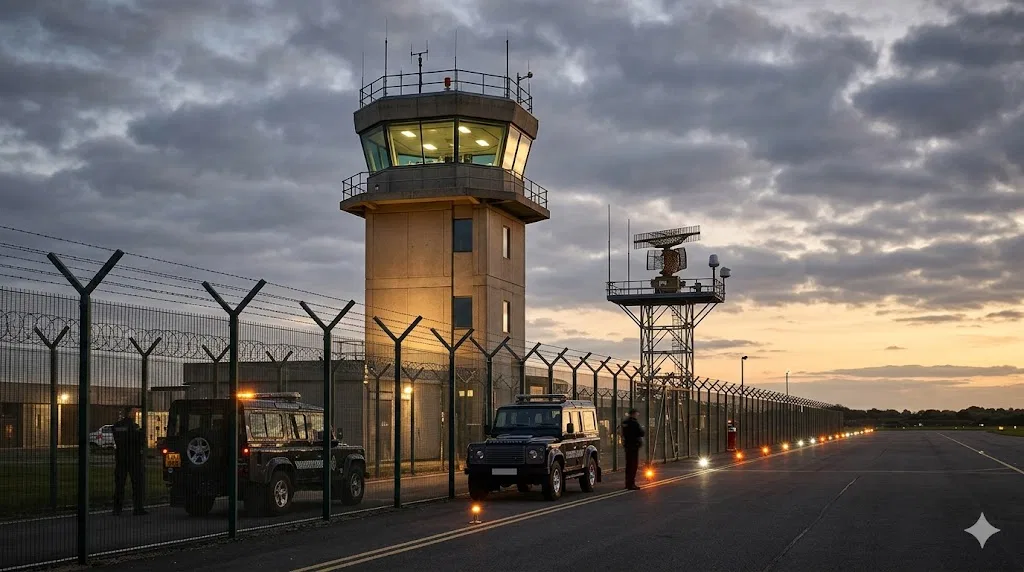
Restricted airspace changes the UFO-and-nuclear-weapons question from “what was it?” to “what should the site do now?” Around nuclear bases, missile fields, bomber installations, weapons laboratories and civil nuclear plants, an unknown object is first a safety and security problem, not an alien mystery. The practical response is to detect it, classify what can be classified, protect critical assets, preserve evidence, notify the right authorities and avoid escalating on assumptions that the object is extraterrestrial, hostile or harmless.
That distinction matters because many modern “UFO” reports near sensitive sites may be drones, balloons, aircraft, sensor artefacts or misidentified lights, yet the risk is still real. The US Nuclear Regulatory Commission now requires nuclear power plant licensees to report drone sightings over their facilities, and those reports go to the NRC, the Federal Aviation Administration, the FBI and local law enforcement. The NRC also stresses a key boundary: nuclear plant security forces do not themselves have authority to interdict or shoot down aircraft, including drones, over their facilities.[Nuclear Regulatory Commission]nrc.govNuclear Regulatory Commission Drones and Nuclear Power Plant Security | Nuclear Regulatory CommissionNuclear Regulatory Commission Drones and Nuclear Power Plant Security | Nuclear Regulatory Commission
Restricted Airspace Is a Warning System, Not a Force Field
Restricted airspace is often misunderstood as a physical shield. It is not. It is a legal and operational boundary that tells pilots, drone operators, air traffic controllers and security agencies that entry is limited, prohibited or conditional. Its first value is prevention: making lawful operators stay away. Its second value is triage: when something enters anyway, responders know the event deserves attention.
In the United States, one important tool is the FAA’s use of special security instructions under 14 CFR section 99.7. The FAA may issue such instructions, in consultation with the Department of Defense or other federal security or intelligence agencies, for situations judged detrimental to national defence. The rule requires aircraft operators in specified defence-related airspace to comply with national-security instructions issued by the FAA under agreement with defence, security or intelligence agencies.[Federal Aviation Administration]faa.govOpen source on faa.gov.[Legal Information Institute]law.cornell.eduLegal Information Institute14 CFR § 99.7Special security instructions. | Electronic Code of Federal Regulations (e-CFR) | US Law | LII / Legal Information Institute…
For drones, the FAA states that operations are prohibited from the surface up to 400 feet above ground level over designated national security sensitive facilities, including some military bases, national landmarks and certain critical infrastructure such as nuclear power plants. This restriction applies to all types and purposes of uncrewed aircraft flight operations, not only commercial drones.[Federal Aviation Administration]faa.govOpen source on faa.gov.
The UK uses a similar logic, though through its own aviation law. The Civil Aviation Authority explains that the Secretary of State can prohibit, restrict or impose conditions on civil aircraft in UK airspace where necessary in the public interest, with restrictions taking the form of prohibited, restricted or danger areas. Requests for access to permanent prohibited and restricted areas are handled through exemption processes, and temporary restrictions can be publicised through notices to airmen.[Civil Aviation Authority]caa.co.ukCivil Aviation Authority Airspace restrictions | UK Civil Aviation AuthorityCivil Aviation Authority Airspace restrictions | UK Civil Aviation Authority Around nuclear installations specifically, UK restrictions have applied to defined radii and altitude limits around listed sites; a parliamentary answer described restricted airspace around nuclear licensed sites as typically extending from 0.5 to 2 miles and from 1,000 to 2,400 feet, with unauthorised flight in the vicinity of nuclear sites treated as a criminal offence.[UK Parliament]questions-statements.parliament.ukUK ParliamentUnmanned Air Systems: Nuclear Installations15 Dec 2015 — These impose restricted airspace of a radius between 0.5 and 2 mile…
The security lesson is simple: restricted airspace does not prove that an intruder is exotic, but it does raise the response threshold. A light in ordinary sky may be logged as an aviation oddity. The same light crossing a protected nuclear perimeter must be treated as a possible surveillance, safety, smuggling, protest, sabotage or intelligence event until evidence narrows the explanation.

What Bases Need to Know Before They Escalate
A nuclear-linked site should not begin by asking whether an unknown object is a UFO in the popular sense. It should begin with operational questions that can be answered quickly and recorded clearly:
- Where is it? Its bearing, altitude estimate, track, speed, duration and proximity to protected assets matter more than its strangeness.
- What is seeing it? A visual sighting, radar return, radio-frequency detection, thermal image and acoustic cue carry different strengths and weaknesses.
- Is it inside controlled or restricted airspace? The same object can move from nuisance to security incident when it crosses a defined boundary.
- Is it behaving like an aircraft, drone, balloon, bird, satellite, flare or sensor artefact? “Unidentified” should mean “not yet identified”, not “extraordinary”.
- What is at risk right now? A flight line, weapons storage area, reactor protected area, command post or public road each implies a different response.
- Who has authority to act? Site guards, air traffic control, local police, federal authorities and military command do not all have the same powers.
This is where modern drone incidents have sharpened the old UFO debate. In older nuclear-UFO cases, accounts often turn on witness recollection, fragmentary records and later interpretation. In contemporary incidents, the practical problem is more immediate: small uncrewed aircraft may be too low, slow or numerous for traditional air-defence systems, yet too legally sensitive for ad hoc kinetic response.
The NRC’s fact sheet captures this implementation tension. It says nuclear plants are hardened, maintain armed security forces, physical barriers, intrusion detection and surveillance systems, and are regulated against design-basis threats. But it also says plant security forces do not have authority to shoot down or interdict aircraft, including drones. That means the right response is not simply “take it down”; it is coordinated reporting, law enforcement involvement and evidence-led threat assessment.[Nuclear Regulatory Commission]nrc.govNuclear Regulatory Commission Drones and Nuclear Power Plant Security | Nuclear Regulatory CommissionNuclear Regulatory Commission Drones and Nuclear Power Plant Security | Nuclear Regulatory Commission
Reporting Paths Should Separate Safety, Security and UAP Analysis
A good escalation system has more than one lane. Unknown aerial activity near a nuclear site may need immediate safety action, criminal investigation, intelligence review and later UAP analysis, but those functions should not be collapsed into one sensational category.
For civil nuclear plants in the United States, the reporting path is now explicit for drones: licensees report sightings to the NRC, FAA, FBI and local law enforcement. That arrangement recognises that a drone over a nuclear plant is simultaneously an aviation issue, a nuclear-security issue, a possible federal crime and a local policing matter.[Nuclear Regulatory Commission]nrc.govNuclear Regulatory Commission Drones and Nuclear Power Plant Security | Nuclear Regulatory CommissionNuclear Regulatory Commission Drones and Nuclear Power Plant Security | Nuclear Regulatory Commission
For military UAP reporting, the All-domain Anomaly Resolution Office, known as AARO, is the US government body tasked with detection, identification and mitigation of unidentified anomalous phenomena near national security areas, in coordination with the intelligence community. The Department of Defense said in 2024 that AARO had received 757 reports for the May 2023 to June 2024 reporting period and previous unreported incidents, while also noting that many resolved cases turned out to be ordinary objects such as balloons, birds, drones, satellites and aircraft.[U.S. Department of War]war.govDOD Examining Unidentified Anomalous Phenomena > U.S. Department of War > Defense Department News | U.S. Department of War…(https://www.war.gov/News/News-Stories/Article/Article/3965403/dod-examining-unidentified-anomalous-phenomena/)
That same 2024 Defence Department discussion is useful because it holds two ideas together. It says unidentified objects near national security sites must be treated seriously and investigated rigorously, but it also states that AARO had found no verifiable evidence of extraterrestrial beings, activity or technology, and that resolved cases had not pointed to breakthrough technologies.[U.S. Department of War]war.govDOD Examining Unidentified Anomalous Phenomena > U.S. Department of War > Defense Department News | U.S. Department of War…(https://www.war.gov/News/News-Stories/Article/Article/3965403/dod-examining-unidentified-anomalous-phenomena/)
For a base commander or site security manager, the implication is practical: do not wait for a philosophical answer before acting. An event can be escalated as a restricted-airspace violation, a safety hazard or a suspected surveillance incident without claiming it is alien. Conversely, calling something a UAP should not downgrade the response into folklore. The label should trigger better data collection, not looser reasoning.
Security Response Without Assuming Aliens
The safest response posture is neither ridicule nor panic. It is a structured sequence that protects the site while preserving the possibility of ordinary explanations.
First, the site should stabilise operations. That may mean pausing exposed work, moving personnel away from vulnerable areas, sheltering key teams, notifying air traffic control, restricting vehicle movement or protecting aircraft and sensitive equipment. A 2026 official Air Force clarification on Barksdale Air Force Base said the base experienced several unauthorised drone incursions beginning on 9 March 2026; leadership issued a shelter-in-place order out of caution after the initial event, lifted it the same morning, and said operations continued while the incident remained under federal investigation.[Kirtland Air Force Base]kirtland.af.milKirtland Air Force Base FACT CHECK: Barksdale Drone IncursionKirtland Air Force BaseFACT CHECK: Barksdale Drone IncursionMarch 31, 2026 — 31 Mar 2026 — To clear up inaccurate and incomplete reportin…
Second, the site should collect evidence before it degrades. Security logs, tower communications, radar data, access-control records, CCTV footage, radio-frequency detections, witness statements and mobile-phone images all have value. The goal is not to produce a dramatic narrative, but to make later identification possible. AARO has highlighted a recurring problem in UAP work: many reports lack enough scientific data for analysis, leaving cases in active archives until better information emerges.[U.S. Department of War]war.govDOD Examining Unidentified Anomalous Phenomena > U.S. Department of War > Defense Department News | U.S. Department of War…(https://www.war.gov/News/News-Stories/Article/Article/3965403/dod-examining-unidentified-anomalous-phenomena/)
Third, responders should avoid unlicensed countermeasures. Jamming, spoofing, capture systems and kinetic defeat can create aviation hazards, interfere with communications or exceed a site’s legal authority. This is especially important around nuclear facilities, where an improvised response can be more dangerous than the observed object. The NRC’s position that plant security forces lack authority to interdict or shoot down aircraft is a reminder that defensive seriousness must operate inside the law.[Nuclear Regulatory Commission]nrc.govNuclear Regulatory Commission Drones and Nuclear Power Plant Security | Nuclear Regulatory CommissionNuclear Regulatory Commission Drones and Nuclear Power Plant Security | Nuclear Regulatory Commission
Fourth, agencies should classify the event by behaviour, not mythology. A single drifting object, a swarm moving across a flight line, a repeated night-time pattern, an object near a weapons storage area and a sensor-only anomaly should not all be treated alike. The most useful categories are operational: accidental incursion, careless hobbyist, authorised but poorly communicated flight, criminal activity, protest, hostile surveillance, foreign intelligence collection, sensor error, natural phenomenon or unresolved UAP.
This approach keeps the nuclear-UFO issue grounded. It accepts that unknown activity near nuclear sites is important without needing the extraordinary conclusion that unknown equals non-human.
Recent Drone Cases Show the Modern Version of the Problem
Recent incidents at military sites show why restricted-airspace response has become more urgent. They are not proof of alien involvement, but they demonstrate the exact implementation challenge that older UFO cases raised in a less instrumented era: unknown objects can appear near highly sensitive assets, remain difficult to identify in real time, and force commanders to choose between continuity of operations and caution.
At Barksdale Air Force Base in Louisiana, a key US strategic bomber base, official statements in March 2026 confirmed multiple unauthorised drone incursions. Reporting citing a base statement said Barksdale detected unauthorised drones operating in its airspace during the week of 9 March, and that flying a drone over a military installation is both a safety issue and a federal criminal offence.[The Independent]independent.co.ukThe IndependentLarge number of 'unidentified drones' spotted over base…March 20, 2026 — 20 Mar 2026 — “Barksdale Air Force Base detect… The base later clarified that the incursions varied in duration and number, that a short shelter-in-place order followed the initial event, and that the matter was under active federal investigation.[Kirtland Air Force Base]kirtland.af.milKirtland Air Force Base FACT CHECK: Barksdale Drone IncursionKirtland Air Force BaseFACT CHECK: Barksdale Drone IncursionMarch 31, 2026 — 31 Mar 2026 — To clear up inaccurate and incomplete reportin…
At Wright-Patterson Air Force Base in Ohio, drones reportedly forced a roughly four-hour airspace closure in December 2024. A base spokesperson said the drones varied in size, did not affect base facilities, and represented the first reported sightings of that kind at the installation.[Sky News]news.sky.comNews Mysterious drone sightings shut down one of the largestNews Mysterious drone sightings shut down one of the largest
In the UK, small uncrewed systems were spotted near and over RAF Lakenheath, RAF Mildenhall, RAF Feltwell and RAF Fairford from 20 November 2024, according to a US Air Forces in Europe statement.[usafe.af.mil]af.milAir Forces Africa Statement on Installation Security in theAir Forces Africa Statement on Installation Security in the Reuters reported that unidentified drones were seen over US Air Force bases in England across several days, while the UK Ministry of Defence said it took threats seriously and was supporting the US response.[Reuters]reuters.comUS Air Force says drones spotted over its military bases in EnglandUS Air Force says drones spotted over its military bases in England
These cases matter for the nuclear-weapons context because several affected installations are part of wider strategic or high-security military infrastructure, even where governments do not confirm specific weapons details. The responsible inference is not “UFOs are targeting nuclear weapons”. It is that nuclear-relevant and strategic sites need airspace security systems built for small, ambiguous, legally complicated objects.
The UK Nuclear Picture Shows the Value of Careful Record-Keeping
The United Kingdom provides a useful caution against overstating the record. In a 2026 Freedom of Information response, the Office for Nuclear Regulation said it did not hold the requested information on unexplained aerial or airspace incidents near UK regulated nuclear sites since 1 January 2010. It said it had searched internal systems and had not identified incidents where the cause of reported aerial activity was unidentified, adding that its understanding was that no such incidents had been recorded.[Office for Nuclear Regulation]onr.org.ukOpen source on onr.org.uk.
That does not prove no unusual activity ever occurred near any UK nuclear site. It tells us something narrower but important: at least for that ONR request and the categories searched, the regulator did not hold records of unidentified aerial incidents. For readers of UFO-and-nuclear claims, this is a useful distinction. Absence of a regulator-held record is not absolute proof of absence; but it is a warning against treating scattered claims, rumours or social-media posts as equivalent to official incident records.
At the same time, drone incidents near UK defence sites have increased. Reuters reported in February 2026 that UK military bases recorded 266 uncrewed aerial vehicle incidents near defence sites in 2025, up from 126 in 2024, and that the government was giving military officers expanded powers to destroy drones operating near bases.[Reuters]reuters.comDrone incidents at UK military bases doubled last year | ReutersDrone incidents at UK military bases doubled last year | Reuters That is a defence-site trend, not a civil nuclear-site UFO finding, but it explains why the response environment is changing.
The lesson for nuclear facilities is that record architecture matters. A site may have security logs, aviation notifications, police records, regulator reports and intelligence channels that do not automatically merge. Without consistent definitions and retention, later investigators can be left arguing over whether “nothing happened”, “nothing was identified”, or “nothing was recorded in the place searched”.
What a Sensible Escalation Model Looks Like
A robust response to unknown objects near nuclear-linked sites should be layered. It should be fast enough for security, disciplined enough for aviation safety, and cautious enough to avoid turning every ambiguous event into either a panic or a joke.
A practical model would look like this:
- Immediate detection and confirmation. Use visual observers, radar where available, radio-frequency monitoring, thermal or optical cameras, air traffic data and perimeter reports. One sensor is rarely enough; multiple independent detections are far stronger.
- Airspace and asset check. Determine whether the object is inside a prohibited, restricted, defence or temporary restriction area, and whether it is near a protected asset such as a reactor protected area, weapons storage area, missile field, bomber flight line, command post or security checkpoint.
- Safety action. Notify air traffic control where relevant, protect personnel, restrict exposed operations and prevent collision risks. Safety of flight should not wait for final identification.
-
Security escalation. Notify the site command chain, law enforcement, aviation authority and nuclear or defence regulator as required. In the US civil nuclear context, drone sightings are reported to the NRC, FAA, FBI and local law enforcement. Nuclear Regulatory Commission
- Evidence preservation. Freeze logs, mark times precisely, retain video in original form, collect witness statements separately, and document weather, celestial objects, scheduled flights and authorised drone operations.
- Threat classification. Separate likely accidental intrusion from repeated surveillance, coordinated swarming, payload concern, cyber-electromagnetic activity, protest action, or unresolved UAP.
- Lawful mitigation. Use only authorised counter-drone or air-defence measures. Where a site lacks authority to interdict, its role is to observe, protect, report and coordinate, not improvise.
- After-action review. Identify whether the event exposed a detection gap, a reporting delay, unclear authority, poor public messaging, or insufficient coordination with air traffic control and police.
This model is deliberately mundane. That is its strength. It handles drones, balloons, misidentified aircraft, sensor faults and genuinely unresolved UAP better than a response built around extraordinary assumptions.
The Hardest Trade-Off: Transparency Versus Security
Unknown aerial activity near nuclear sites creates a public-information problem. Too little disclosure feeds suspicion. Too much disclosure can reveal sensor coverage, blind spots, response times or counter-drone capabilities.
Officials often solve this by confirming the existence of incidents while withholding details. During the 2024 drone sightings over US-operated bases in Britain, the US Air Force confirmed small uncrewed systems had been seen in the vicinity of and over several bases, while also saying it would not discuss specific force-protection measures. usafe.af.mil That pattern can frustrate the public, but it reflects a genuine security constraint.
A better public posture would be to separate three things clearly:
- Confirmed facts: dates, general location, broad object type where known, whether operations or critical infrastructure were affected.
- Actions taken: monitoring, notifications, airspace closure, law enforcement involvement, investigation status.
- Withheld details: sensor types, countermeasures, vulnerabilities, exact asset proximity, classified mission implications.
This helps avoid two common failures. The first is over-disclosure that teaches future intruders how to evade detection. The second is vague reassurance that makes officials sound as though they are hiding the whole event. In nuclear contexts, credibility depends on acknowledging uncertainty without filling it with speculation.
Why This Subtopic Matters for UFOs and Nuclear Weapons
The restricted-airspace issue is the most practical part of the UFO-and-nuclear-weapons debate. It does not require proving that unknown objects are alien, or that nuclear sites are uniquely attractive to non-human intelligence. It asks a narrower and more useful question: when an unknown object appears near a nuclear-relevant site, does the system detect it, report it, respond lawfully and learn from it?
The current evidence points to a sober answer. Unidentified or unauthorised activity near sensitive sites can be real and operationally significant. Many cases are later explained as ordinary objects or remain unresolved because the data are weak. Modern drones have made the problem more frequent, more ambiguous and harder to manage inside old aviation and security frameworks. Nuclear facilities and strategic bases therefore need better airspace awareness, clearer reporting duties, rehearsed escalation paths and public communication that is factual without being reckless.
The strongest response is not to assume aliens, and not to assume harmlessness. It is to treat restricted airspace as a decision trigger: protect the site, preserve the evidence, involve the right authorities and let the explanation follow the data.
Amazon book picks
Further Reading
Books and field guides related to How Should Bases Handle Unknown Objects?. Use these as the next step if you want deeper reading beyond the article.
The Report on Unidentified Flying Objects
Discusses official investigation and classification of sightings.

eBay marketplace picks
Marketplace Samples
Example marketplace items related to this page. Use the search link to explore similar finds on eBay.


Endnotes
2.
Source: faa.gov
Link:https://www.faa.gov/air_traffic/publications/atpubs/foa_html/chap21_section_6.html
3.
Source: faa.gov
Link:https://www.faa.gov/uas/critical_infrastructure
4.
Source: questions-statements.parliament.uk
Link:https://questions-statements.parliament.uk/written-questions/detail/2015-12-15/20272
Source snippet
UK ParliamentUnmanned Air Systems: Nuclear Installations15 Dec 2015 — These impose restricted airspace of a radius between 0.5 and 2 mile...
5.
Source: war.gov
Title: U.S. Department of War
Link:https://www.war.gov/News/News-Stories/Article/Article/3965403/dod-examining-unidentified-anomalous-phenomena/
Source snippet
DOD Examining Unidentified Anomalous Phenomena > U.S. Department of War > Defense Department News | U.S. Department of War...
6.
Source: news.sky.com
Title: News Mysterious drone sightings shut down one of the largest
Link:https://news.sky.com/story/mysterious-drone-sightings-shut-down-one-of-the-largest-us-air-force-bases-in-the-world-13275051
8.
Source: reuters.com
Title: US Air Force says drones spotted over its military bases in England
Link:https://www.reuters.com/world/us-air-force-says-drones-spotted-over-its-military-bases-england-2024-11-26/
9.
Source: reuters.com
Title: Drone incidents at UK military bases doubled last year | Reuters
Link:https://www.reuters.com/world/uk/drone-incidents-uk-military-bases-doubled-last-year-2026-02-02/
10.
Source: faa.gov
Link:https://www.faa.gov/sites/faa.gov/files/pilots/safety/notams_tfr/tfrweb.pdf
11.
Source: faa.gov
Link:https://www.faa.gov/
12.
Source: faa.gov
Title: Restricting Drones Near Critical Infrastructure Sites
Link:https://www.faa.gov/newsroom/restricting-drones-near-critical-infrastructure-sites
13.
Source: faa.gov
Link:https://www.faa.gov/air_traffic/publications/atpubs/ntap_aug_18/part1_Section3.html
14.
Source: faa.gov
Title: UAS Detection Mitigation Systems ARC Final Report 02052024
Link:https://www.faa.gov/regulations_policies/rulemaking/committees/documents/media/UAS-Detection-Mitigation-Systems-ARC_Final-Report_02052024.pdf
15.
Source: faa.gov
Link:https://www.faa.gov/air_traffic/publications/atpubs/foa_html/chap2_section_1.html
16.
Source: faa.gov
Title: UAS ID ARC Final Report with Appendices
Link:https://www.faa.gov/regulations_policies/rulemaking/committees/documents/media/UAS%20ID%20ARC%20Final%20Report%20with%20Appendices.pdf
17.
Source: faa.gov
Link:https://www.faa.gov/air_traffic/publications/us_restrictions/procedures
18.
Source: faa.gov
Link:https://www.faa.gov/air_traffic/publications/atpubs/atc_html/chap9_section_2.html
19.
Source: faa.gov
Title: Second Edition Integration of Civil UAS NAS Roadmap July%202018
Link:https://www.faa.gov/sites/faa.gov/files/uas/resources/policy_library/Second_Edition_Integration_of_Civil_UAS_NAS_Roadmap_July%25202018.pdf
20.
Source: faa.gov
Title: establishes restrictions drone operations over additional military facilities
Link:https://www.faa.gov/newsroom/faa-establishes-restrictions-drone-operations-over-additional-military-facilities
21.
Source: faa.gov
Title: 7210.3EE Chg 2 dtd 1 22 26 Final
Link:https://www.faa.gov/documentLibrary/media/Order/7210.3EE_Chg_2_dtd_1-22-26_Final.pdf
22.
Source: faa.gov
Link:https://www.faa.gov/air_traffic/publications/atpubs/atc_html/chap2_section_1.html
23.
Source: faa.gov
Title: suasarc 4102008
Link:https://www.faa.gov/regulations_policies/rulemaking/committees/documents/media/suasarc-4102008.pdf
24.
Source: faa.gov
Title: jo 7200.23a unmanned aircraft systems (uas)
Link:https://www.faa.gov/documentlibrary/media/order/jo_7200.23a_unmanned_aircraft_systems_%28uas%29.pdf
25.
Source: faa.gov
Title: FA A Establishes Restrictions on Drone Operations Near
Link:https://www.faa.gov/newsroom/faa-establishes-restrictions-drone-operations-near-us-navy-vessels
26.
Source: aaro.mil
Link:https://www.aaro.mil/
27.
Source: aaro.mil
Link:https://www.aaro.mil/UAP-Cases/Official-UAP-Imagery/
28.
Source: aaro.mil
Link:https://www.aaro.mil/Portals/136/PDFs/AARO_UAP_Program_Report_User_Guide-20231211.pdf?ver=dJtqTlbDr3HqkIVDW8MP4Q%3D%3D
29.
Source: aaro.mil
Link:https://www.aaro.mil/Portals/136/PDFs/FOIA/2023%20FOIAs/23-F-1423.pdf
30.
Source: aaro.mil
Link:https://www.aaro.mil/Portals/136/PDFs/AARO_Mission_Brief_2025.pdf
31.
Source: aaro.mil
Title: 2025 UAP Workshop Paper
Link:https://www.aaro.mil/Portals/136/PDFs/Information%20Papers/2025_UAP_Workshop_Paper.pdf
32.
Source: aaro.mil
Link:https://www.aaro.mil/Submit-A-Report/
33.
Source: nrc.no
Link:https://www.nrc.no/
34.
Source: nrc.gov
Link:https://www.nrc.gov/
35.
Source: nrc.gov
Link:https://www.nrc.gov/docs/ML2418/ML24184A122.pdf
36.
Source: media.defense.gov
Title: FY24 CONSOLIDATED ANNUAL REPORT ON UAP 508
Link:https://media.defense.gov/2024/Nov/14/2003583603/-1/-1/0/FY24-CONSOLIDATED-ANNUAL-REPORT-ON-UAP-508.PDF
37.
Source: war.gov
Title: department of defense releases the annual report on unidentified anomalous phen
Link:https://www.war.gov/News/Releases/Release/Article/3964824/department-of-defense-releases-the-annual-report-on-unidentified-anomalous-phen/
38.
Source: law.cornell.edu
Title: Legal Information Institute14 CFR § 99.7
Link:https://www.law.cornell.edu/cfr/text/14/99.7
Source snippet
Special security instructions. | Electronic Code of Federal Regulations (e-CFR) | US Law | LII / Legal Information Institute...
39.
Source: caa.co.uk
Title: Civil Aviation Authority Airspace restrictions | UK Civil Aviation Authority
Link:https://www.caa.co.uk/commercial-industry/airspace/event-and-obstacle-notification/airspace-restrictions/
40.
Source: kirtland.af.mil
Title: Kirtland Air Force Base FACT CHECK: Barksdale Drone Incursion
Link:https://www.kirtland.af.mil/News/Article/4448052/fact-check-barksdale-drone-incursion/
Source snippet
Kirtland Air Force BaseFACT CHECK: Barksdale Drone IncursionMarch 31, 2026 — 31 Mar 2026 — To clear up inaccurate and incomplete reportin...
Published: March 31, 2026
41.
Source: independent.co.uk
Link:https://www.independent.co.uk/news/world/americas/barksdale-louisiana-drones-lockdown-b2942878.html
Source snippet
The IndependentLarge number of 'unidentified drones' spotted over base...March 20, 2026 — 20 Mar 2026 — “Barksdale Air Force Base detect...
Published: March 20, 2026
42.
Source: onr.org.uk
Link:https://www.onr.org.uk/publications/corporate-publications/foi-releases/2026/02/unexplained-airspace-or-aerial-incidents-near-regulated-nuclear-sites
43.
Source: assets.publishing.service.gov.uk
Title: 2022 126 FOI response letter drone sightings 30062022 Redacted
Link:https://assets.publishing.service.gov.uk/media/6311e079e90e077b70cc374f/2022_126_FOI_response_letter_drone_sightings_30062022_Redacted.pdf
44.
Source: assets.publishing.service.gov.uk
Title: RA2330 Issue 10
Link:https://assets.publishing.service.gov.uk/media/6970ee49011505255b2d42fb/RA2330_Issue_10.pdf
45.
Source: abcnews.com
Link:https://abcnews.com/International/multiple-waves-unauthorized-drones-spotted-strategic-us-air/story?id=131245527
46.
Source: abcnews.com
Link:https://abcnews.com/International/unidentified-drones-3-british-air-bases-us-forces/story?id=116236414
47.
Source: onr.org.uk
Link:https://www.onr.org.uk/
48.
Source: onr.org.uk
Title: land use planning
Link:https://www.onr.org.uk/our-work/what-we-regulate/other-regulationslegislations/land-use-planning
49.
Source: onr.org.uk
Title: about us
Link:https://www.onr.org.uk/about-us
50.
Source: onr.org.uk
Link:https://www.onr.org.uk/publications/publication-search?type=researchReportPublication
51.
Source: legislation.gov.uk
Title: uksi 20161003 en
Link:https://www.legislation.gov.uk/uksi/2016/1003/pdfs/uksi_20161003_en.pdf
52.
Source: legislation.gov.uk
Link:https://www.legislation.gov.uk/uksi/2007/1929/made/data.xht?view=snippet&wrap=true
53.
Source: legislation.gov.uk
Link:https://www.legislation.gov.uk/uksi/2016/1003/contents/made
54.
Source: caa.co.uk
Link:https://www.caa.co.uk/publication/download/15773
55.
Source: facebook.com
Link:https://www.facebook.com/FAA/
56.
Source: x.com
Link:https://x.com/lemonodor/status/1944385799262277882
57.
Source: Wikipedia
Title: Federal Aviation Administration
Link:https://en.wikipedia.org/wiki/Federal_Aviation_Administration
58.
Source: Wikipedia
Title: 2024 drone sightings
Link:https://en.wikipedia.org/wiki/2024_drone_sightings
59.
Source: youtube.com
Link:https://www.youtube.com/%40FAAnews/featured
60.
Source: GOV.UK
Title: the response to an foi on the use of drones within the cnc 2
Link:https://www.gov.uk/government/publications/the-response-to-an-foi-on-the-use-of-drones-within-the-cnc–2
61.
Source: GOV.UK
Link:https://www.gov.uk/government/organisations/office-for-nuclear-regulation
62.
Source: uk.finance.yahoo.com
Link:https://uk.finance.yahoo.com/quote/NRC/
63.
Source: uk.linkedin.com
Title: office for nuclear regulation
Link:https://uk.linkedin.com/company/office-for-nuclear-regulation
64.
Source: skybrary.aero
Link:https://skybrary.aero/articles/federal-aviation-administration-faa
65.
Source: catalog.hathitrust.org
Link:https://catalog.hathitrust.org/Record/101828893
Additional References
66.
Source: youtube.com
Link:https://www.youtube.com/watch?v=QY6naT5OZSc
Source snippet
U.S. Fails To Counter Mysterious Aircraft Over Langley Base; 'Sensitive Sites Filmed'...
67.
Source: youtube.com
Title: Pentagon’s new UFO files show no evidence of aliens found
Link:https://www.youtube.com/watch?v=yY-iebpKygk
Source snippet
Lawmakers from both parties, whistleblower David Grusch call for UAP records be declassified | FULL...
68.
Source: youtube.com
Link:https://www.youtube.com/watch?v=CgcfZaC_pPg
Source snippet
Drone strike near UAE nuclear power plant | ABC NEWS...
69.
Source: federalregister.gov
Link:https://www.federalregister.gov/documents/2024/03/26/2024-06391/issuance-of-multiple-exemptions-regarding-security-notifications-reports-and-recording-keeping
70.
Source: youtube.com
Title: Drone strike near UAE nuclear power plant | ABC NEWS
Link:https://www.youtube.com/watch?v=8hX50uV9fNY
Source snippet
Drone strikes UAE nuclear power plant in blow to Iran ceasefire...
71.
Source: instagram.com
Link:https://www.instagram.com/p/DWHhzJ8kQXS/
72.
Source: aui.edu
Link:https://aui.edu/aaro-releases-report-on-unidentified-anomalous-phenomena-uap/
73.
Source: norad.mil
Link:https://www.norad.mil/About-NORAD/
74.
Source: adsgroup.org.uk
Link:https://www.adsgroup.org.uk/wp-content/uploads/2019/10/ADS-policy-paper-on-counter-drone-use-cases-October-2019.pdf
75.
Source: defensescoop.com
Link:https://defensescoop.com/2023/10/31/dod-invites-past-and-present-military-personnel-and-contractors-to-report-uap-activity-via-new-portal/
Topic Tree