Within Drones
Who can actually stop the drone?
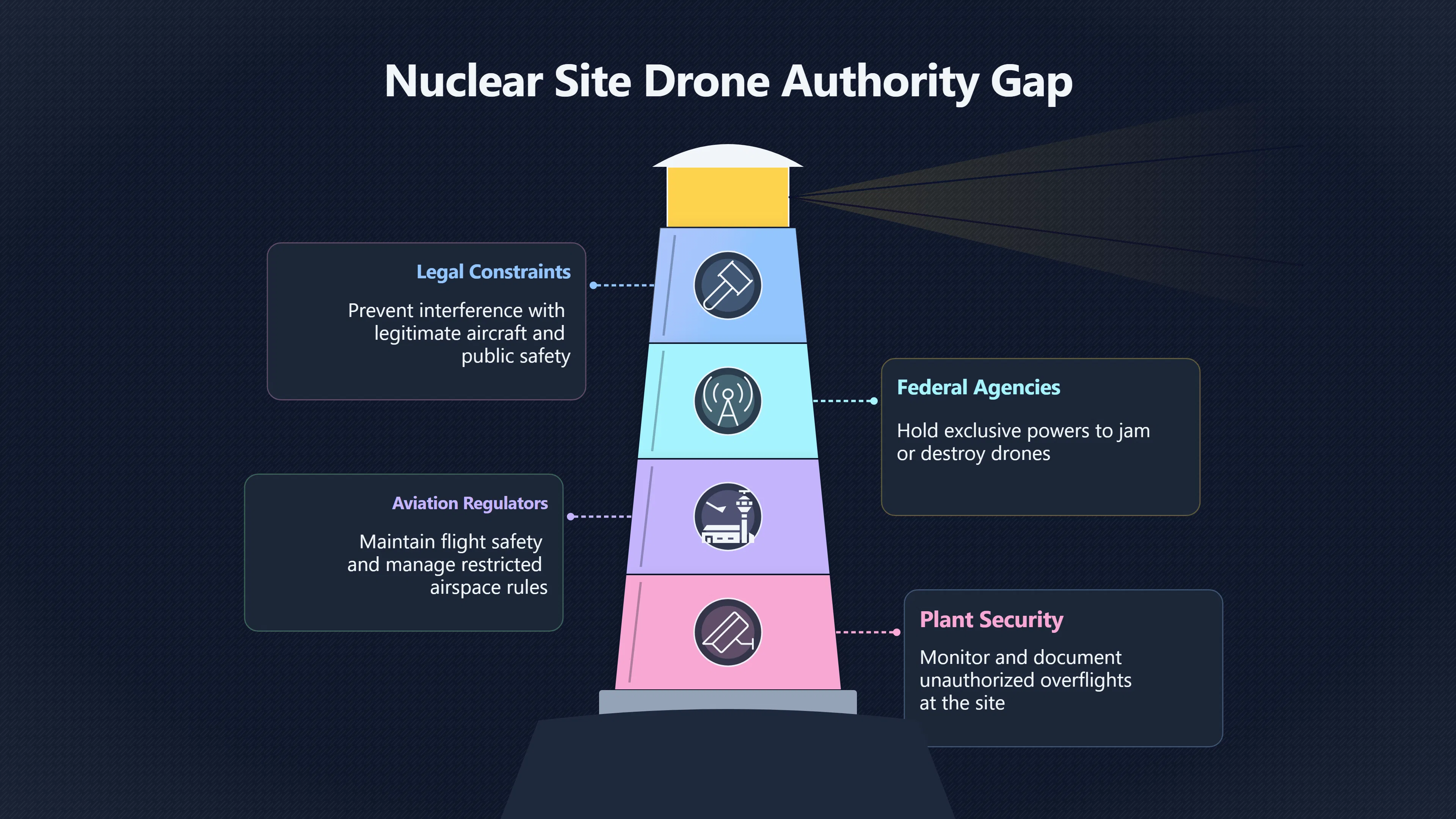
Nuclear guards may see a drone but lack direct authority to jam, seize or shoot it down, creating a dangerous handoff problem.
On this page
- Why detection does not equal interdiction
- How agencies split response powers
- Why legal limits shape nuclear site security
Page outline Jump by section
Introduction
When a drone appears over a nuclear facility, the most immediate question is often not what the object is, but who has the authority to stop it. Modern nuclear-site security systems can frequently detect suspicious aircraft, track their movements and alert authorities. Yet detection does not automatically grant the legal power to interfere with the aircraft. In many countries, and particularly in the United States, civilian nuclear operators face a persistent “authority gap”: guards may observe a drone over protected airspace but lack the legal authority to jam its signals, seize control of it, or shoot it down. The result is a potentially dangerous handoff between plant security, aviation regulators and law-enforcement agencies at precisely the moment when rapid action may matter most.[Nuclear Regulatory Commission]nrc.govNuclear Regulatory CommissionDrones and Nuclear Power Plant SecurityWhile nuclear power plant security forces do not have the authority t…
 Within the broader story of drones and modern nuclear-site security scares, this governance problem helps explain why some incidents generate frustration and public speculation. A drone may be identified as a conventional aircraft rather than a mysterious object, yet authorities can still struggle to respond in real time because responsibility is fragmented across multiple agencies.[Nuclear Regulatory Commission]nrc.govNuclear Regulatory CommissionDrones and Nuclear Power Plant SecurityWhile nuclear power plant security forces do not have the authority t…
Why Detection Does Not Equal Interdiction
Nuclear facilities increasingly deploy sensors capable of spotting low-flying drones. The challenge begins after detection.
Commercial nuclear plant security forces generally do not possess the authority to bring down an aircraft merely because it has entered restricted airspace. The U.S. Nuclear Regulatory Commission (NRC) has repeatedly stated that nuclear power plant security personnel are not authorised to interdict or shoot down aircraft, including drones, over their facilities. Instead, operators are expected to report sightings and coordinate with federal, state and local authorities.[Nuclear Regulatory Commission]nrc.govNuclear Regulatory CommissionDrones and Nuclear Power Plant SecurityWhile nuclear power plant security forces do not have the authority t…
This creates a practical dilemma. A small drone can cross a facility perimeter in seconds, conduct surveillance, collect imagery or test response procedures, and then depart before outside responders arrive. Even when plant personnel know an overflight is unlawful, they may have few lawful options beyond observation, documentation and notification.[blog.aerodefense.tech]blog.aerodefense.techdrone power plantFederal law prohibits private entities from jamming, shooting down, or otherwise interfering with aircraft, including drones. Power plant…
The problem became particularly visible after repeated drone incursions near sensitive facilities. Following a series of drone overflights at the Palo Verde Nuclear Generating Station in Arizona, internal discussions later reported by journalists reflected concern that restricted airspace alone would not stop a determined operator and that law enforcement might not arrive quickly enough to engage the pilot.[WIRED]wired.comThese incidents have raised serious concerns among state lawmakers and prompted calls for a state of emergency. Some speculated foreign a…
How Agencies Split Response Powers
The authority gap exists because responsibility for drones is divided among institutions with different missions.
Aviation regulators control the airspace
Civil aviation authorities are responsible for maintaining flight safety. Rules restricting drone flights around sensitive facilities are designed not only to protect those facilities but also to prevent unsafe interference with legitimate aircraft operations. For that reason, actions such as radio-frequency jamming can create risks beyond the immediate target and are tightly regulated.[Federal Aviation Administration]faa.govcritical infrastructureFederal Aviation AdministrationCritical Infrastructure and Public VenuesFeb 22, 2023 — Operations are prohibited from the ground up to 40…
Nuclear operators protect the site
Plant security teams are responsible for physical protection of reactors, spent-fuel facilities and other sensitive infrastructure. They can monitor, investigate and report incidents, but in many jurisdictions their powers stop short of disabling aircraft. The NRC’s guidance reflects this distinction between site security responsibilities and aviation enforcement powers.[Nuclear Regulatory Commission]nrc.govNuclear Regulatory CommissionDrones and Nuclear Power Plant SecurityWhile nuclear power plant security forces do not have the authority t…

Federal security agencies hold most counter-drone powers
In the United States, specialised counter-unmanned aircraft authorities are concentrated within a limited group of federal agencies. Certain military, homeland-security and law-enforcement entities can employ technologies that disrupt, seize or destroy threatening drones under specific legal conditions. Those authorities generally do not extend automatically to commercial nuclear operators.[DRONELIFE]dronelife.comdrones threaten nuclear power plants counter drone part 3Jan 31, 2025 — Currently, only a handful of federal agencies are author…
The result is a layered system in which the organisation that first sees the threat is often not the organisation legally empowered to neutralise it.
Why Legal Limits Shape Nuclear-Site Security
The restrictions are not simply bureaucratic obstacles. They reflect competing public-safety concerns.
A drone is legally considered an aircraft in many regulatory frameworks. Interfering with aircraft communications, transmitting jamming signals or destroying an aircraft can have consequences beyond the immediate incident. A falling drone may injure people or damage property. Radio-frequency interference can affect other systems. Mistaken identification is also a concern, especially during fast-moving events.[blog.aerodefense.tech]blog.aerodefense.techdrone power plantFederal law prohibits private entities from jamming, shooting down, or otherwise interfering with aircraft, including drones. Power plant…
Governments therefore tend to reserve counter-drone powers for specially authorised entities operating under defined rules. The same legal framework that prevents reckless responses can also slow legitimate defensive action when an unidentified drone appears over critical infrastructure. This tension lies at the heart of the authority-gap debate.[IACP]theiacp.orgIACPEXPIRED A Joint Resolution To Support The Enhancement…Jul 13, 2023 — Expand DOJ and DHS existing authorities to protect critical i…
For nuclear facilities, the issue is particularly sensitive because operators are expected to defend against sophisticated threats while simultaneously remaining constrained by aviation law and communications regulations. A facility may be physically hardened against attack yet still dependent on external agencies for aerial threat mitigation.[NEI]nei.org4 reasons us nuclear plants safe from drones4 Reasons Why U.S. Nuclear Power Plants Are Safe from…Aug 6, 2018 — U.S. nuclear power plants are extremely well-protected against…
The Push to Close the Gap
Recent legislative and policy debates have increasingly focused on whether critical infrastructure operators should receive limited counter-drone authority.
Supporters argue that nuclear plants, electrical substations and other high-value facilities need the ability to respond immediately to hostile or suspicious drones. Several legislative proposals have sought to expand counter-unmanned aircraft powers beyond a small set of federal agencies and permit trained personnel at designated critical infrastructure sites to detect and mitigate drone threats under federal oversight.[peters.senate.gov+2commercialuavnews.com]peters.senate.govSenators Peters and Blackburn Introduce Bipartisan BillMay 14, 2025 — US Senators Gary Peters (D-MI) and Marsha Blackburn (R-TN) introduced bipartisan legislation to protect our nation's nucle…
Advocates for reform point to the growing number of drone incidents reported around nuclear facilities and argue that current arrangements leave a dangerous delay between detection and action.[The War Zone]twz.commassive uptick in official drone sightings by nuclear power plantsThe War ZoneNuclear Power Plants Report Massive Uptick In Drone…21 Dec 2024 — Drone flights over nuclear facilities have been increasi…
Critics, however, warn that broader authority could create aviation-safety risks, increase the chances of mistaken engagements and complicate oversight. They argue that expanding the number of organisations allowed to interfere with aircraft requires careful safeguards, training standards and accountability mechanisms.[IACP]theiacp.orgIACPEXPIRED A Joint Resolution To Support The Enhancement…Jul 13, 2023 — Expand DOJ and DHS existing authorities to protect critical i…

Why the Authority Gap Matters in Nuclear-Site UFO Scares
The authority gap helps explain why drone incidents around nuclear facilities can appear more mysterious than they actually are.
Observers may assume that if a drone is seen over a highly protected installation, authorities will immediately identify and stop it. In reality, security personnel may detect the object yet remain unable to take direct action. The drone can therefore remain unidentified in public reporting even when officials strongly suspect it is a conventional unmanned aircraft.[Nuclear Regulatory Commission]nrc.govNuclear Regulatory CommissionDrones and Nuclear Power Plant SecurityWhile nuclear power plant security forces do not have the authority t…
This dynamic feeds uncertainty. A sighting can begin as a straightforward security event, evolve into a public mystery because the operator is never identified, and eventually enter wider discussions about unexplained aerial phenomena. The crucial issue is often not a failure of detection but a failure of legal and organisational alignment. Until authority, technology and responsibility are more closely integrated, nuclear facilities will continue to face a situation in which seeing the drone and stopping the drone are two very different things.[Nuclear Regulatory Commission+2peters.senate.gov]nrc.govNuclear Regulatory CommissionDrones and Nuclear Power Plant SecurityWhile nuclear power plant security forces do not have the authority t…
Amazon book picks
Further Reading
Books and field guides related to Who can actually stop the drone?. Use these as the next step if you want deeper reading beyond the article.

The secret state
First published 2002. Subjects: Geschichte 1940-1970, Military planning, Nuclear weapons, Cold War, Kernoorlog.

eBay marketplace picks
Marketplace Samples
Example marketplace items related to this page. Use the search link to explore similar finds on eBay.


Endnotes
1.
Source: nrc.gov
Link:https://www.nrc.gov/reading-rm/doc-collections/fact-sheets/fs-drone-pwr-plant-security
Source snippet
Nuclear Regulatory CommissionDrones and Nuclear Power Plant SecurityWhile nuclear power plant security forces do not have the authority t...
2.
Source: wired.com
Link:https://www.wired.com/story/us-military-mystery-drones-response
Source snippet
These incidents have raised serious concerns among state lawmakers and prompted calls for a state of emergency. Some speculated foreign a...
3.
Source: blog.aerodefense.tech
Title: drone power plant
Link:https://blog.aerodefense.tech/drone-power-plant
Source snippet
Federal law prohibits private entities from jamming, shooting down, or otherwise interfering with aircraft, including drones. Power plant...
4.
Source: dronelife.com
Link:https://dronelife.com/2025/01/31/are-drones-a-threat-to-nuclear-power-plants-examining-risks-to-the-u-s-electric-grid/
Source snippet
drones threaten nuclear power plants counter drone part 3Jan 31, 2025 — Currently, only a handful of federal agencies are author...
5.
Source: nei.org
Title: 4 reasons us nuclear plants safe from drones
Link:https://www.nei.org/news/2018/4-reasons-us-nuclear-plants-safe-from-drones
Source snippet
4 Reasons Why U.S. Nuclear Power Plants Are Safe from...Aug 6, 2018 — U.S. nuclear power plants are extremely well-protected against...
6.
Source: peters.senate.gov
Title: Senators Peters and Blackburn Introduce Bipartisan Bill
Link:https://www.peters.senate.gov/newsroom/press-releases/senators-peters-and-blackburn-introduce-bipartisan-bill-to-protect-us-nuclear-facilities-from-drone-threats
Source snippet
May 14, 2025 — US Senators Gary Peters (D-MI) and Marsha Blackburn (R-TN) introduced bipartisan legislation to protect our nation's nucle...
Published: May 14, 2025
7.
Source: commercialuavnews.com
Link:https://www.commercialuavnews.com/senate-bill-critical-infrastructure-counter-uas-authority-
Source snippet
plants and power grid facilities, with training requirements and a 2031 sunset...
8.
Source: dronelife.com
Title: ndaa fy 2026 key counter uas provisions explained
Link:https://dronelife.com/2025/12/09/ndaa-fy-2026-key-counter-uas-provisions-explained/
Source snippet
NDAA FY 2026: Key Counter-UAS Provisions ExplainedDec 9, 2025 — The FY26 NDAA expands counter-UAS authority across DoD, DOE, DHS, and DOJ...
9.
Source: twz.com
Title: massive uptick in official drone sightings by nuclear power plants
Link:https://www.twz.com/news-features/massive-uptick-in-official-drone-sightings-by-nuclear-power-plants
Source snippet
The War ZoneNuclear Power Plants Report Massive Uptick In Drone...21 Dec 2024 — Drone flights over nuclear facilities have been increasi...
10.
Source: faa.gov
Title: critical infrastructure
Link:https://www.faa.gov/uas/critical_infrastructure
Source snippet
Federal Aviation AdministrationCritical Infrastructure and Public VenuesFeb 22, 2023 — Operations are prohibited from the ground up to 40...
11.
Source: faa.gov
Link:https://www.faa.gov/
Source snippet
Federal Aviation AdministrationFederal Aviation AdministrationThe Federal Aviation Administration is an operating mode of the U.S. Depart...
12.
Source: theiacp.org
Link:https://www.theiacp.org/resources/resolution/expired-a-joint-resolution-to-support-the-enhancement-of-authorities-for-the
Source snippet
IACPEXPIRED A Joint Resolution To Support The Enhancement...Jul 13, 2023 — Expand DOJ and DHS existing authorities to protect critical i...
Additional References
13.
Source: y12.doe.gov
Title: nnsa release y 12 deploys system counter unauthorized unmanned aircraft systems
Link:https://www.y12.doe.gov/news/press-releases/nnsa-release-y-12-deploys-system-counter-unauthorized-unmanned-aircraft-systems
Source snippet
Release: Y-12 Deploys System to Counter...The Y-12 National Security Complex has deployed a system to counter all unauthorized unmanned...
14.
Source: csgmidwest.org
Link:https://csgmidwest.org/wp-content/uploads/2021/01/NRC-Drones-Memo.pdf
Source snippet
Drones and Nuclear Power Plant SecurityNuclear power plant security forces do not have authority to attempt to interdict or shoot down ai...
15.
Source: armscontrol.org
Link:https://www.armscontrol.org/act/2019-12/news-briefs/nrc-will-not-require-drone-defenses
Source snippet
NRC Will Not Require Drone DefensesThe U.S. Nuclear Regulatory Commission (NRC) announced on Oct. 30 that it would not require nuclear po...
16.
Source: theguardian.com
Link:https://www.theguardian.com/us-news/2024/dec/15/mayorkas-north-east-drone-sightings
Source snippet
Despite federal efforts, social and political tensions remain high due to insufficient official information. To address security concerns...
17.
Source: unmannedairspace.info
Link:https://www.unmannedairspace.info/counter-uas-systems-and-policies/us-department-for-energy-publishes-rfi-for-c-uas-protection-of-nuclear-sites/
Source snippet
US Department for Energy publishes RFI for C-UAS...“Sandia National Laboratories (SNL), on behalf of the Center for Security, Technology...
18.
Source: industrialcyber.co
Link:https://industrialcyber.co/regulation-standards-and-compliance/us-bill-allows-critical-infrastructure-operators-to-detect-and-neutralize-rogue-drones-closing-key-defense-gaps/
Source snippet
Senator introduced legislation aimed at strengthening defenses against drone threats targeting critical infrastructure, proposing to...R...
19.
Source: energy.gov
Title: protecting nnsa facilities counter unmanned aircraft systems
Link:https://www.energy.gov/nnsa/protecting-nnsa-facilities-counter-unmanned-aircraft-systems
Source snippet
Protecting NNSA Facilities: Counter Unmanned Aircraft...Apr 17, 2026 — Flying a UAS over or near an NNSA facility without authorization...
20.
Source: thebulletin.org
Title: memo to trump address the new threat of drone vulnerable nuclear reactors
Link:https://thebulletin.org/2025/01/memo-to-trump-address-the-new-threat-of-drone-vulnerable-nuclear-reactors/
Source snippet
Bulletin of the Atomic ScientistsAddress the new threat of drone-vulnerable nuclear reactorsJan 17, 2025 — At the very least, the United...
21.
Source: thebulletin.org
Title: its past time to start protecting us nuclear power reactors from drones
Link:https://thebulletin.org/2025/09/its-past-time-to-start-protecting-us-nuclear-power-reactors-from-drones/
Source snippet
lacked the authority to shoot the drones down or any reliable means to detect and disable them. RELATED: The 2025 nuclear year in review...
22.
Source: hklaw.com
Title: Holland & Knight Citing National Security Needs, the FCC and FAA Take
Link:https://www.hklaw.com/en/insights/publications/2026/05/citing-national-security-needs-the-fcc-and-faa-take-steps-on-uas
Source snippet
Holland & KnightCiting National Security Needs, the FCC and FAA Take...May 12, 2026 — Commercial drone growth has raised security concer...
Published: May 12, 2026
Topic Tree