Within Nuclear UFOs
When Radar Helps A UFO Case
Radar can strengthen a UFO case, but sensor readings still need context, calibration and independent corroboration.
On this page
- What radar can confirm
- False tracks and interpretation problems
- Radar plus witness testimony
Page outline Jump by section
Introduction
Radar can make a UFO report near a nuclear base harder to dismiss, but it does not make it self-explaining. A radar return can confirm that a sensor registered something at a reported time and bearing; in stronger cases, it can add range, movement, altitude or correlation with a visual sighting. Yet radar also has known failure modes: atmospheric bending, ground clutter, weather returns, transponder gaps, blind speeds, processing artefacts and missing metadata. Near nuclear facilities, that distinction matters because the practical question is not “was it alien?” but “was there an unauthorised object, a sensor problem, a misidentified ordinary craft, or an intrusion that should have triggered a security response?”
The most useful way to read radar evidence in nuclear-UFO cases is therefore layered. Radar is strongest when it is time-synchronised with witness testimony, logs, communications, independent sensors and environmental data. It is weakest when later retellings refer vaguely to “radar confirmation” without preserved tracks, equipment details or operator notes.
What radar can confirm
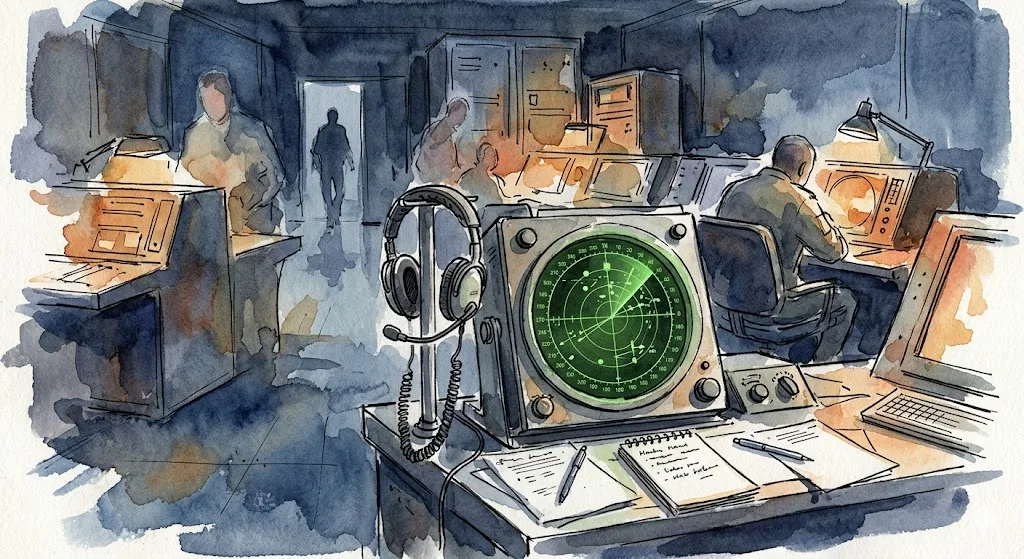
Radar is not a camera. It transmits radio waves and displays returns from objects or conditions that reflect those waves. In a good case, it can help establish that something was detected in a particular part of the sky at a particular time. It can also narrow the range of ordinary explanations: a return that moves consistently with an aircraft may point towards an unreported aircraft; a stationary or erratic return may invite checks for weather, terrain, equipment mode, clutter filtering or anomalous propagation.
That is why radar-visual cases have a special place in UFO debates. A witness report alone may be affected by distance, darkness, stress or expectation. A radar report alone may be a false track or ambiguous return. Together, they become more interesting because two different information channels appear to be describing the same event. The key word is “appear”: investigators still need to know whether the radar return and the witness observation were genuinely correlated in time, direction and motion, rather than merely occurring during the same confusing episode.
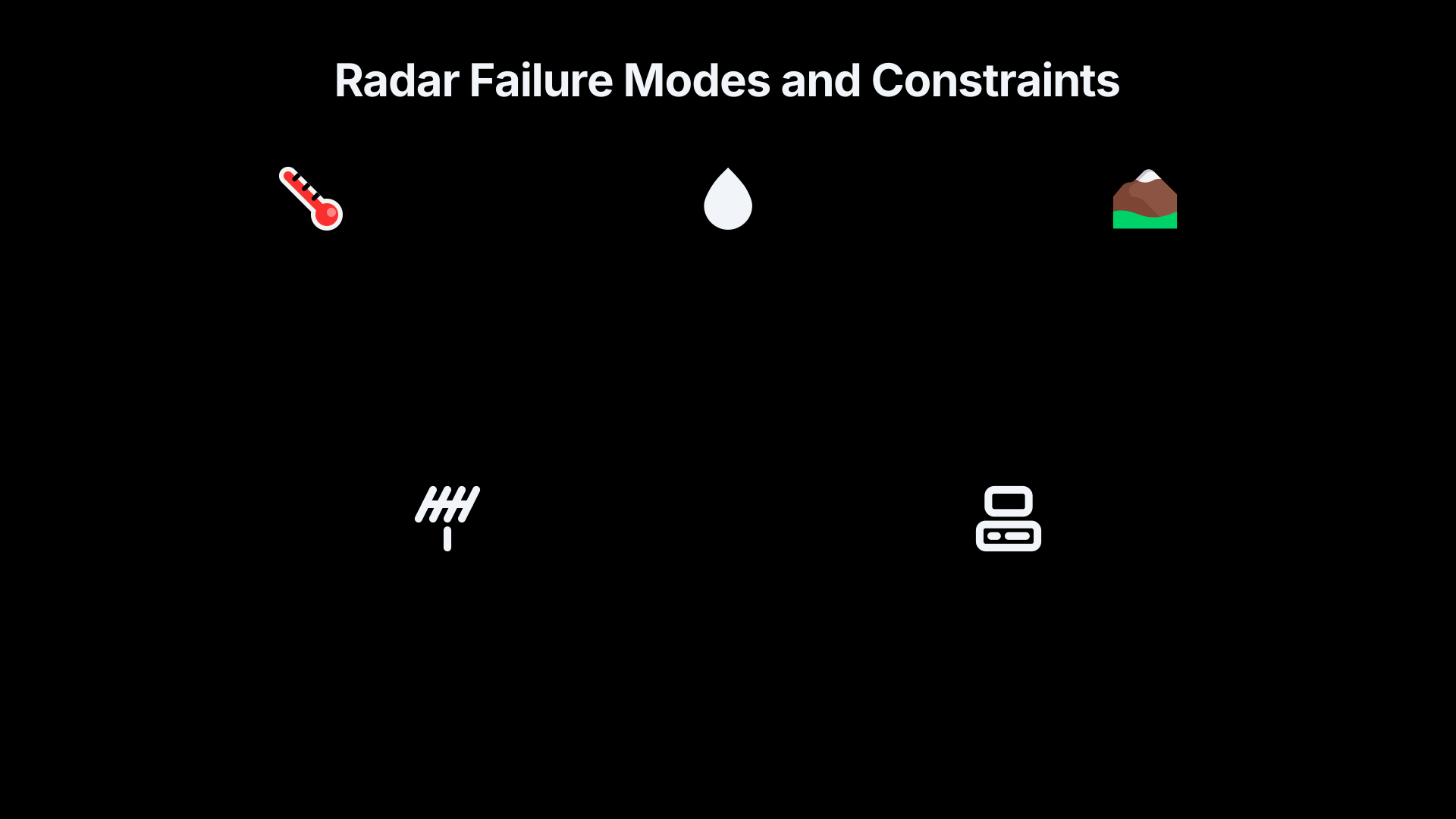
The Federal Aviation Administration’s aviation guidance is a useful corrective to overconfident readings of radar. It notes that radar service has limits and that radio waves can be bent by abnormal atmospheric conditions such as temperature inversions, reflected or weakened by dense objects such as heavy clouds or precipitation, and screened by terrain. It also explains that anomalous propagation or ducting can create extraneous blips, while low-altitude aircraft may be hidden by terrain or earth curvature. These are not exotic excuses; they are normal operating constraints of radar interpretation.[Federal Aviation Administration]faa.govFederal Aviation Administrationwww.faa.govFederal Aviation Administrationwww.faa.gov
In nuclear-base UFO cases, the strongest radar evidence would show several things at once: a preserved primary radar track, a known radar mode, a named operator or log, a reliable time stamp, weather data, and independent confirmation from visual witnesses or another sensor. Without those details, “radar picked it up” is not enough to distinguish an intruder from an artefact.
Minot shows why radar can strengthen a case without settling it
The 24 October 1968 Minot Air Force Base case is one of the clearest examples of why radar matters in the nuclear-UFO discussion. Minot was a Strategic Air Command base in North Dakota, and the case involved both ground witnesses around missile-related facilities and a B-52 crew. Unlike many famous nuclear-UFO stories, the surviving file is not just a later memory: the Minot case archive identifies a Project Blue Book case file of 145 pages, including maps and thirteen B-52 radarscope photographs.[Minot AFB UFO Case]minotb52ufo.comMinot AFB UFO CaseDocumentation | The Minot AFB UFO case | 24 OCTOBER 1968…
The Minot file is important because it contains several kinds of evidence that can be compared against each other. The documentation includes a Base Operations Dispatcher log, a transcription of recorded conversations between Radar Approach Control and the B-52 co-pilot, witness materials, an upper-air dataset and the sequence of radarscope photographs. The archive also notes that the investigating officer interviewed 17 witnesses, although only seven completed the Air Force’s formal sighting questionnaire.[Minot AFB UFO Case]minotb52ufo.comMinot AFB UFO CaseDocumentation | The Minot AFB UFO case | 24 OCTOBER 1968…
That mix makes Minot more valuable than a simple anecdote. It gives investigators a way to ask concrete questions: did the B-52 radar target line up with what ground observers reported? Did the object’s apparent position match the aircraft’s movement? Were the reported lights consistent with an aircraft, astronomical object, plasma effect or radar anomaly? Did the weather support unusual propagation? These are exactly the questions that turn a UFO story into a testable evidence problem.
The limits are just as important. Project Blue Book’s later evaluation categorised the Minot case as “Identified (Other)” by radar analysis as plasma, while later researchers have criticised parts of the official evaluation, including reported inaccuracies in time, duration and treatment of the radarscope photographs.[Minot AFB UFO Case]minotb52ufo.comsection 6Minot AFB UFO CaseInvestigation: Section 6. Project Blue Book Evaluation | The Minot AFB UFO case | 24 OCTOBER 1968… The result is not a clean proof of an extraordinary craft, but a case where radar evidence prevents easy dismissal while still leaving room for dispute over interpretation.
For readers trying to assess nuclear-UFO claims, Minot is a better model than more dramatic retellings because it shows what the argument should be about: records, tracks, witness timing, atmospheric data and the quality of the official analysis. Radar helps here because it gives the case a technical spine. It does not, by itself, identify the cause.
False tracks and interpretation problems
Radar systems are built to detect, filter and display targets, but the displayed target is the product of hardware, signal processing, environment and human interpretation. A return can be real without being a solid craft. It can be a reflection, a weather-related return, a ground object displayed under unusual propagation, a track formed by processing assumptions, or an aircraft whose identity is missing because no transponder return is available.
This is especially relevant near bases, where the environment is often crowded with overlapping systems: air-traffic radars, military surveillance, weather radar, training aircraft, security sensors, drones, restricted airspace procedures and classified activity. A nuclear base may be sensitive, but sensitivity does not automatically make every unknown return extraordinary. It means the standard for resolving it should be higher.
Modern official UAP reviews repeatedly make the same point in updated language. The Office of the Director of National Intelligence stated in its 2021 preliminary assessment that sensors registering UAP generally operate correctly and capture enough real data for initial assessment, but that some UAP may be attributable to sensor anomalies; the same report said the limited amount of high-quality reporting hampered firm conclusions about the nature or intent of UAP.[Director of National Intelligence]dni.govDirector of National Intelligence NASA’s independent UAP study likewise found that analysis was hampered by poor sensor calibration, lack of multiple measurements, lack of sensor metadata and lack of baseline data.[NASA Science]science.nasa.govNASA Science…
That is the central sensor-limit lesson for nuclear-base cases. A radar return can be meaningful, but investigators need the surrounding data that explain what the sensor was doing. Missing metadata can make a dramatic track impossible to evaluate: radar type, scan rate, range scale, filtering mode, maintenance status, local weather, operator workload and whether the target was primary radar, secondary radar, weather radar or an aircraft radar contact all affect interpretation.
AARO’s recent public reporting reinforces the same caution. Its 2024 annual report said case resolution remains constrained by a lack of timely and actionable sensor data, and that many case holdings remain unresolved because they lack the data needed for further analysis. It also noted that AARO is working on sensor requirements and advanced processing, including a GREMLIN prototype sensor suite designed to detect, track, characterise and identify UAP in areas of interest.[U.S. Department of War]media.defense.govFY24 CONSOLIDATED ANNUAL REPORT ON UAP 508U.S. Department of WarFiscal Year 2024 Consolidated Annual Report on Unidentified Anomalous Phenomena…
Radar plus witness testimony
The best radar-supported cases are not simply “radar cases”. They are correlation cases. The evidential strength comes from comparing what different observers and instruments reported independently.
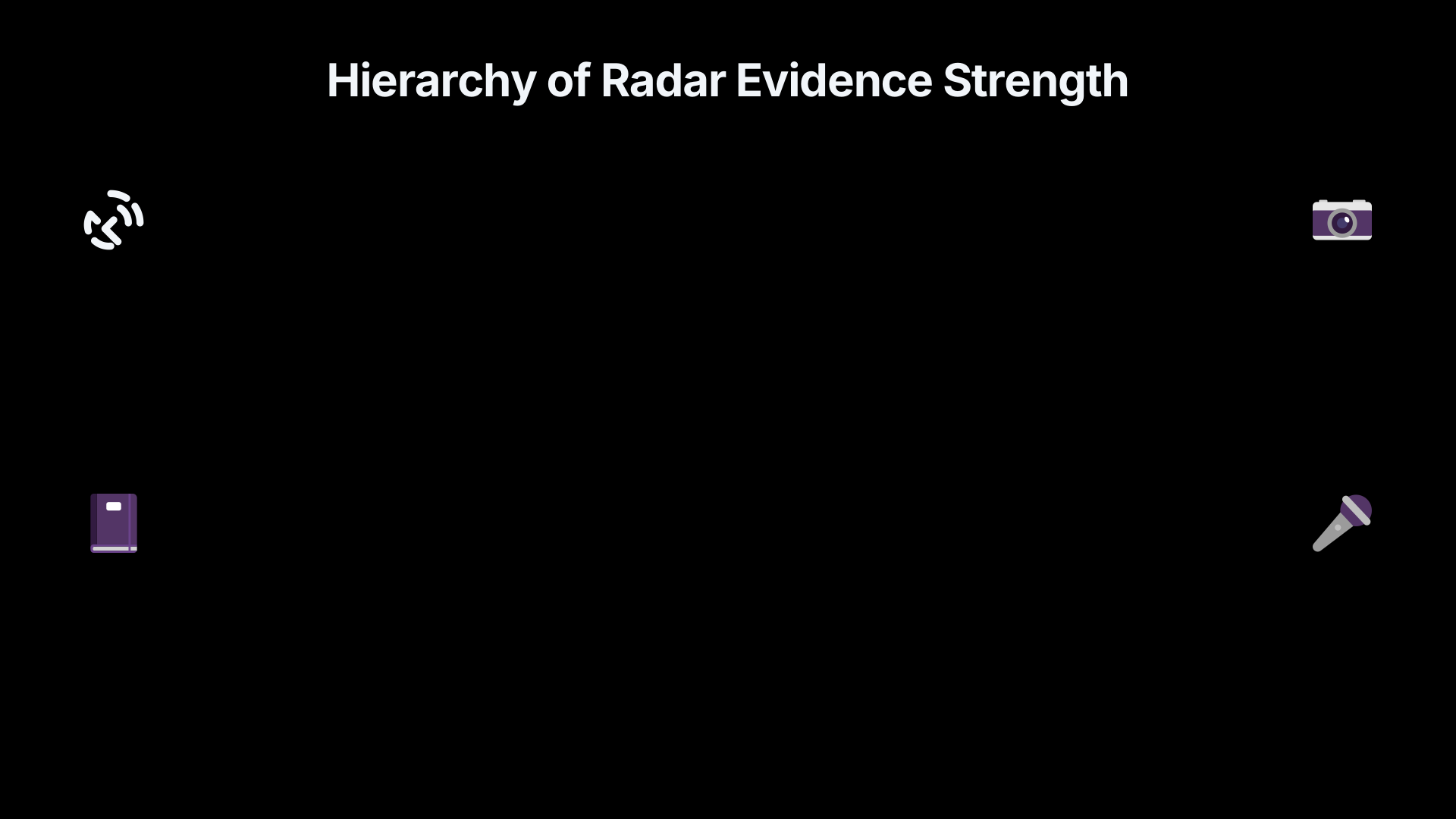
A useful hierarchy looks like this:
- Weak: a later claim that a UFO was “on radar”, with no track, log, operator statement or sensor details.
- Moderate: a contemporaneous note or witness statement saying radar saw something, but with little technical data.
- Stronger: preserved radar imagery or logs, named operators, time stamps and matching witness accounts.
- Strongest: multiple independent sensors, visual witnesses, communications transcripts, weather data, calibration details and a documented chain of custody.
Minot approaches the stronger end because it includes radarscope photographs, communications transcripts and multiple witness accounts. Rendlesham Forest, by contrast, is famous for military witnesses near RAF Woodbridge and RAF Bentwaters, but the publicly accessible official record is much thinner as radar evidence. The UK National Archives describes Rendlesham as Britain’s best-known UFO event and notes that Lieutenant Colonel Charles Halt reported lights near the rear gate, but it also says the Ministry of Defence continued to state there was no threat to UK airspace or national security and that a single sheet report is the only record of the event itself held by the Archives.[The National Archives]nationalarchives.gov.ukThe National Archives UFO reportsThe National ArchivesUFO reports - The National Archives…
That distinction is crucial. Rendlesham is often discussed as if it had robust sensor confirmation, but the available public record does not support treating it like Minot as a preserved radar-data case. The Ministry of Defence’s later response to a Freedom of Information request confirmed that it held information within the scope of the request and pointed to already released files, but that does not by itself create a publicly verifiable radar track.[GOV.UK Assets]assets.publishing.service.gov.ukUK AssetsUK Assets
Witness testimony still matters. Trained personnel near sensitive facilities may notice unusual behaviour that casual observers would miss. But radar does not simply “upgrade” testimony unless the timing and geometry match. A guard seeing lights low over a perimeter while a radar operator tracks a return at a different bearing or altitude may describe two unrelated things. Conversely, a witness report that matches a radar track in time, direction and motion can turn an uncertain sighting into a serious airspace event.
Nuclear sites raise the stakes, not the certainty
Radar evidence near nuclear bases matters because the security threshold is lower than the proof threshold. Authorities do not need evidence of an extraordinary craft before they should care about an unknown return near weapons, launch sites, storage areas or nuclear infrastructure. Drones, balloons, uncooperative aircraft and sensor confusion can all be operationally important.
Recent AARO reporting shows how this has shifted in modern terms. In its 2024 annual report, AARO said it received 18 reports from the Administrator for Nuclear Security and the Chairman of the Nuclear Regulatory Commission regarding incidents near US nuclear infrastructure, weapons and launch sites; those incidents were categorised as unmanned aircraft systems. Some flew over protected areas for less than five minutes, while two lasted 53 minutes and 1 hour 57 minutes respectively.[U.S. Department of War]media.defense.govFY24 CONSOLIDATED ANNUAL REPORT ON UAP 508U.S. Department of WarFiscal Year 2024 Consolidated Annual Report on Unidentified Anomalous Phenomena…
That is a sober modern parallel to older nuclear-UFO cases. The most likely security problem near a nuclear site today may not be an unknown physics-defying object, but a drone whose operator, intent, route or payload is unknown. Radar and other sensors are still central, but the investigative question becomes practical: was the object detected, tracked, identified, intercepted, recovered or linked to a pattern?
AARO’s 2025 mission brief also notes that only a very small percentage of UAP reports display anomalous signatures and that most anomalous detections reported to AARO show ordinary characteristics of readily explainable sources. It also highlights two problems that directly apply to radar-heavy cases: lack of data hinders comprehensive analysis, and sensor bias influences reporting.[AARO]aaro.milMission BriefAARO Mission Brief…
So the right conclusion is balanced. Radar can turn a nuclear-base UFO case from a story into a serious record. It can show that military systems registered something worthy of attention. But it cannot carry the case alone. The decisive evidence is not the word “radar”; it is the quality of the data around the radar return.

How to read a radar claim near a base
A good radar claim should answer basic questions before asking the reader to accept extraordinary possibilities. What radar saw the target? Was it primary radar, secondary radar, weather radar, airborne radar or another sensor? Was the target recorded or only remembered? Was the radar calibrated and operating normally? Were there weather conditions that could produce ducting, clutter or false returns? Was there a matching visual sighting from a known location? Did independent sensors confirm the same object?
The most common mistake is treating all radar references as equal. A preserved radarscope photograph is not the same as a veteran recalling that someone said radar saw something. A military base log is not the same as a later documentary claim. A radar return with no altitude, no track continuity and no operator context is not the same as a correlated track followed across multiple sensors.
For the nuclear-weapons branch of the UFO subject, radar evidence is therefore best understood as a credibility multiplier, not a final answer. It strengthens a case when it is documented, synchronised and independently corroborated. It weakens a case when the radar reference is vague, missing, technically unsupported or contradicted by known sensor limitations. The strongest unsolved cases are the ones where the radar record survives well enough for sceptics and believers to argue over the same data rather than over the legend that grew around it.
Amazon book picks
Further Reading
Books and field guides related to When Radar Helps A UFO Case. Use these as the next step if you want deeper reading beyond the article.
UFOs and Government: A Historical Inquiry
Discusses official investigations involving radar data.
UFOs: Generals, Pilots, and Government Officials Go on the Re...
Contains radar-supported incidents and evidence discussions.
UFOs
Focuses on military and government witnesses, making it highly relevant to missile personnel testimony.

UFOs & Nukes: Extraordinary Encounters at Nuclear Weapons Sites
Includes cases involving radar evidence near nuclear sites.
eBay marketplace picks
Marketplace Samples
Example marketplace items related to this page. Use the search link to explore similar finds on eBay.




Endnotes
1.
Source: dni.gov
Title: Director of National Intelligence
Link:https://www.dni.gov/files/ODNI/documents/assessments/Prelimary-Assessment-UAP-20210625.pdf
2.
Source: science.nasa.gov
Link:https://science.nasa.gov/wp-content/uploads/2023/09/uap-independent-study-team-final-report.pdf
Source snippet
NASA Science...
3.
Source: nationalarchives.gov.uk
Title: The National Archives UFO reports
Link:https://www.nationalarchives.gov.uk/explore-the-collection/explore-by-time-period/postwar/ufo-reports/
Source snippet
The National ArchivesUFO reports - The National Archives...
4.
Source: assets.publishing.service.gov.uk
Title: UK Assets
Link:https://assets.publishing.service.gov.uk/media/5a7f599240f0b6230268ef6d/20150511-FOI2015-03810-Rendlesham-Redacted-Final-Response.pdf
5.
Source: aaro.mil
Title: Mission Brief
Link:https://www.aaro.mil/Portals/136/PDFs/AARO_Mission_Brief_2025.pdf
Source snippet
AARO Mission Brief...
6.
Source: aaro.mil
Title: AARO Historical Record Report Vol 1 2024
Link:https://www.aaro.mil/Portals/136/PDFs/AARO_Historical_Record_Report_Vol_1_2024.pdf
7.
Source: aaro.mil
Link:https://www.aaro.mil/UAP-Cases/Official-UAP-Imagery/
8.
Source: aaro.mil
Link:https://www.aaro.mil/
9.
Source: aaro.mil
Title: UNCLASSIFIED FY23 Consolidated Annual Report on UAP Oct 25 2023 1236
Link:https://www.aaro.mil/Portals/136/PDFs/UNCLASSIFIED-FY23_Consolidated_Annual_Report_on_UAP-Oct_25_2023_1236.pdf
10.
Source: nasa.gov
Title: update nasa shares uap independent study report names director
Link:https://www.nasa.gov/news-release/update-nasa-shares-uap-independent-study-report-names-director/
11.
Source: science.nasa.gov
Link:https://science.nasa.gov/uap/
12.
Source: cdn.nationalarchives.gov.uk
Link:https://cdn.nationalarchives.gov.uk/documents/podcast-transcript.pdf
13.
Source: nationalarchives.gov.uk
Title: defe 241948
14.
Source: war.gov
Title: department of defense releases the annual report on [unidentified]({{ ‘unidentified/’ | relative_url }}) anomalous phen
Link:https://www.war.gov/News/Releases/Release/Article/3964824/department-of-defense-releases-the-annual-report-on-unidentified-anomalous-phen/
15.
Source: war.gov
Title: dod examining unidentified anomalous phenomena
Link:https://www.war.gov/News/News-Stories/Article/Article/3965403/dod-examining-unidentified-anomalous-phenomena/
16.
Source: archives.gov
Title: Project BLUE BOOK
Link:https://www.archives.gov/research/military/air-force/ufos
17.
Source: unsolved.com
Title: Bentwaters UFO
Link:https://unsolved.com/gallery/bentwaters-ufo/
18.
Source: faa.gov
Title: Federal Aviation Administrationwww.faa.gov
Link:https://www.faa.gov/air_traffic/publications/atpubs/aim/aim0405.html
19.
Source: minotb52ufo.com
Link:https://minotb52ufo.com/doc.php
Source snippet
Minot AFB UFO CaseDocumentation | The Minot AFB UFO case | 24 OCTOBER 1968...
Published: OCTOBER 1968
20.
Source: minotb52ufo.com
Title: section 6
Link:https://minotb52ufo.com/investigation/section-6.php
Source snippet
Minot AFB UFO CaseInvestigation: Section 6. Project Blue Book Evaluation | The Minot AFB UFO case | 24 OCTOBER 1968...
Published: OCTOBER 1968
21.
Source: media.defense.gov
Title: FY24 CONSOLIDATED ANNUAL REPORT ON UAP 508
Link:https://media.defense.gov/2024/Nov/14/2003583603/-1/-1/0/FY24-CONSOLIDATED-ANNUAL-REPORT-ON-UAP-508.PDF
Source snippet
U.S. Department of WarFiscal Year 2024 Consolidated Annual Report on Unidentified Anomalous Phenomena...
22.
Source: dni.gov
Title: Unclassified 2022 Annual Report UAP
Link:https://www.dni.gov/files/ODNI/documents/assessments/Unclassified-2022-Annual-Report-UAP.pdf
23.
Source: dni.gov
Title: DF 2021 00275 Preliminary Assessment Unidentified Aerial Phenomena
Link:https://www.dni.gov/files/documents/FOIA/DF-2021-00275-Preliminary-Assessment-Unidentified-Aerial-Phenomena.pdf
24.
Source: dni.gov
Title: 4020 uap 2024
Link:https://www.dni.gov/index.php/newsroom/reports-publications/reports-publications-2024/4020-uap-2024
25.
Source: minotb52ufo.com
Link:https://minotb52ufo.com/
26.
Source: faa.gov
Link:https://www.faa.gov/air_traffic/publications/atpubs/aim_html/chap4_section_5.html
27.
Source: Wikipedia
Title: Project Blue Book
Link:https://en.wikipedia.org/wiki/Project_Blue_Book
28.
Source: media.defense.gov
Title: WHAT GOV KNOWS ABOUT UFOS
Link:https://media.defense.gov/2021/Jul/13/2002761349/-1/-1/0/WHAT_GOV_KNOWS_ABOUT_UFOS.PDF
29.
Source: zenodo.org
Link:https://zenodo.org/records/8331502
30.
Source: hstoday.us
Link:https://www.hstoday.us/subject-matter-areas/intelligence/director-of-national-intelligence-submits-annual-report-on-unidentified-aerial-phenomena/
31.
Source: uapglobe.com
Title: rendlesham forest
Link:https://uapglobe.com/cases/rendlesham-forest
Additional References
32.
Source: youtube.com
Title: The Proof Is Out There: UFO SPOTTED ON U.S. MILITARY BASE (Season 2) | History
Link:http://www.youtube.com/watch?v=rB6OQV2gD-E
Source snippet
HISTORY · 3.2M views Former Navy Fighter Pilot Testifies to Witnessing UFO in Category 4 Winds...
33.
Source: youtube.com
Title: Former Navy Fighter Pilot Testifies to Witnessing UFO in Category 4 Winds
Link:http://www.youtube.com/watch?v=P0OEMT5RyL0
Source snippet
The Proof Is Out There: UFO SPOTTED ON U.S. MILITARY BASE (Season 2) | History...
34.
Source: youtube.com
Link:http://www.youtube.com/watch?v=KTOO726CMbE
Source snippet
Former Navy Fighter Pilot Testifies to Witnessing UFO in Category 4 Winds...
35.
Source: cia.gov
Link:https://www.cia.gov/readingroom/docs/CIA-RDP81R00560R000100060001-5.pdf
36.
Source: cia.gov
Link:https://www.cia.gov/readingroom/document/cia-rdp81r00560r000100010001-0
37.
Source: nsa.gov
Link:https://www.nsa.gov/portals/75/documents/news-features/declassified-documents/ufo/usaf_fact_sheet_95_03.pdf
38.
Source: cia.gov
Link:https://www.cia.gov/readingroom/docs/CIA-RDP88-01315R000300070004-1.pdf
39.
Source: youtube.com
Title: 📱 How Real Sensor Systems Track UFOs/UAP and USOs
Link:http://www.youtube.com/watch?v=8TpGDh32fpE
Source snippet
The 2008 Stephenville UFO Sighting | The Case the Air Force Couldn't Deny...
40.
Source: reddit.com
Link:https://www.reddit.com/r/UFOs/comments/10m5grq/major_brad_runyon_1968_minot_afb_he_reports_that/
Source snippet
on Reddit: Major Brad Runyon - 1968 Minot AFB - He reports...January 26, 2023 — He filmed a UFO shooting down a nuclear warhead in 1964...
Published: January 26, 2023
41.
Source: facebook.com
Link:https://www.facebook.com/TheHeraldMail/posts/in-a-limited-number-of-incidents-uap-reportedly-appeared-to-exhibit-unusual-flig/10160699566288644/
Topic Tree