Within Nuclear UFOs
How aliens learned to fear the bomb
Films, comics and television taught audiences to connect flying saucers with radiation, invasion and atomic power.
On this page
- Radiation as a story device
- Atomic facilities in invasion plots
- How fiction shaped real world interpretations
Page outline Jump by section
Introduction
In the 1950s, science fiction did more than entertain. It gave Cold War audiences a narrative framework for understanding a world transformed by atomic weapons. Films, comic books and early television repeatedly connected extraterrestrials, flying saucers and radiation with the new realities of the nuclear age. Alien visitors arrived to warn humanity about atomic warfare, radioactive forces created monsters and mutations, and invasion stories placed advanced technologies alongside fears of annihilation. By the middle of the decade, many viewers had absorbed an implicit idea: if aliens existed, they would probably be interested in humanity’s nuclear activities. This cultural link became an important backdrop to later claims that UFOs were appearing near missile fields, weapons laboratories and nuclear test sites.[Wikipedia]WikipediaThe Day the Earth Stood StillThe Day the Earth Stood Still

Radiation as a story device
The atomic bomb provided science fiction with a new source of wonder and terror. Before 1945, alien stories often focused on exploration and adventure. After Hiroshima and Nagasaki, radiation became a central plot mechanism. Science fiction increasingly portrayed atomic energy as a force capable of transforming life, reshaping nature and attracting attention from beyond Earth.
Many 1950s films used radiation to explain giant creatures, mutations and scientific disasters. Although not every story involved extraterrestrials, audiences repeatedly encountered narratives in which atomic power opened doors to unknown dangers. Historians of the genre note that fears of radiation and nuclear weapons became recurring themes across the decade’s science-fiction cinema.[BFI+2American Heritage Center]bfi.org.uk10 great american sci fi films 1950s10 great American sci-fi films of the 1950sOctober 30, 2014 — 30 Oct 2014 — 50s sci-fi film chose to exteriorise and inflate its Nucle…
Alien stories often incorporated the same anxieties. Flying saucers were presented as technologies far beyond human capabilities, while atomic weapons represented humanity’s newest and most dangerous achievement. Placing the two together created an obvious dramatic question: had humans become technologically significant enough to attract extraterrestrial attention?
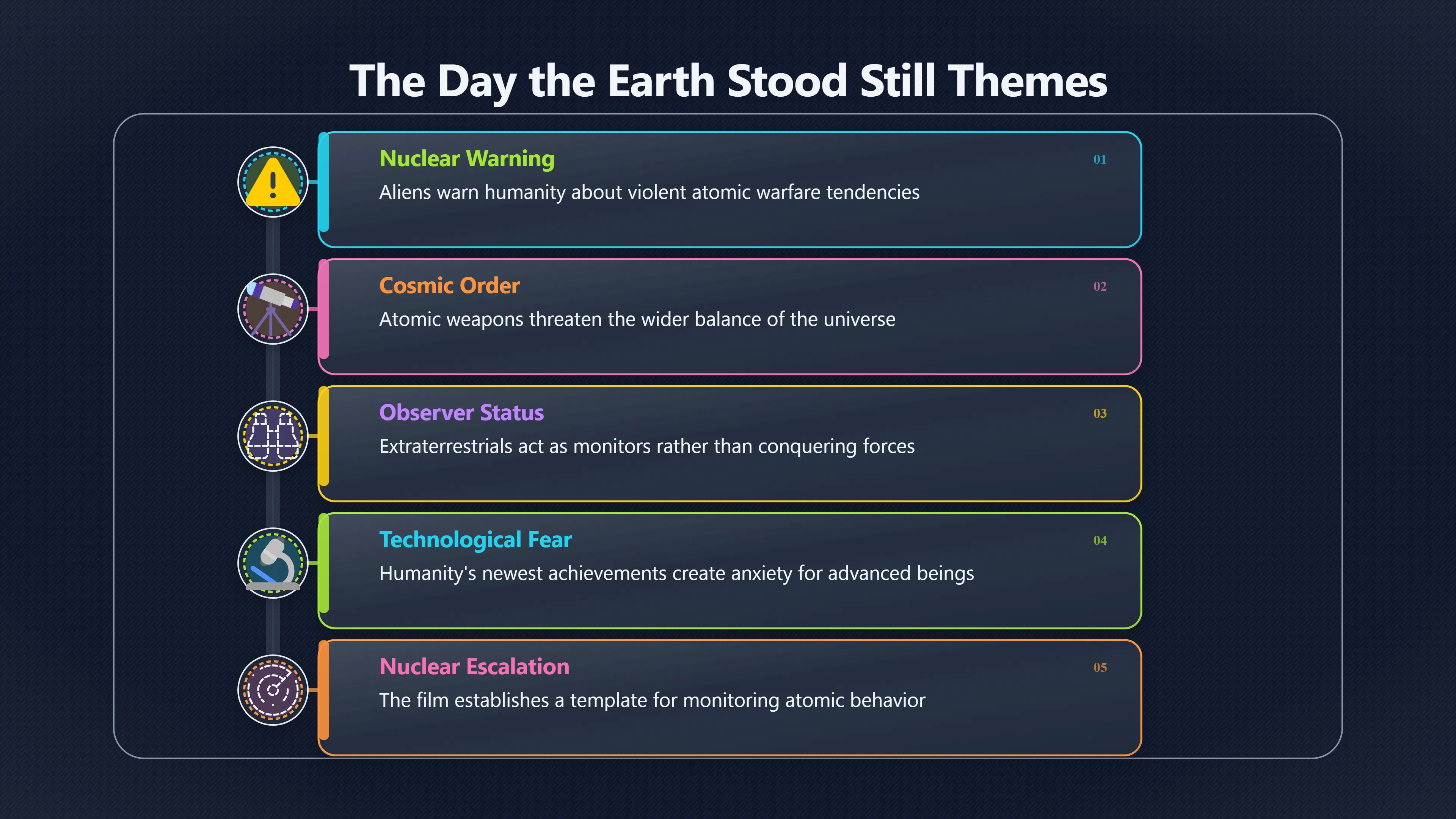
The most influential example was The Day the Earth Stood Still (1951). In the film, the alien Klaatu arrives during the early nuclear arms race and warns humanity that its violent tendencies and atomic weapons threaten wider cosmic order. Rather than portraying aliens as conquerors, the story casts them as observers alarmed by nuclear escalation. The film effectively established a template in which extraterrestrials monitored Earth’s atomic behaviour.[Wikipedia+2classicfilmtvcafe.com]WikipediaThe Day the Earth Stood StillThe Day the Earth Stood Still
Atomic facilities in invasion plots
While some films imagined aliens as moral guardians, many others linked extraterrestrials to invasion, military secrecy and strategic technology. The resulting stories frequently placed scientists, military installations and advanced weapons at the centre of the action.
Flying-saucer films such as Earth vs. the Flying Saucers (1956) depicted technologically superior visitors confronting governments and military authorities. The imagery closely resembled Cold War defence concerns: radar systems, command structures, scientific experts and fears of attack from the sky. Audiences accustomed to hearing about bombers and missiles could easily map those fears onto alien spacecraft.[IMDb]imdb.comEarth vs. the Flying Saucers (1956)Extraterrestrials traveling in high-tech flying saucers contact a scientist as part of a plan to e…
The invasion theme became one of the defining features of 1950s science fiction. Scholars and film historians have noted that alien invasions, infiltration plots and nuclear anxiety often appeared together as expressions of broader Cold War fears. The threat might be extraterrestrial rather than Soviet, but the emotional structure was similar: an unseen enemy, advanced technology, sudden attack and the possibility of civilisation-ending consequences.[Encyclopedia.com+2coldwarstudies.com]encyclopedia.comscience fiction films and cold war anxietyMany science fiction films of the 1950s present allegorical treatments of communism as a plague, a form of mind control, an invasion, or…
Comic books reinforced the pattern. Covers and stories routinely showed saucers hovering over cities, military bases and scientific laboratories. Atomic symbols, mushroom clouds and futuristic weapons appeared alongside extraterrestrial imagery. Readers repeatedly encountered the suggestion that the atomic age and the space age were part of the same story.
Television amplified these associations. Science-fiction anthologies and serials brought alien threats and atomic themes directly into living rooms. The combination normalised a vision of extraterrestrials as actors in humanity’s technological and military future rather than distant curiosities.
How fiction shaped real-world interpretations
The importance of these stories lies not in whether they accurately predicted UFO reports, but in how they influenced interpretation. By the late 1950s, many Americans had spent years consuming fiction that linked flying saucers, nuclear danger and government secrecy.
At the same time, real-world UFO reports were becoming a recognised cultural phenomenon. The flying-saucer wave that began in the late 1940s generated intense media coverage, while Hollywood transformed those reports into dramatic narratives about extraterrestrial visitors and global threats. The result was a feedback loop in which sightings inspired fiction and fiction influenced expectations about sightings.[The Library of Congress]loc.govufos and aliens among usSightings of strange objects in the sky became the raw materials for…Read more…
This cultural environment made certain ideas seem plausible. If an unexplained object appeared near a military installation, audiences already possessed a ready-made story: perhaps advanced beings were monitoring humanity’s most dangerous weapons. That interpretation drew less from direct evidence than from years of exposure to atomic-age science fiction.
The emerging UFO contact movement of the 1950s reflected the same pattern. Many self-described contactees claimed that extraterrestrials were concerned about nuclear testing and the possibility of atomic war. These messages closely resembled themes already popularised in films and popular media, particularly the idea that wiser beings were warning humanity about self-destruction.[digitalcommons.chapman.edu]digitalcommons.chapman.eduOpen source on chapman.edu.
Why the connection endured
The connection between aliens and the bomb survived because it solved several Cold War anxieties at once. It explained why extraterrestrials might suddenly appear. It transformed abstract fears of nuclear annihilation into dramatic stories with characters and motives. It also offered a way to imagine that someone—however distant or mysterious—was paying attention to humanity’s most dangerous inventions.
By presenting radiation, atomic weapons and flying saucers within the same imaginative universe, 1950s science fiction helped establish one of the most persistent ideas in UFO culture: that extraterrestrial visitors would be especially interested in nuclear technology. Long before reports of UFOs near missile silos became famous, popular culture had already taught audiences how to connect those two subjects.[BFI+2editorial.rottentomatoes.com]bfi.org.uk10 great american sci fi films 1950s10 great American sci-fi films of the 1950sOctober 30, 2014 — 30 Oct 2014 — 50s sci-fi film chose to exteriorise and inflate its Nucle…
Amazon book picks
Further Reading
Books and field guides related to How aliens learned to fear the bomb. Use these as the next step if you want deeper reading beyond the article.

Astounding
Provides context for how mid-century speculative ideas influenced UFO culture.
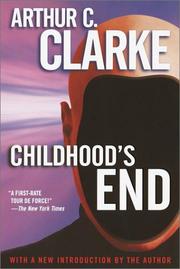
Childhood’s End
Represents influential post-war alien-contact themes that informed public expectations.

The mammoth encyclopedia of science fiction
Covers major atomic-age and alien-invasion themes that shaped public imagination.

eBay marketplace picks
Marketplace Samples
Example marketplace items related to this page. Use the search link to explore similar finds on eBay.




Endnotes
1.
Source: Wikipedia
Title: The Day the Earth Stood Still
Link:https://en.wikipedia.org/wiki/The_Day_the_Earth_Stood_Still
2.
Source: Wikipedia
Title: List of science fiction films of the 1950s
Link:https://en.wikipedia.org/wiki/List_of_science_fiction_films_of_the_1950s
Source snippet
They drew upon political themes or public concerns of the day, including depersonalization, infiltration, or fear of nuclear weapons. Inv...
3.
Source: classicfilmtvcafe.com
Title: 3 on 3 science fiction films of 1950s
Link:https://www.classicfilmtvcafe.com/2011/09/3-on-3-science-fiction-films-of-1950s.html
Source snippet
3 on 3: Science Fiction Films of the 1950s14 Sept 2011 — 1951's The Day The Earth Stood Still, which is very much a warning against nucle...
4.
Source: imdb.com
Link:https://www.imdb.com/title/tt0049169/
Source snippet
Earth vs. the Flying Saucers (1956)Extraterrestrials traveling in high-tech flying saucers contact a scientist as part of a plan to e...
5.
Source: encyclopedia.com
Title: science fiction films and cold war anxiety
Link:https://www.encyclopedia.com/arts/culture-magazines/science-fiction-films-and-cold-war-anxiety
Source snippet
Many science fiction films of the 1950s present allegorical treatments of communism as a plague, a form of mind control, an invasion, or...
6.
Source: coldwarstudies.com
Title: the scary cold war 1950s science fiction films
Link:https://coldwarstudies.com/2023/09/14/the-scary-cold-war-1950s-science-fiction-films/
Source snippet
The Scary Cold War: 1950s Science Fiction Films14 Sept 2023 — Selected themes include: Alien Invasion and Infiltration; Nuclear Anxiety a...
7.
Source: digitalcommons.chapman.edu
Link:https://digitalcommons.chapman.edu/cgi/viewcontent.cgi?article=1002&context=sociology_articles
8.
Source: editorial.rottentomatoes.com
Title: best 1950s sci fi movies
Link:https://editorial.rottentomatoes.com/guide/best-1950s-sci-fi-movies/
Source snippet
rottentomatoes.com71 Best Sci-Fi Movies of the 1950sThe Day the Earth Stood Still, Invaders From Mars, On the Beach, and even Plan 9 From...
9.
Source: imdb.com
Link:https://www.imdb.com/list/ls096140900/
Source snippet
Monster & Alien Invasion Sci-Fi Films from the 1950sA list of sci-fi films from the 1950s in which the growing fear of a Cold War-era glo...
10.
Source: youtube.com
Link:https://www.youtube.com/watch?v=ESC6Ceqqflg
Source snippet
The Day the Earth Stood Still (1951) - The Sci-Fi Classic That Warned Humanity...
11.
Source: youtube.com
Link:https://www.youtube.com/watch?v=0v1DPRZK99Y
Source snippet
Tales of Tomorrow (1951) 'Blunder' | The Atomic Anxiety Episode...
12.
Source: loc.gov
Title: ufos and aliens among us
Link:https://www.loc.gov/static/collections/finding-our-place-in-the-cosmos-with-carl-sagan/articles-and-essays/life-on-other-worlds/ufos-and-aliens-among-us.html
Source snippet
Sightings of strange objects in the sky became the raw materials for...Read more...
13.
Source: bfi.org.uk
Title: 10 great american sci fi films 1950s
Link:https://www.bfi.org.uk/lists/10-great-american-sci-fi-films-1950s
Source snippet
10 great American sci-fi films of the 1950sOctober 30, 2014 — 30 Oct 2014 — 50s sci-fi film chose to exteriorise and inflate its Nucle...
Published: October 30, 2014
14.
Source: ahcwyo.org
Title: terror in the theater fifties fears 2
Link:https://ahcwyo.org/2017/11/13/terror-in-the-theater-fifties-fears-2/
Source snippet
American Heritage CenterTerror in the Theater – Fifties Fears13 Nov 2017 — Science fiction films of the 1950s commonly expressed several...
15.
Source: tile.loc.gov
Link:https://tile.loc.gov/storage-services/master/gdc/gdcebookspublic/20/20/71/54/77/2020715477/2020715477.pdf
Source snippet
Fiction Cinema and 1950s Britain - Locelaborate shots of alien spaceships and falling debris in Flying Saucers. This sug- gests that this...
16.
Source: digitalcommons.usf.edu
Link:https://digitalcommons.usf.edu/cgi/viewcontent.cgi?article=2592&context=etd
Source snippet
Kolker explains the monolith in...Read more...
Additional References
17.
Source: researchgate.net
Link:https://www.researchgate.net/publication/261854096_Extraterrestrial_encounters_UFOs_science_and_the_quest_for_transcendence
Source snippet
UFOs, science and the quest for transcendence, 1947–1972Hynek quoted after Salisbury, 'Scientist and the UFO,'16; 'Playboy Panel: UFOs,'8...
18.
Source: facebook.com
Link:https://www.facebook.com/groups/324897304599197/posts/2171497263272516/
Source snippet
Essay on alien invasions and humanismThe alien invasion is a common theme in science fiction stories... In this fiction, the aliens inte...
19.
Source: researchgate.net
Link:https://www.researchgate.net/publication/379726085A_history_of_scientific_approaches_to[Unidentified
Source snippet
Swords, M., & Powell, R. (2012). UFOs and government: A. historical inquiry. Anomalist Books, LLC. T...Read more...
20.
Source: humanities.org
Link:https://www.humanities.org/spark/movie-critic-robert-horton-discusses-sci-fi-films-the-cold-war-and-today/
Source snippet
War, Horton explores how themes such as McCarthyism and scientific innovation...Read more...
21.
Source: wellcomecollection.org
Title: the unearthly children of science fiction s cold war
Link:https://wellcomecollection.org/stories/the-unearthly-children-of-science-fiction-s-cold-war
Source snippet
The unearthly children of science fiction's Cold War13 Mar 2019 — In the 1950s a new figure emerged in British novels, film and televisio...
22.
Source: youtube.com
Link:https://www.youtube.com/watch?v=yE3TY23HZPM
Source snippet
These videos provide historical analysis and examples of how post-WWII nuclear anxiety and Cold War tensions directly shaped 1950s alien...
23.
Source: blogs.iu.edu
Title: humanity vs aliens in it came from outer space 1953
Link:https://blogs.iu.edu/establishingshot/2023/08/24/humanity-vs-aliens-in-it-came-from-outer-space-1953/
Source snippet
vs Aliens in It Came from Outer Space (1953)24 Aug 2023 — Bradbury rewrites the story of aliens to not simply be just an 'us versus them'...
24.
Source: bostonreview.net
Title: ufos and the boundaries of science
Link:https://www.bostonreview.net/articles/ufos-and-the-boundaries-of-science/
Source snippet
Aug 4, 2021 — He is presently writing a history of the UFO and alien contact phenomenon. His research on UFOs has received funding from t...
25.
Source: governmentattic.org
Title: An Annotated Bibliography, Lynn E
Link:https://www.governmentattic.org/13docs/UFOsRelatedSubjBiblio_Catoe_1969.pdf
Source snippet
Catoe, Prepared bysaucers are extraterrestrial and engaged in reconnaissance activities.... Summary of evidence in support of theory of...
26.
Source: jaysclassicmovieblog.com
Link:https://www.jaysclassicmovieblog.com/post/7-the-day-the-earth-stood-still-1951
Source snippet
THE DAY THE EARTH STOOD STILL, 1951, Patricia Neal...27 Sept 2023 — The story for “The Day the Earth Stood Still” in...
Topic Tree