Within Drones
Why weapons sites reveal so little
Restrictions around sites such as Los Alamos and Y-12 show how nuclear-weapons facilities treat drones as a security problem with limited public detail.
On this page
- Why nuclear weapons sites are harder to assess
- How drone restrictions signal official concern
- What counter UAS announcements can and cannot prove
Page outline Jump by section
Introduction
When drones are reported near nuclear-weapons facilities, the public often learns far less than it would about similar incidents at civilian nuclear power plants. That difference is not accidental. Facilities involved in the design, production, storage, or handling of nuclear-weapons materials operate under unusually strict security regimes, and their response to unauthorised drones reflects that reality. Across the United States nuclear-weapons complex, sites such as Los Alamos National Laboratory, Y-12, Pantex and other National Nuclear Security Administration (NNSA) facilities are covered by special airspace restrictions and “No Drone Zone” policies intended to prevent unauthorised overflights. At the same time, officials typically reveal little about specific incursions, attribution efforts, detection capabilities, or counter-drone systems. The result is a recurring pattern: evidence that governments take the drone threat seriously, but limited public information about who was responsible for particular incidents or what exactly occurred. The Department of Energy’s Energy.gov+2y12.doe.gov[energy.gov]energy.govThe Department of Energy's Energy.govProtecting NNSA Facilities: Counter Unmanned Aircraft…7 days ago — All NNSA facilities with sensi…

Why nuclear-weapons sites are harder to assess
Weapons-related nuclear facilities differ from civilian reactors in one crucial respect: much of what they protect is itself classified. Public discussion of a drone event can inadvertently reveal security procedures, sensor coverage, response times, or the location of sensitive operations.
For that reason, the most visible evidence of concern often comes not from incident reports but from regulatory actions. In 2017, the Federal Aviation Administration expanded drone restrictions over several Department of Energy sites connected to the nuclear-weapons enterprise, including Y-12, Pantex, Hanford and other facilities. The restrictions prohibit unauthorised drone operations within the designated boundaries of those sites and were implemented at the request of national-security and law-enforcement authorities.[Voice of America+2DRONELIFE]voanews.comVoice of America US Bars Drones Over Nuclear Sites for Security Reasons29 and include ・ the Y-12 National Security Site and ・ bar drones. FAA banned drone flights over 133 U.S…
The logic behind these restrictions is straightforward. A small commercial drone may not be capable of penetrating hardened facilities, but it can collect imagery, map security routines, test response procedures, or create uncertainty during periods of heightened alert. In a weapons-security environment, even information gathering can be treated as a significant threat. That concern has led the NNSA to describe drones as a security challenge requiring dedicated detection and mitigation systems across its facilities.[The Department of Energy's Energy.gov]energy.govThe Department of Energy's Energy.govProtecting NNSA Facilities: Counter Unmanned Aircraft…7 days ago — All NNSA facilities with sensi…
The consequence for outside observers is that many reported drone events remain difficult to evaluate. Unlike incidents at commercial infrastructure, where regulators may release extensive documentation, events around nuclear-weapons facilities often disappear into classified investigative channels.
How drone restrictions signal official concern
The existence of a “No Drone Zone” is itself evidence of official concern, even when specific threat details remain undisclosed.
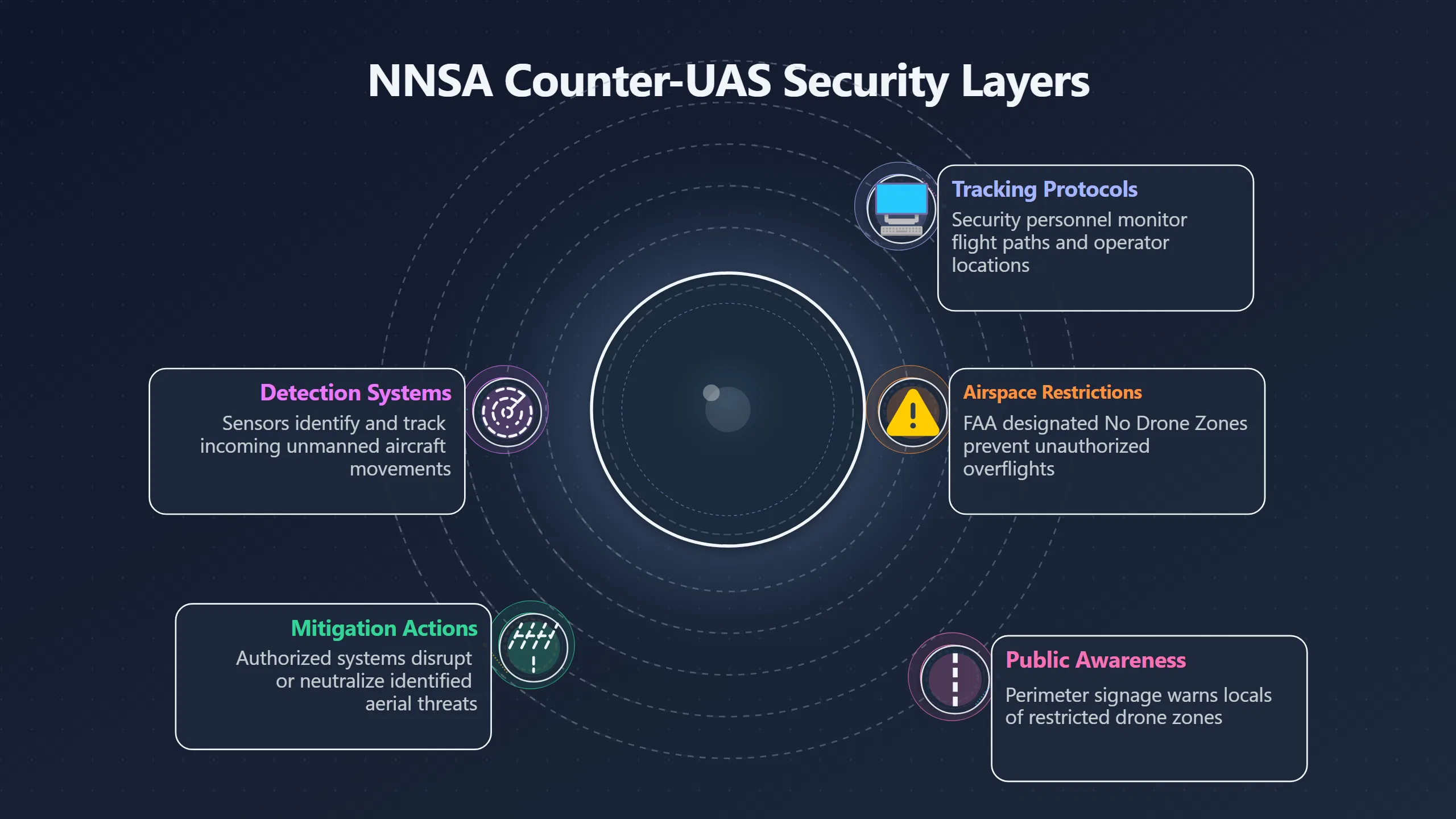
The NNSA has stated that facilities containing highly sensitive nuclear materials are protected by FAA-designated drone restrictions and supported by counter-unmanned aircraft systems (counter-UAS) programmes designed to detect, identify, track and, where authorised, mitigate threats. Public outreach materials explicitly frame unauthorised drones as a security risk rather than a mere nuisance.[The Department of Energy's Energy.gov]energy.govIf a UAS poses a threat, the site is authorized to disrupt…
Los Alamos National Laboratory provides a useful example. The laboratory has repeatedly warned that unauthorised drone flights are prohibited in its restricted airspace and surrounding designated No Drone Zones. Public messaging emphasises that the restrictions are tied to security requirements rather than ordinary aviation management.[Los Alamos National Laboratory]lanl.govLos Alamos National LaboratoryUnauthorized drone flights prohibited in restricted airspaceDec 19, 2025 — Unauthorized drone flights are p…
Y-12, the Tennessee facility associated with uranium processing and weapons-related missions, has taken a similarly visible approach. The site has publicly identified itself as an FAA-designated No Drone Zone and announced deployment of systems intended to counter unauthorised unmanned aircraft. Officials have also used perimeter signage and public-awareness campaigns to reinforce the message that drone operations near the complex are prohibited.[y12.doe.gov+2The War Zone]y12.doe.govNNSA Release: Y-12 Deploys System to Counter…The Y-12 National Security Complex has deployed a system to counter all unauthorized unma…
What makes these announcements noteworthy is not simply that drones are banned. Many sensitive facilities have restricted airspace. The more revealing point is that nuclear-weapons facilities have invested in dedicated counter-UAS capabilities and have chosen to publicise that fact. Such announcements signal that officials regard drones as a realistic operational threat rather than a hypothetical future concern.[The Department of Energy's Energy.gov]energy.govThe Department of Energy's Energy.govProtecting NNSA Facilities: Counter Unmanned Aircraft…7 days ago — All NNSA facilities with sensi…
Why attribution remains so difficult
One of the most persistent features of modern drone scares is the gap between detection and attribution.
Identifying a drone is not the same as identifying its operator. Security personnel may know that an unmanned aircraft entered restricted airspace, yet still struggle to determine who launched it, from where, and for what purpose. Small drones can be inexpensive, difficult to track over long distances, and capable of departing before investigators arrive. Even when operators are eventually identified, authorities may choose not to disclose investigative methods or outcomes if doing so would reveal security capabilities.[FedScoop]fedscoop.comFed Scoop Lawmakers seek drone-fighting abilities for federal nuclearLawmakers seek drone-fighting abilities for federal nuclear…March 18, 2025 — 18 Mar 2025 — The Federal Aviation Administration…
This attribution problem has broader implications for the UFO and nuclear-weapons discussion. Early reports often describe lights, hovering objects, or unknown aircraft near sensitive facilities. In some cases, a drone may later emerge as the most plausible explanation. In others, authorities never publicly identify the source. The absence of public attribution can leave an incident suspended between competing interpretations, even when security agencies may have reached internal conclusions.
A related issue is that governments frequently release information selectively. Officials may confirm that an unauthorised aircraft was detected while withholding details about sensors, tracking methods, recovered data, or investigative findings. From the outside, that limited disclosure can create an impression of unresolved mystery even when classified assessments exist.
What counter-UAS announcements can and cannot prove
Public announcements about anti-drone systems are often misunderstood.
They do prove that authorities believe drones present a sufficiently serious risk to justify specialised equipment, legal authorities, and restricted airspace. They also demonstrate that nuclear-weapons facilities have adapted to the rapid spread of commercial unmanned aircraft technology. The Department of Energy’s Energy.gov+2y12.doe.gov[energy.gov]energy.govThe Department of Energy's Energy.govProtecting NNSA Facilities: Counter Unmanned Aircraft…7 days ago — All NNSA facilities with sensi…
However, they do not prove that a particular drone incident involved espionage, sabotage, foreign intelligence services, or any other specific actor. Nor do they establish that every unidentified object reported near a nuclear facility was a drone. Security agencies may deploy counter-UAS systems because the threat category exists, not because every sighting has been solved.
Likewise, the presence of a No Drone Zone does not guarantee perfect enforcement. Legislators and security officials have repeatedly acknowledged that unauthorised drone sightings still occur near sensitive government facilities despite airspace restrictions. Restrictions reduce legal ambiguity and support enforcement, but they do not eliminate incursions altogether.[FedScoop]fedscoop.comFed Scoop Lawmakers seek drone-fighting abilities for federal nuclearLawmakers seek drone-fighting abilities for federal nuclear…March 18, 2025 — 18 Mar 2025 — The Federal Aviation Administration…
For readers examining modern nuclear-site UFO reports, this distinction is important. A restricted airspace designation and counter-drone deployment indicate official concern about aerial intrusions. They do not, by themselves, identify who was responsible for a specific event or explain every unexplained sighting.

The central tension: transparency versus security
The defining characteristic of drone incidents at nuclear-weapons facilities is not necessarily the drone itself but the limited visibility available to outsiders. Governments have publicly established No Drone Zones, expanded airspace restrictions, deployed counter-UAS technologies, and warned that unauthorised flights pose genuine security risks. Yet the same security logic that motivates those measures also constrains what officials are willing to disclose about individual events. The Department of Energy’s Energy.gov+2y12.doe.gov[energy.gov]energy.govThe Department of Energy's Energy.govProtecting NNSA Facilities: Counter Unmanned Aircraft…7 days ago — All NNSA facilities with sensi…
That tension explains why modern drone-related security scares around weapons sites often remain only partially understood in public. The restrictions clearly signal concern, but public attribution remains difficult, incomplete, or absent. For observers trying to interpret reports of unidentified aerial activity near nuclear-weapons facilities, that gap between detection and disclosure is often the most important fact of all.

eBay marketplace picks
Marketplace Samples
Example marketplace items related to this page. Use the search link to explore similar finds on eBay.



Endnotes
1.
Source: energy.gov
Link:https://www.energy.gov/nnsa/protecting-nnsa-facilities-counter-unmanned-aircraft-systems
Source snippet
The Department of Energy's Energy.govProtecting NNSA Facilities: Counter Unmanned Aircraft...7 days ago — All NNSA facilities with sensi...
2.
Source: y12.doe.gov
Link:https://www.y12.doe.gov/news/press-releases/nnsa-release-y-12-deploys-system-counter-unauthorized-unmanned-aircraft-systems
Source snippet
NNSA Release: Y-12 Deploys System to Counter...The Y-12 National Security Complex has deployed a system to counter all unauthorized unma...
3.
Source: dronelife.com
Title: faa restricts drone operations 7 department energy facilities
Link:https://dronelife.com/2017/12/19/faa-restricts-drone-operations-7-department-energy-facilities/
Source snippet
FAA Restricts Drone Operations Over 7 Department of...Dec 19, 2017 — Drone flight will be restricted “up to 400 feet within the lateral...
4.
Source: energy.gov
Link:https://www.energy.gov/sites/default/files/2021-09/20210928%20-%20Counter%20UAS.pdf
Source snippet
If a UAS poses a threat, the site is authorized to disrupt...
5.
Source: fedscoop.com
Title: Fed Scoop Lawmakers seek drone-fighting abilities for federal nuclear
Link:https://fedscoop.com/drone-fighting-federal-nuclear-facilities/
Source snippet
Lawmakers seek drone-fighting abilities for federal nuclear...March 18, 2025 — 18 Mar 2025 — The Federal Aviation Administration...
Published: March 18, 2025
6.
Source: faa.gov
Link:https://www.faa.gov/uas/getting_started/b4ufly
Source snippet
Jul 31, 2025 — The FAA's B4UFLY service shows where recreational flyers can and cannot fly. Starting February 1, 2024, recreational flyer...
Published: February 1, 2024
7.
Source: faa.gov
Title: no drone zone
Link:https://www.faa.gov/uas/resources/community_engagement/no_drone_zone
Source snippet
Federal Aviation Administration27 Jan 2025 — A No Drone Zone sign lets you know that taking off or landing your drone from the designated...
8.
Source: lanl.gov
Link:https://www.lanl.gov/media/news/1219-drone-flights-prohibited
Source snippet
Los Alamos National LaboratoryUnauthorized drone flights prohibited in restricted airspaceDec 19, 2025 — Unauthorized drone flights are p...
9.
Source: voanews.com
Title: Voice of America US Bars Drones Over Nuclear Sites for Security Reasons
Link:https://www.voanews.com/a/us-bars-drones-nuclear-sites/4169110.html
Source snippet
29 and include ・ the Y-12 National Security Site and ・ bar drones. FAA banned drone flights over 133 U.S...
10.
Source: youtube.com
Link:https://www.youtube.com/watch?v=Fg1cllF5gOw
Source snippet
Los Alamos National Laboratory is a “No Drone Zone”The airspace above the Los Alamos National Laboratory is restricted by the Federal Avi...
11.
Source: twz.com
Title: the y 12 nuclear development site has deployed its first anti drone system
Link:https://www.twz.com/41002/the-y-12-nuclear-development-site-has-deployed-its-first-anti-drone-system
Source snippet
The War ZoneThe Y-12 Nuclear Development Site Has Deployed Its First...9 Jun 2021 — For one, the plant is installing “No Drone Zone” sig...
12.
Source: facebook.com
Link:https://www.facebook.com/y12nsc/photos/did-you-know-y-12-is-a-no-drone-zone-httpswwwy12doegovnewspress-releasesnnsa-rel/4320863797943918/
Source snippet
[https://www....9](https://www....9) Jun 2021 — Y-12 is a no-drone zone? drones are prohibited and. The drone restriction is due to outstanding terror alert...
13.
Source: flyingmag.com
Title: no drone zones
Link:https://www.flyingmag.com/no-drone-zones/
Source snippet
Beware of the No Drone ZonesOct 14, 2021 — The FAA's free, downloadable B4UFly app allows anyone to access detailed maps pinpointing the...
14.
Source: play.google.com
Link:https://play.google.com/store/apps/details?hl=en_US&id=gov.faa.b4ufly2
Source snippet
google.comB4UFLY by FAA - Apps on Google PlayB4UFLY is the simple way for drone operators to check airspace and local advisories before t...
15.
Source: easa.europa.eu
Title: eu Drones (UAS) | EASA
Link:https://www.easa.europa.eu/en/the-agency/faqs/drones-uas
Source snippet
(UAS) | EASA - European UnionRegulations on UAS (drone) explained. What are the applicability dates under EU regulation 2019/947 and 2019...
Additional References
16.
Source: peters.senate.gov
Link:https://www.peters.senate.gov/newsroom/press-releases/senators-peters-and-blackburn-introduce-bipartisan-bill-to-protect-us-nuclear-facilities-from-drone-threats
Source snippet
Senators Peters and Blackburn Introduce Bipartisan Bill...14 May 2025 — “The NEDD Act would protect nuclear facilities from unauthorized...
Published: May 2025
17.
Source: primetake.com
Link:https://primetake.com/anti-drone-weapons/
Source snippet
Anti Drone WeaponsCountering drone threats with anti-drone weapons. Explore the types, challenges, and future trends in the development o...
18.
Source: media.nti.org
Link:https://media.nti.org/documents/THE_RISKS_AND_REWARDS_OF_EMERGING_TECHNOLOGY_IN_NUCLEAR_SECURITY.pdf
Source snippet
risks and rewards of emerging technology in...Nuclear security measures for protecting all nuclear weapons, weapons-usable nuclear mater...
19.
Source: aopa.org
Title: faa expands drone restrictions over federal facilities
Link:https://www.aopa.org/news-and-media/all-news/2017/december/21/faa-expands-drone-restrictions-over-federal-facilities
Source snippet
Dec 21, 2017 — The FAA is expanding the list of sensitive government facilities where unmanned aircraft operations are prohibited.Read more...
20.
Source: dedrone.com
Title: the importance of anti drone systems in power plants
Link:https://www.dedrone.com/blog/the-importance-of-anti-drone-systems-in-power-plants
Source snippet
The Importance of Anti-Drone Systems in Power Plants25 Apr 2023 — Learn how drones are disrupting nuclear power plants and how you can pr...
21.
Source: unmannedairspace.info
Link:https://www.unmannedairspace.info/counter-uas-systems-and-policies/us-nuclear-agency-deploys-counter-drone-technology-to-secure-no-drone-zones/
Source snippet
The counter drone system is intended to detect, identify, and track...Read more...
22.
Source: nrc.gov
Title: fs drone pwr plant security
Link:https://www.nrc.gov/reading-rm/doc-collections/fact-sheets/fs-drone-pwr-plant-security
Source snippet
Drones and Nuclear Power Plant SecurityThe Nuclear Regulatory Commission updated its regulations in 2024 to require nuclear power plant l...
23.
Source: facebook.com
Link:https://www.facebook.com/LADailyPost/posts/unauthorized-drone-flights-prohibited-in-los-alamos-national-laboratory-restrict/1465618235363698/
Source snippet
s restricted airspace, yet the signs prohibit drone use.Read more...
24.
Source: youtube.com
Link:https://www.youtube.com/watch?v=u99x2Jw3oOs
Source snippet
Drone swarms inside the U.S. could be spying — and the ability to detect, track them is lagging...
25.
Source: uavcoach.com
Title: faa special restrictions
Link:https://uavcoach.com/faa-special-restrictions/
Source snippet
A List of All the Locations Where the FAA Has Established...Nov 21, 2018 — These restrictions prohibit UAV operations up to 400 feet wit...
Topic Tree