Within Nuclear UFOs
What A Useful UFO Report Needs
Good reporting systems can capture useful details before memory fades and before rumors fill the gaps.
On this page
- Timing, location and witness basics
- Sensor and maintenance records
- Why poor reporting feeds mythology
Page outline Jump by section
Introduction
A useful UFO report at a nuclear site is not a dramatic story; it is a fast, disciplined record of an anomaly before memory, rumour and institutional embarrassment distort it. The reporting channel needs to capture the basics — exact time, location, witness role, direction of travel, duration, sensor records, maintenance status and security response — while routing the information to the people who can compare it with radar, drone, aircraft, satellite, weather and plant-security data. This matters because many nuclear-site “UFO” claims later turn on missing details: whether an object was over a protected area or merely nearby, whether instruments were working normally, whether a drone was recovered, and whether the event was logged before witnesses began comparing stories.
In the nuclear-weapons and nuclear-infrastructure context, good reporting does two jobs at once. It improves security response to real intrusions, including drones, and it prevents weakly documented incidents from hardening into mythology. Recent US reporting practice reflects this dual role: the Nuclear Regulatory Commission now requires nuclear power plant licensees to report drone sightings over their facilities, and those reports go to the NRC, the Federal Aviation Administration, the FBI and local law enforcement.[Nuclear Regulatory Commission]nrc.govOpen source on nrc.gov.
What should be reported first?
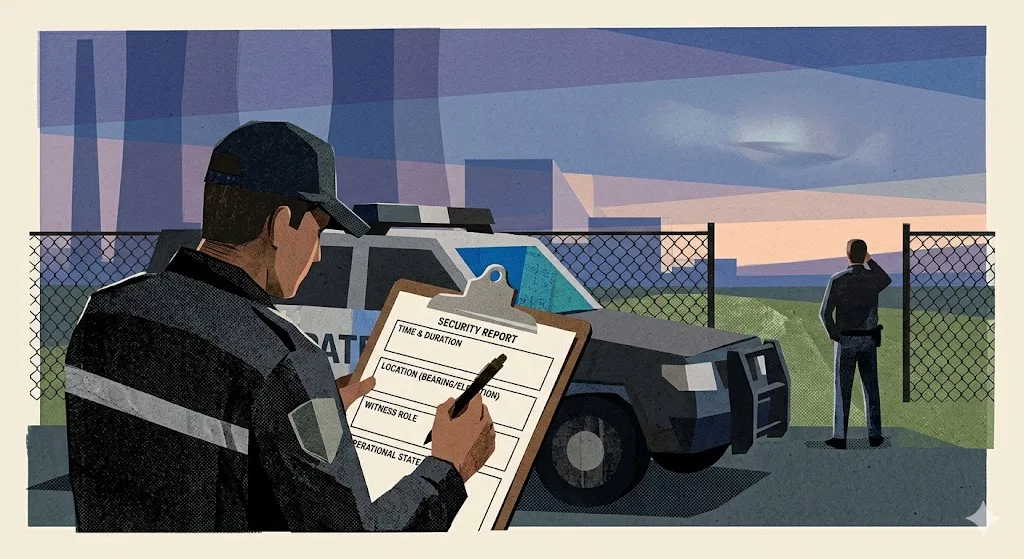
The first report should preserve what is most perishable: the witness’s immediate observations and the site’s machine-readable records. A nuclear-site anomaly can quickly become a multi-agency problem, but the initial log entry should stay practical. It should answer: who saw what, from where, at what time, under what conditions, and what else was happening at the facility.
For a sighting or sensor alert near a missile field, weapons storage area, nuclear power station or fuel-cycle facility, the minimum useful report includes:
- Time and duration: clock time, time zone, start and end, and whether timing came from a personal watch, control-room system, access-control log, camera timestamp or communications record.
- Location: exact observer position, object bearing and elevation if known, distance estimate, whether the object crossed a protected area, and whether it approached sensitive assets.
- Witness basics: role, training, shift position, whether the witness was alone, and whether accounts were taken separately before discussion.
- Object description: light pattern, sound, apparent size, motion, altitude estimate, speed estimate, changes in direction, hover time and loss of sight.
- Operational state: whether alarms, access-control events, power changes, communications interruptions, missile or reactor status changes, maintenance tests or drills were occurring at the same time.
- Immediate response: who was notified, whether security forces observed it, whether law enforcement or airspace authorities were contacted, and whether evidence was preserved.
The distinction between “unknown object” and “unknown significance” is crucial. A small drone, a hobby aircraft, a balloon, a bird on infrared video, a satellite train or a sensor artefact can all begin as unexplained from one observer’s viewpoint. A report should not force a conclusion at the intake stage. It should preserve enough detail for later comparison.
This is why reporting channels matter more than labels. Calling something a “UFO” or “UAP” may be administratively necessary in some systems, but the most useful content is concrete: the object’s track, timing, location, instrument context and response history. NASA’s 2023 independent UAP study made the same broad point for UAP research generally, warning that analysis is hampered by poor sensor calibration, lack of multiple measurements, lack of sensor metadata and lack of baseline data.[NASA Science]science.nasa.govNASA Science…
The channel has to split security response from long-term analysis
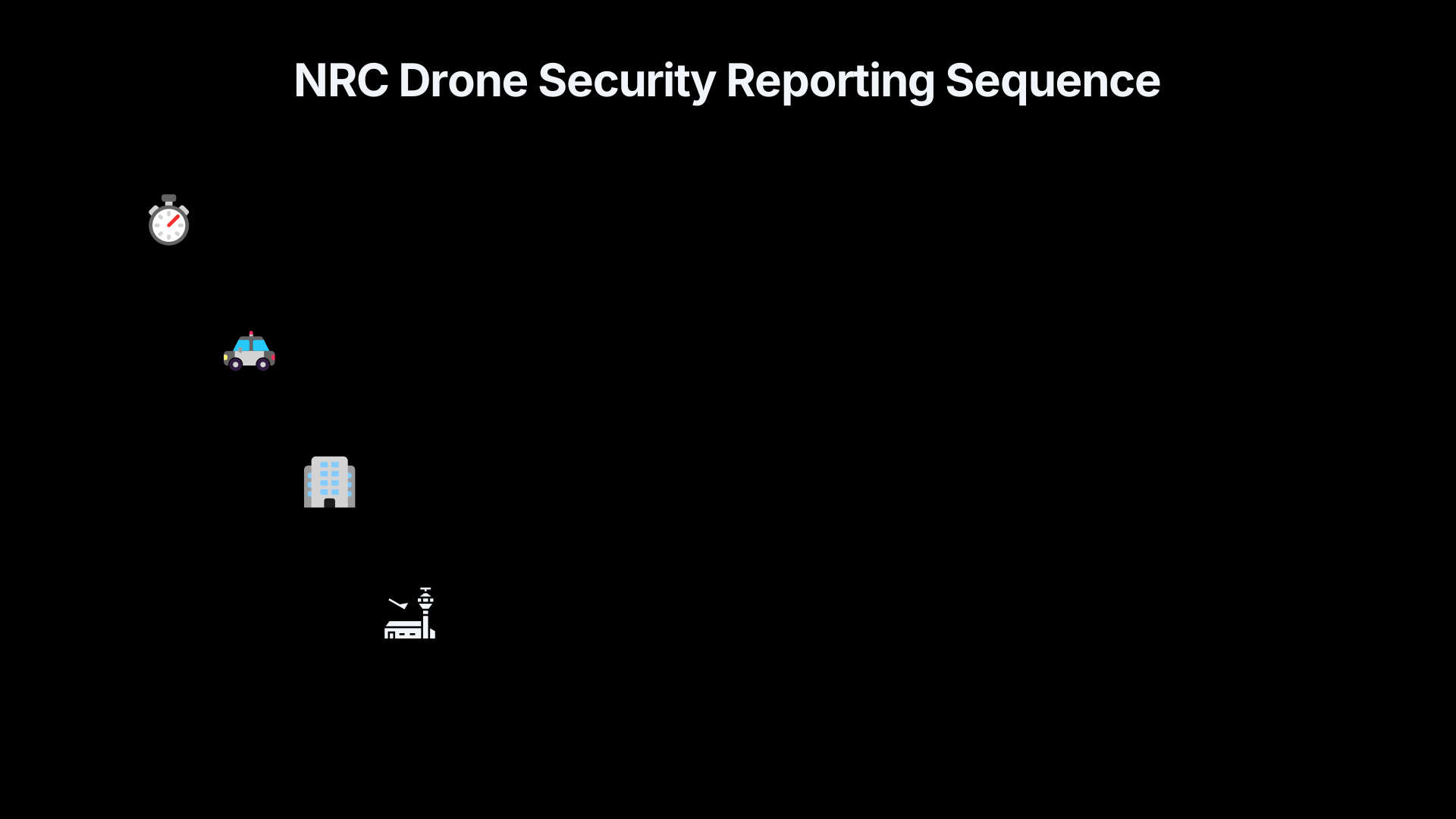
A nuclear site cannot treat every aerial anomaly as a speculative mystery. The first pathway is operational: protect the site, identify the object if possible, and notify the right authorities. The second pathway is analytical: preserve records so that investigators can later determine whether the event was a drone, aircraft, satellite, weather effect, sensor fault, deliberate surveillance or unresolved anomaly.
US nuclear regulation now makes this split visible. The NRC’s drone-security fact sheet says reports of drone sightings over nuclear power plants are sent to the NRC, FAA, FBI and local law enforcement. It also notes that nuclear power plant security forces do not have authority to interdict or shoot down aircraft, including drones, over their facilities. That means the reporting channel must connect plant security to external airspace and law-enforcement authorities rather than assuming the site can resolve the event alone.[Nuclear Regulatory Commission]nrc.govOpen source on nrc.gov.
The NRC’s broader security reporting rules also distinguish between physical security events and suspicious activity. Under 10 CFR Part 73 Subpart T, licensees must promptly assess whether an activity is suspicious and complete that assessment and any reporting as soon as possible, but within four hours of discovery. For suspicious activity at relevant facilities, the ordered reporting sequence is local law enforcement, the applicable FBI field office, the NRC Headquarters Operations Center, and the local FAA control tower if aircraft overflights are involved.[eCFR]ecfr.gov10 CFR Part 73 Subpart T – Security Notifications, Reports, and Recordkeeping…
That ordered sequence is important for UFO-related nuclear-site claims because it creates an audit trail. A report that moved through local law enforcement, the FBI, the NRC and the FAA is easier to test than a story that survives only as a later recollection. It also reduces the temptation to frame every anomaly as either “nothing” or “alien”. A good channel allows an event to be treated as a security incident first and an unresolved analytical case only if the evidence remains unclear.
Timing, location and witness basics
The most common weakness in older UFO cases is not that witnesses were insincere. It is that the report often arrived late, in narrative form, with few independent anchors. Project Blue Book’s Special Report No. 14, a major US Air Force statistical study of early UFO reports, noted that many reports were not reduced to writing immediately and that the gap between sighting and report ranged from one day to several years.[U.S. Department of War]media.defense.govU.S. Department of War(https://www.war.gov/medialink/ufo/061226/release_03/documents/CIA-UAP-015-Project_Blue_Book_Special_Report_No_14.pdf)
That problem becomes sharper at nuclear sites. A witness may be trained, sober and security-conscious, but even a trained witness can misjudge distance, altitude and speed when looking at lights in the night sky. A missile field or nuclear plant also gives the story higher emotional weight. If the first written account is delayed until after shift discussion, command briefing, press attention or online speculation, later investigators cannot easily separate original perception from group reconstruction.
A useful witness intake should therefore happen quickly and separately. The reporting form should ask for the observer’s fixed position, line of sight, weather, visibility, object movement against known landmarks, and whether the witness used binoculars, cameras, thermal sights, radar displays or unaided vision. The person taking the report should avoid leading questions such as “Did it disable anything?” or “Was it triangular?” and should instead ask the witness to describe what they saw before using labels.
The best nuclear-site report also records non-sightings. Did the control room see no alarm? Did another guard facing the same direction see nothing? Did a camera covering the reported area fail to capture the object? These negative records are not embarrassing; they are valuable. They narrow the possible explanations and prevent a single vivid account from becoming the whole evidential record.
Sensor and maintenance records
For the nuclear-UFO topic, the most useful reporting channel is one that automatically preserves surrounding technical records. A witness statement without logs can still be worth investigating, but it is much harder to evaluate. A sensor alert without human context has the opposite problem: it may show an artefact, calibration issue or ordinary object that looked unusual only inside one system.
The records worth preserving include security camera footage, radar tracks if available, access-control logs, perimeter alarms, communications recordings, maintenance tickets, shift logs, weather data, air-traffic information, drone-detection system data and any plant or weapons-system status logs relevant to the claimed time window. The key implementation choice is not simply “collect more data”; it is to collect synchronised data. If the witness says the object hovered for five minutes at 22:14, investigators need the relevant camera, alarm, radio and maintenance records from before, during and after that window.
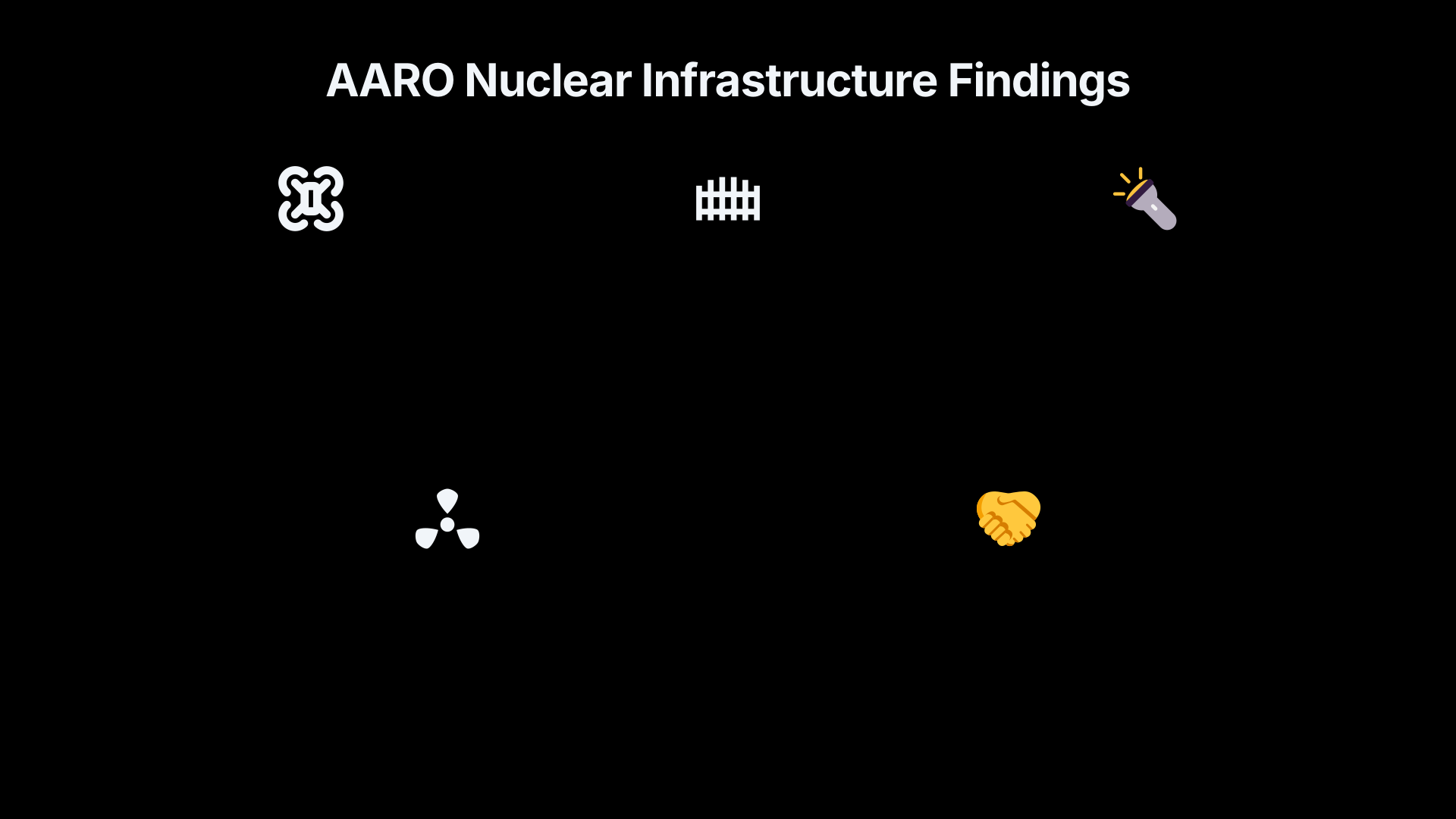
The 2024 AARO annual report shows why this matters. AARO reported 18 incidents near US nuclear infrastructure, weapons and launch sites from the Administrator for Nuclear Security and the NRC chairman; those incidents were categorised as uncrewed aircraft systems. The report gave operationally useful details: ten flew over protected areas for less than five minutes, two lasted much longer, most involved one UAS, and on-site security observed UAS in at least half the cases. It also recorded that security at the D.C. Cook Nuclear Power Plant recovered a crashed UAS on 3 August 2023 and gave it to local law enforcement.[U.S. Department of War]media.defense.govU.S. Department of War(https://media.defense.gov/2024/Nov/14/2003583603/-1/-1/0/FY24-CONSOLIDATED-ANNUAL-REPORT-ON-UAP-508.PDF)
That level of detail changes the conversation. Instead of a vague claim that “UFOs were seen near nuclear sites”, the report distinguishes duration, number of objects, protected-area overflight, witness source, recovery of physical evidence and handoff to law enforcement. It still may not answer every question, but it gives investigators something to test.
Maintenance records are just as important. In nuclear-weapons cases, the most controversial claims often involve both an aerial sighting and a technical malfunction. A serious reporting channel should therefore force the two records to remain linked but not automatically causally connected. It should record that an aerial anomaly and a system fault occurred within a given time window, then preserve maintenance diagnostics so analysts can test whether the timing is meaningful or coincidental.

Where AARO fits — and where it does not
AARO, the All-domain Anomaly Resolution Office, is the US government body created to address UAP using a data-driven framework. It is relevant to nuclear-site anomalies because recent UAP reporting laws require consultation on incidents associated with nuclear weapons infrastructure and NRC-regulated nuclear sites. The 2024 AARO report explicitly includes reporting requirements for incidents associated with nuclear weapons production, transport or storage, and for UAP or drones of unknown origin associated with nuclear power generating stations, fuel storage sites and other NRC-regulated facilities.[U.S. Department of War]media.defense.govU.S. Department of War(https://media.defense.gov/2024/Nov/14/2003583603/-1/-1/0/FY24-CONSOLIDATED-ANNUAL-REPORT-ON-UAP-508.PDF)
However, AARO is not a substitute for the immediate security chain. A guard at a nuclear plant, an operator in a control room or a missile-site security team should not treat a live aerial anomaly as primarily a research submission. The first reporting path is local site security and the established regulatory, law-enforcement and airspace notification process. AARO’s value comes later, when a case enters a wider federal UAP or anomaly-resolution system and can be compared with other reports.
AARO’s own public submission page also has limits. It currently accepts reports from current or former US government employees, service members or contractor personnel with direct knowledge of US government UAP programmes or activities dating back to 1945, and says the web form is an initial point of contact rather than a place to send potentially sensitive or classified information. It also tells users not to submit ordinary UAP sightings through that programme-reporting form.[AARO]aaro.milSubmit A ReportSubmit A Report
That distinction matters for nuclear sites. A reporting channel should not encourage staff to bypass classified, safeguards, security or operational procedures by sending sensitive information through a public-facing form. The proper design is layered: immediate site and agency notification first, secure classified or safeguards handling where required, and only then wider anomaly-resolution reporting through authorised channels.
Why poor reporting feeds mythology
Nuclear-site UFO stories become durable when there is just enough substance to be interesting but not enough documentation to resolve the case. A real alarm, a real missile fault, a real security deployment or a real drone sighting can be joined later to a poorly recorded aerial observation. Once the story circulates, missing data often becomes part of the legend: absent logs are interpreted as concealment, delayed reports become hints of suppression, and normal classification around nuclear security is taken as proof that the most extraordinary version must be true.
Poor reporting creates three recurring failure modes.
First, vague location turns “near” into “over”. A light seen from a nuclear site may be miles away, while a drone over a protected area is a different security problem. Reports need to distinguish line of sight, site boundary, protected area and asset proximity.
Second, delayed witness collection blends memory with interpretation. If witnesses compare accounts before writing them down, later consistency may reflect conversation rather than independent confirmation. Separate, prompt statements protect both the witnesses and the investigation.
Third, missing technical context makes ordinary failures look connected. A maintenance event, alarm or communications issue may be real, but without logs and diagnostics investigators cannot tell whether it coincided with, followed from, or had nothing to do with an aerial report.
NASA’s UAP study warned that stigma around UAP reporting probably leads to data loss, and that transparent reporting and rigorous analysis are needed to move the subject away from sensationalism.[NASA Science]science.nasa.govNASA Science… RAND’s analysis of public UAP reports also cautioned that public reporting may help identify threats, but individual public databases should not be treated as validated evidence; the value lies in awareness, pattern-finding and follow-up, not automatic acceptance of every entry.[RAND Corporation]rand.orgRAND CorporationNot the X-Files: Mapping Public Reports of Unidentified Aerial Phenomena Across America | RAND…
For nuclear sites, that means a good channel must make reporting safe without making it credulous. Staff should be able to report an odd object without ridicule or career penalty, but the report should still be checked against aircraft, drones, satellites, weather, sensor performance and site operations.
What an effective nuclear-site anomaly channel looks like
A practical reporting system for nuclear-site anomalies should be designed around decision points rather than folklore. It should help a shift supervisor, security commander, regulator and later analyst make better decisions from the same event record.
A strong implementation would include:
- A single initial intake form for aerial, sensor and perimeter anomalies, with required fields for time, location, witness role, object behaviour, evidence sources and immediate actions.
- Automatic evidence preservation for a defined time window around the event, including video, access-control logs, radio traffic, alarm histories, maintenance records and weather data.
- Separate witness statements taken before group debriefing wherever practicable.
- Clear escalation thresholds for protected-area overflight, repeated activity, drone recovery, interference with operations, law-enforcement response, or correlation with security or system anomalies.
- Parallel routing to operational security, regulator, law enforcement and airspace authorities, rather than leaving the event trapped in a local logbook.
- A later analytical review that records likely explanation, unresolved elements, evidence gaps and whether the case should be forwarded into a wider UAP or counter-UAS review process.
The point is not to prove or disprove extraordinary claims at the reporting stage. The point is to stop the evidence from decaying. A nuclear site does not need a “UFO belief” policy; it needs an anomaly-reporting policy that is fast, boring, secure and auditable.
The takeaway for UFOs and nuclear weapons
The UFO-and-nuclear-weapons debate often focuses on dramatic cases: missile shutdown claims, strange lights over bases, alleged incursions near storage sites, and witness testimony from retired personnel. Reporting channels are less glamorous, but they are where many cases are won or lost. A well-designed channel can turn a frightening sighting into a solvable drone, aircraft, satellite or sensor case. It can also preserve the rare case that remains genuinely unresolved after serious review.
The strongest recent lesson is that nuclear-site anomalies should be treated neither as jokes nor as automatic evidence of exotic technology. The NRC’s mandatory drone-reporting framework, AARO’s nuclear-related reporting category, and NASA’s emphasis on calibrated, multi-source data all point in the same direction: capture the facts early, route them securely, compare them with technical records, and keep conclusions separate from first impressions. That is how reporting reduces both security risk and mythology.

eBay marketplace picks
Marketplace Samples
Example marketplace items related to this page. Use the search link to explore similar finds on eBay.




Endnotes
1.
Source: nrc.gov
Link:https://www.nrc.gov/reading-rm/doc-collections/fact-sheets/fs-drone-pwr-plant-security
2.
Source: science.nasa.gov
Link:https://science.nasa.gov/wp-content/uploads/2023/09/uap-independent-study-team-final-report.pdf
Source snippet
NASA Science...
3.
Source: ecfr.gov
Link:https://www.ecfr.gov/current/title-10/chapter-I/part-73/subpart-T
Source snippet
10 CFR Part 73 Subpart T -- Security Notifications, Reports, and Recordkeeping...
4.
Source: war.gov
Title: CIA UAP 015 Project Blue Book Special Report No 14
Link:https://www.war.gov/medialink/ufo/061226/release_03/documents/CIA-UAP-015-Project_Blue_Book_Special_Report_No_14.pdf
Source snippet
Department of WarRETURN IMMEDIATELY AFTER USE TO THE CIA...Further more, most of the reports were not reduced to written form immediatel...
5.
Source: media.defense.gov
Title: U.S. Department of War
Link:https://media.defense.gov/2024/Nov/14/2003583603/-1/-1/0/FY24-CONSOLIDATED-ANNUAL-REPORT-ON-UAP-508.PDF
6.
Source: aaro.mil
Title: Submit A Report
Link:https://www.aaro.mil/Submit-A-Report/
7.
Source: rand.org
Link:https://www.rand.org/pubs/research_reports/RRA2475-1.html
Source snippet
RAND CorporationNot the X-Files: Mapping Public Reports of [Unidentified]({{ 'unidentified/' | relative_url }}) Aerial Phenomena Across America | RAND...
8.
Source: aaro.mil
Link:https://www.aaro.mil/
Source snippet
AARO HomeWelcome to the website for the All-domain Anomaly Resolution Office (AARO). Our team of experts leads the U.S. government's effo...
9.
Source: aaro.mil
Link:https://www.aaro.mil/UAP-Cases/Official-UAP-Imagery/
10.
Source: nrc.gov
Link:https://www.nrc.gov/docs/ML2417/ML24177A281.pdf
11.
Source: nrc.gov
Link:https://www.nrc.gov/docs/ML2335/ML23356A083.pdf
12.
Source: nrc.gov
Link:https://www.nrc.gov/docs/ML2329/ML23299A176.pdf
13.
Source: nrc.gov
Link:https://www.nrc.gov/docs/ML2329/ML23299A172.pdf
14.
Source: science.nasa.gov
Link:https://science.nasa.gov/uap/
15.
Source: war.gov
Title: department of defense releases the annual report on unidentified anomalous phen
Link:https://www.war.gov/News/Releases/Release/Article/3964824/department-of-defense-releases-the-annual-report-on-unidentified-anomalous-phen/
16.
Source: war.gov
Title: dr jon kosloski director aaro media roundtable on the fy24 consolidated annual
Link:https://www.war.gov/News/Transcripts/Transcript/Article/3965734/dr-jon-kosloski-director-aaro-media-roundtable-on-the-fy24-consolidated-annual/
17.
Source: rand.org
Title: RAND RRA2368 1
Link:https://www.rand.org/content/dam/rand/pubs/research_reports/RRA2300/RRA2368-1/RAND_RRA2368-1.pdf
18.
Source: ecfr.gov
Title: part 73
Link:https://www.ecfr.gov/current/title-10/chapter-I/part-73
19.
Source: faa.gov
Link:https://www.faa.gov/uas/resources/public_records/uas_sightings_report
20.
Source: vault.fbi.gov
Link:https://vault.fbi.gov/Project%20Blue%20Book%20%28UFO%29%20/Project%20Blue%20Book%20%28UFO%29%20Part%2001%20%28Final%29/at_download/file
21.
Source: media.defense.gov
Title: DOPSR 2024 0263 AARO HISTORICAL RECORD REPORT VOLUME 1 2024
Link:https://media.defense.gov/2024/Mar/08/2003409233/-1/-1/0/DOPSR-2024-0263-AARO-HISTORICAL-RECORD-REPORT-VOLUME-1-2024.PDF
22.
Source: archives.gov
Title: Project BLUE BOOK
Link:https://www.archives.gov/research/military/air-force/ufos
23.
Source: federalregister.gov
Link:https://www.federalregister.gov/index/2024/nuclear-regulatory-commission
24.
Source: Wikipedia
Title: Project Blue Book
Link:https://en.wikipedia.org/wiki/Project_Blue_Book
25.
Source: cia.gov
Title: CIA RDP81R00560R000100010001 0
Link:https://www.cia.gov/readingroom/docs/CIA-RDP81R00560R000100010001-0.pdf
26.
Source: cia.gov
Link:https://www.cia.gov/readingroom/docs/CIA-RDP81R00560R000100060001-5.pdf
27.
Source: cdn.nationalarchives.gov.uk
Link:https://cdn.nationalarchives.gov.uk/documents/the-ufo-files-extract.pdf
28.
Source: downloads.regulations.gov
Link:https://downloads.regulations.gov/NRC-2008-0122-0155/content.pdf
29.
Source: violationtracker.goodjobsfirst.org
Link:https://violationtracker.goodjobsfirst.org/agency/NRC
30.
Source: dvidshub.net
Link:https://www.dvidshub.net/video/977839/pr-008-unresolved-uap-report-europe-2022
Additional References
31.
Source: youtube.com
Title: Law Enforcement Resources: Reporting Non-Compliant Drone Operations
Link:https://www.youtube.com/watch?v=I9Wptj-IuhY
Source snippet
Ex-Air Force captain on mysterious nuke incident at base during Cold War | Jesse Weber Live - YouTube Ex-Air Force captain on mysterious...
32.
Source: youtube.com
Link:https://www.youtube.com/watch?v=op_wCAep23o
Source snippet
All-domain Anomaly Resolution Office (AARO): a Duality in Mission Regarding UAPs (Sean Kirkpatrick)...
33.
Source: youtube.com
Title: UFO Nuclear Missile Shootdown (Big Sur UFO Incident)
Link:https://www.youtube.com/watch?v=_kbLEtvzjHg
Source snippet
Jimmy Akin's Mysterious World...
34.
Source: youtube.com
Title: UFOs have taken U.S. nuclear capabilities ‘offline,’ says former AATIP director
Link:https://www.youtube.com/watch?v=tioJj_lqtLU
Source snippet
UFO Nuclear Missile Shootdown (Big Sur UFO Incident) - Jimmy Akin's Mysterious World...
35.
Source: youtube.com
Title: Researcher says UAPs and nukes are connected | Reality Check with Ross Coulthart
Link:https://www.youtube.com/watch?v=X2c3_vG7yhs
Source snippet
Why UFOs Were Seen Near America's Most Secure Nuclear Facility | WION Podcast...
36.
Source: youtube.com
Title: Unidentified Anomalous Phenomena: Senate Armed Forces Subcommittee Hearing
Link:https://www.youtube.com/watch?v=qpL6X1CNfD4
Source snippet
Law Enforcement Resources: Reporting Non-Compliant Drone Operations...
37.
Source: youtube.com
Title: Ex-Air Force captain on mysterious nuke incident at base during Cold War
Link:https://www.youtube.com/watch?v=x7uzLVw5HwA
Source snippet
Notable UFO testimony at House hearing on government transparency...
38.
Source: youtube.com
Title: Notable UFO testimony at House hearing on government transparency
Link:https://www.youtube.com/watch?v=ZPtX8isVsQo
Source snippet
Unidentified Anomalous Phenomena: Senate Armed Forces Subcommittee Hearing...
39.
Source: youtube.com
Title: Why UFOs Were Seen Near America’s Most Secure Nuclear Facility | WION Podcast
Link:https://www.youtube.com/watch?v=xpYTG2xoc7Y
Source snippet
The Connection Between UAP And Nuclear Sites Explained...
40.
Source: youtube.com
Title: Unknown Drones over US Nuclear Command!!!
Link:https://www.youtube.com/watch?v=T_sfOf0zomM
Source snippet
SOMETHING IS HAPPENING — We Are Detecting Anomalous Objects | What They Don't Explain...
Topic Tree