Within Drones
Why drones are so hard to spot
Small drones can be quiet, low and visually ambiguous, so nuclear sites often need layered radar, radio, acoustic and optical detection.
On this page
- Why low slow drones confuse security systems
- What different sensors can and cannot see
- Why layered detection matters near nuclear facilities
Page outline Jump by section
Introduction
When reports emerge of unidentified objects near nuclear facilities, it is tempting to assume that spotting a drone should be straightforward. In practice, small drones are among the most difficult airborne targets to detect and classify. They are often low-flying, slow-moving, electrically powered, and physically small. A security team may know that “something” is present while still being uncertain whether it is a drone, a bird, a balloon, a maintenance aircraft, or a harmless visual anomaly. That uncertainty is why modern counter-drone systems at sensitive sites increasingly rely on multiple sensor types working together rather than a single detection method.[PMC]pmc.ncbi.nlm.nih.govby U Seidaliyeva · 2023 · Cited by 229 — The research problem is compounded by the rapid evolution of drone technology, which includes…
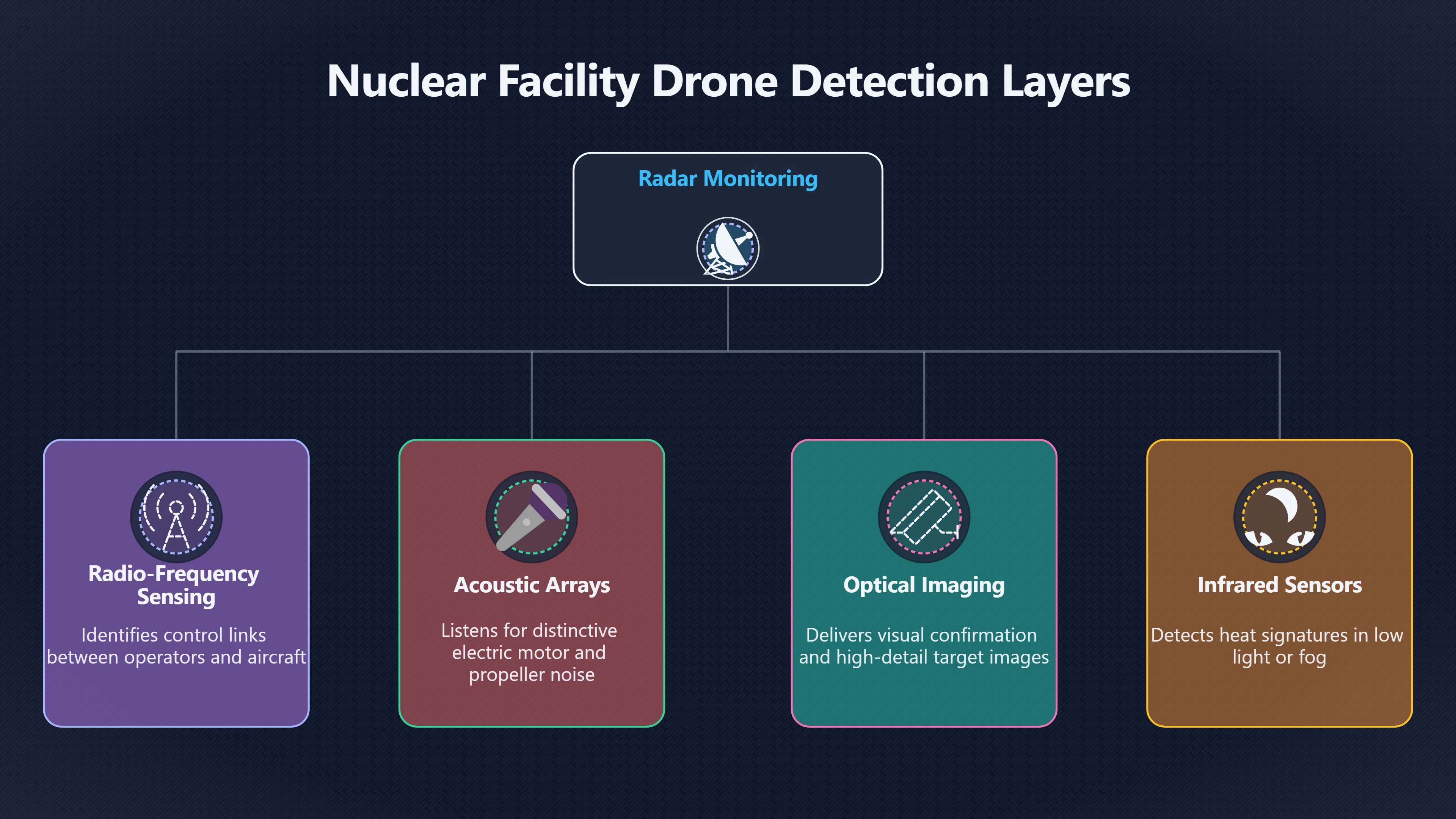
 For nuclear facilities, the challenge is especially important. Operators need enough confidence to distinguish a genuine security concern from a false alarm, and they need that confidence quickly. A layered detection architecture combining radar, radio-frequency (RF), acoustic, electro-optical and infrared sensors is designed to solve precisely that problem.[Nuclear Regulatory Commission+2IAEA]nrc.govfs drone pwr plant securityNuclear Regulatory CommissionDrones and Nuclear Power Plant SecurityThe Nuclear Regulatory Commission updated its regulations in 2024 to…
Why low slow drones confuse security systems
Traditional air-surveillance systems were largely developed to detect aircraft and missiles that are bigger, faster and operate at higher altitudes. Small drones behave differently.
Many commercially available quadcopters have a very small radar cross-section, meaning they reflect relatively little radar energy. Researchers and defence analysts have repeatedly identified low radar visibility as one of the central reasons drones can be difficult to detect. Their low altitude further complicates matters because radar returns from the drone can become mixed with reflections from trees, buildings, terrain and other ground clutter.[JAPCC+2ar5iv]japcc.orgDetecting and Neutralizing Mini-DronesHowever, mini-drones are hard to detect and identify due to very low radar signatures (with a…
Speed can also be deceptive. Conventional air-defence systems are often optimised to identify fast-moving threats. A drone hovering or creeping along a perimeter fence may not immediately stand out from background activity. Experts studying drone detection routinely describe the problem as the challenge of finding “low, slow and small” aerial targets.[ScienceDB]scidb.cnThe data acquisition equipment isScienceDBRadar Detection Dataset of Low-Slow-Small UAVs Under…This data set provides a set of radar detection data of "low, slow and s…
The result is that a suspicious object may be obvious in hindsight yet difficult to classify in real time. Security personnel might see a light, hear a sound or receive a radar alert without immediately knowing whether all those observations relate to the same object.
What different sensors can and cannot see
No sensor provides perfect awareness. Each technology excels under certain conditions and struggles under others.
Radar: broad coverage, imperfect identification
Radar remains one of the most important drone-detection tools because it can monitor large areas continuously and provide range, direction and movement information. Modern radar systems can detect many small drones that older air-surveillance radars might miss.[arXiv]arxiv.orgarXiv Micro-UAV Detection with a Low-Grazing Angle Millimeter Wave RadararXiv Micro-UAV Detection with a Low-Grazing Angle Millimeter Wave Radar
However, radar alone has limitations. Small drones can resemble birds, especially at long range. Ground clutter, vegetation and structures can generate confusing returns. Very small drones may produce weak reflections, particularly when flying close to terrain.[JAPCC]japcc.orgDetecting and Neutralizing Mini-DronesHowever, mini-drones are hard to detect and identify due to very low radar signatures (with a…
Radar is therefore excellent at answering the question, “Is something flying there?”, but not always, “Exactly what is it?”
Radio-frequency detection: useful until the drone goes silent
RF sensors look for communications between a drone and its operator. They can often identify the presence of a control link before the aircraft itself becomes visible. Some systems can even help estimate the locations of both the drone and the pilot.[TechRadar]techradar.comTraditional security methods are no longer sufficient as drones can bypass ground-level access controls. Governments, such as China, the…
The weakness is obvious: not every drone emits useful radio signals. Autonomous drones may follow pre-programmed routes, and newer systems can minimise or eliminate detectable RF transmissions. If the drone is radio-silent, RF detection may contribute little.[Drone Warfare]drone-warfare.comDrone Warfare Counter-UAS 101 – Acoustic Drone DetectionUkraine's 14000-sensor network achieves 95% interception at $500 per unit…

Acoustic sensors: hearing what radar misses
Acoustic systems listen for the distinctive sound patterns generated by electric motors and propellers. Because they are passive, they do not depend on a drone transmitting radio signals or reflecting strong radar energy.[PMC]pmc.ncbi.nlm.nih.govPMCDevelopment of an Acoustic System for UAV Detectionby C Dumitrescu · 2020 · Cited by 117 — The purpose of this paper is to investigate the possibility of developing and using an intelli…
Yet acoustics have their own weaknesses. Wind, traffic, industrial machinery, weather and terrain can interfere with detection. Range is often more limited than radar, and noisy environments can complicate identification. Researchers increasingly use multiple microphones and advanced signal processing to improve reliability.[MDPI]mdpi.comAcoustic Source Drone Detection System Using…by MT Ghenescu · 2026 — The results demonstrate that the proposed system effectively…
Acoustic sensing is valuable precisely because it covers scenarios where radar or RF methods may struggle.
Optical and infrared sensors: confirmation, not complete coverage
Electro-optical cameras and infrared sensors can provide the evidence security teams want most: a visual image. They are often critical for confirming whether an object is truly a drone.[D-Fend Solutions]d-fendsolutions.comKey challenge when using Electro-optical to detect rogue drones: Requires line of sight. Electro-optical/Infrared (EO/IR) sensors are…
The problem is that cameras require favourable viewing conditions. Darkness, fog, rain, glare, vegetation and physical obstructions can limit effectiveness. Even sophisticated imaging systems can struggle to maintain continuous coverage over large areas.[D-Fend Solutions]d-fendsolutions.comKey challenge when using Electro-optical to detect rogue drones: Requires line of sight. Electro-optical/Infrared (EO/IR) sensors are…
A camera may be excellent at identifying a target once it is pointed in the right direction, but another sensor usually has to find the target first.
Why layered detection matters near nuclear facilities
The strength of a multi-sensor system lies not in any single technology but in the fusion of information.
Imagine a radar detects a small object approaching a nuclear facility at low altitude. On its own, that contact could be a bird. If an RF sensor simultaneously detects a drone-control signal from the same direction, confidence increases. If an acoustic array also detects rotor noise, confidence increases again. Finally, a camera can be directed toward the target for visual confirmation. What began as an uncertain radar return becomes a much more reliable assessment.[TechRadar+2OUCI]techradar.comTraditional security methods are no longer sufficient as drones can bypass ground-level access controls. Governments, such as China, the…
This process reduces two major risks:
- False positives, where harmless objects trigger unnecessary security responses.
- False negatives, where a genuine drone threat is overlooked because one sensor fails to detect it.[PMC]pmc.ncbi.nlm.nih.govby U Seidaliyeva · 2023 · Cited by 229 — The research problem is compounded by the rapid evolution of drone technology, which includes…
Data fusion also helps compensate for changing environmental conditions. A camera may struggle at night, but radar performance remains largely unaffected. An RF sensor may fail against an autonomous drone, while acoustic or radar systems continue to track it. Each layer provides resilience when another layer is degraded.[D-Fend Solutions+2Drone Warfare]d-fendsolutions.comKey challenge when using Electro-optical to detect rogue drones: Requires line of sight. Electro-optical/Infrared (EO/IR) sensors are…

Why this matters in the wider UFO-and-nuclear context
Many modern reports of unidentified objects near nuclear facilities begin with incomplete information. Witnesses may observe lights, movement or unusual behaviour without having access to the underlying sensor picture. From a distance, a small drone can appear ambiguous enough to generate speculation and confusion.
For security professionals, however, the primary challenge is not solving a mystery after the fact. It is building enough situational awareness to identify a potential threat while it is still present. The growing emphasis on layered radar, RF, acoustic and optical systems reflects a simple reality: no single sensor can reliably detect every drone under every condition. Nuclear-site security therefore depends less on finding a perfect detector and more on combining imperfect detectors into a system that can reach a trustworthy conclusion.[businessinsider.com+3IAEA+3IAEA]iaea.orgTechnical Meeting on Nuclear Security Countermeasures…The primary objective of this technical meeting is to address pressing conce…
Amazon book picks
Further Reading
Books and field guides related to Why drones are so hard to spot. Use these as the next step if you want deeper reading beyond the article.
The Drone Age
Covers the operational realities of drones and counter-drone challenges.

eBay marketplace picks
Marketplace Samples
Example marketplace items related to this page. Use the search link to explore similar finds on eBay.




Endnotes
1.
Source: pmc.ncbi.nlm.nih.gov
Link:https://pmc.ncbi.nlm.nih.gov/articles/PMC10780901/
Source snippet
by U Seidaliyeva · 2023 · Cited by 229 — The research problem is compounded by the rapid evolution of drone technology, which includes...
2.
Source: japcc.org
Link:https://www.japcc.org/articles/detecting-and-neutralizing-mini-drones/
Source snippet
Detecting and Neutralizing Mini-DronesHowever, mini-drones are hard to detect and identify due to very low radar signatures (with a...
3.
Source: iaea.org
Link:https://www.iaea.org/events/evt2005113
Source snippet
Technical Meeting on Nuclear Security Countermeasures...The primary objective of this technical meeting is to address pressing conce...
4.
Source: techradar.com
Link:https://www.techradar.com/pro/a-fully-secured-critical-site-in-2030-does-not-look-like-a-single-technology-drone-visibility-and-accountability-are-just-as-important-as-security-controls
Source snippet
Traditional security methods are no longer sufficient as drones can bypass ground-level access controls. Governments, such as China, the...
5.
Source: ar5iv.labs.arxiv.org
Link:https://ar5iv.labs.arxiv.org/html/1911.05926
Source snippet
This explains why it is difficult for many traditional radars to detect a small...Read more...
6.
Source: arxiv.org
Title: arXiv Micro-UAV Detection with a Low-Grazing Angle Millimeter Wave Radar
Link:https://arxiv.org/abs/1902.05483
7.
Source: arxiv.org
Title: arXiv Robust Low-Cost Drone Detection and Classification in Low SNR Environments
Link:https://arxiv.org/abs/2406.18624
8.
Source: drone-warfare.com
Title: Drone Warfare Counter-UAS 101 – Acoustic Drone Detection
Link:https://drone-warfare.com/counter-uas/acoustic-detection/
Source snippet
Ukraine's 14000-sensor network achieves 95% interception at $500 per unit...
9.
Source: pmc.ncbi.nlm.nih.gov
Title: PMCDevelopment of an Acoustic System for UAV Detection
Link:https://pmc.ncbi.nlm.nih.gov/articles/PMC7506852/
Source snippet
by C Dumitrescu · 2020 · Cited by 117 — The purpose of this paper is to investigate the possibility of developing and using an intelli...
10.
Source: mdpi.com
Link:https://www.mdpi.com/1424-8220/26/6/1778
Source snippet
Acoustic Source Drone Detection System Using...by MT Ghenescu · 2026 — The results demonstrate that the proposed system effectively...
11.
Source: arxiv.org
Link:https://arxiv.org/abs/2508.17831
12.
Source: ouci.dntb.gov.ua
Title: ld Gw Da L4
Link:https://ouci.dntb.gov.ua/en/works/ldGwDaL4/
Source snippet
Detection Using a Fusion of RF and Acoustic...This article presents a systematic review of 184 recent studies (2019–2025) covering five...
13.
Source: iaea.org
Link:https://www.iaea.org/topics/security-aspects
Source snippet
Security aspects of nuclear facilitiesPhysical protection requires a mix of hardware (security devices), procedures (organization of guar...
14.
Source: businessinsider.com
Link:https://www.businessinsider.com/why-militaries-used-to-missile-threat-can-struggle-drones
Source snippet
Originally focused on bird detection, Robin Radar now provides improved drone-detection systems used in Ukraine and by U.S. allies in the...
15.
Source: www-pub.iaea.org
Title: PUB1875 web
Link:https://www-pub.iaea.org/MTCD/Publications/PDF/PUB1875_web.pdf
Source snippet
Nuclear Security Series No. 40-TNuclear security issues relating to the prevention and detection of, and response to, criminal or intenti...
16.
Source: mdpi.com
Title: 2504 446X
Link:https://www.mdpi.com/2504-446X/7/1/39
Source snippet
Small Fixed-Wing UAV Radar Cross-Section Signature...by IK Kapoulas · 2023 · Cited by 28 — The purpose of this study is to partially fil...
17.
Source: mdpi.com
Title: 2504 446X
Link:https://www.mdpi.com/2504-446X/9/1/76
Source snippet
UAV Detection with Passive Radar: Algorithms...by Z Tang · 2025 · Cited by 37 — In the context of UAV detection, clutter suppression is...
18.
Source: energy.gov
Link:https://www.energy.gov/nnsa/protecting-nnsa-facilities-counter-unmanned-aircraft-systems
Source snippet
Protecting NNSA Facilities: Counter Unmanned Aircraft...NNSA has established a comprehensive counter unmanned aircraft systems (CUAS) pr...
19.
Source: nrc.gov
Title: fs drone pwr plant security
Link:https://www.nrc.gov/reading-rm/doc-collections/fact-sheets/fs-drone-pwr-plant-security
Source snippet
Nuclear Regulatory CommissionDrones and Nuclear Power Plant SecurityThe Nuclear Regulatory Commission updated its regulations in 2024 to...
20.
Source: scidb.cn
Title: The data acquisition equipment is
Link:https://www.scidb.cn/en/detail?dataSetId=1b2a6498f10347af9c2a8f1769487f25
Source snippet
ScienceDBRadar Detection Dataset of Low-Slow-Small UAVs Under...This data set provides a set of radar detection data of "low, slow and s...
21.
Source: d-fendsolutions.com
Link:https://d-fendsolutions.com/anti-drone-detection/
Source snippet
Key challenge when using Electro-optical to detect rogue drones: Requires line of sight. Electro-optical/Infrared (EO/IR) sensors are...
Additional References
22.
Source: mindfoundry.ai
Link:https://www.mindfoundry.ai/blog/acoustic-intelligence-for-counter-uas
Source snippet
AI-enabled Acoustic Intelligence for Counter-UASUnmanned Aircraft Systems (UAS) are now a staple of modern warfare. AI-enabled acoustic i...
23.
Source: linkedin.com
Link:https://www.linkedin.com/posts/guidadosy_nuclearsecurity-radiationprotection-nuclearscience-activity-7449821520627154946-ZNFg
Source snippet
Guidado Sy's PostDrones (unmanned aerial systems or UAS) play a dual role in nuclear security: they serve as valuable tools for enhancing...
24.
Source: unmannedairspace.info
Link:https://www.unmannedairspace.info/counter-uas-systems-and-policies/iaea-chief-gravely-concerned-over-drone-threats-to-nuclear-infrastructure-in-the-middle-east/
Source snippet
IAEA chief 'gravely concerned' over drone threats to...6 days ago — Nuclear Power Plants (NPP) are protected under international humanit...
25.
Source: unmannedsystemstechnology.com
Link:https://www.unmannedsystemstechnology.com/feature/protecting-nuclear-infrastructure-from-drone-threats/
Source snippet
Protecting Nuclear Infrastructure from Drone ThreatsThis article from D-Fend Solutions examines the growing challenge of drone threats to...
26.
Source: robinradar.com
Link:https://www.robinradar.com/why-traditional-radar-isnt-effective-at-tracking-drones
Source snippet
Why Traditional Radar Isn't Effective at Tracking DronesAn unbiased look at the anti-drone market, including helpful pros and cons of eac...
27.
Source: publications.sto.nato.int
Link:https://publications.sto.nato.int/publications/STO%20Meeting%20Proceedings/STO-MP-MSG-SET-183/MP-MSG-SET-183-11.pdf
Source snippet
Sensor Processing and Data Fusion for Drone...by S Jovanoska · Cited by 17 — One of the challenges when applying GSM in passive radar is...
28.
Source: nationalacademies.org
Link:https://www.nationalacademies.org/read/26630/chapter/11
29.
Source: armscontrol.org
Link:https://www.armscontrol.org/act/2024-07/news/iaea-warns-about-drones-near-zaporizhzhia
Source snippet
IAEA Warns About Drones Near ZaporizhzhiaThe head of the International Atomic Energy Agency (IAEA) said it is unacceptable for any party...
30.
Source: linkedin.com
Link:https://www.linkedin.com/posts/vigilitec_drones-unmanned-aerial-systems-or-uas-play-activity-7449783613501419521-YU03
31.
Source: media.nti.org
Link:https://media.nti.org/documents/THE_RISKS_AND_REWARDS_OF_EMERGING_TECHNOLOGY_IN_NUCLEAR_SECURITY.pdf
Source snippet
risks and rewards of emerging technology in...A good example for this problem is how the United States has addressed the growing threat...
Topic Tree