Within Threat Claims
Why the Robertson Panel narrowed UFO threat claims
The 1953 Robertson Panel helps explain why officials separated unknown sightings from proven hostile or extraterrestrial threats.
On this page
- What the panel was asked to judge
- Why public alarm mattered more than alien proof
- How its logic shaped later nuclear UFO debates
Page outline Jump by section
Introduction
The 1953 Robertson Panel occupies a pivotal place in the history of UFO policy because it reframed the question officials believed they needed to answer. Rather than asking whether UFO reports proved extraterrestrial visitors, the panel focused on whether the phenomenon created a national-security problem. Its answer was narrow but influential: the available evidence did not demonstrate a direct threat from the reported objects themselves, yet the growing volume of reports, public excitement and potential for confusion could create security risks in their own right.[Wikipedia]WikipediaRobertson PanelRobertson Panel
 This distinction became especially important in later debates about UFOs and nuclear weapons. Witnesses at sensitive military facilities often argued that unusual incidents deserved deeper attention. The Robertson Panel’s logic, however, established an evidentiary framework in which unexplained sightings were not automatically treated as hostile or extraordinary threats. Understanding that framework helps explain why official conclusions and witness concerns frequently diverged during the Cold War and afterwards.[Wikipedia]WikipediaRobertson PanelRobertson Panel
What the panel was asked to judge
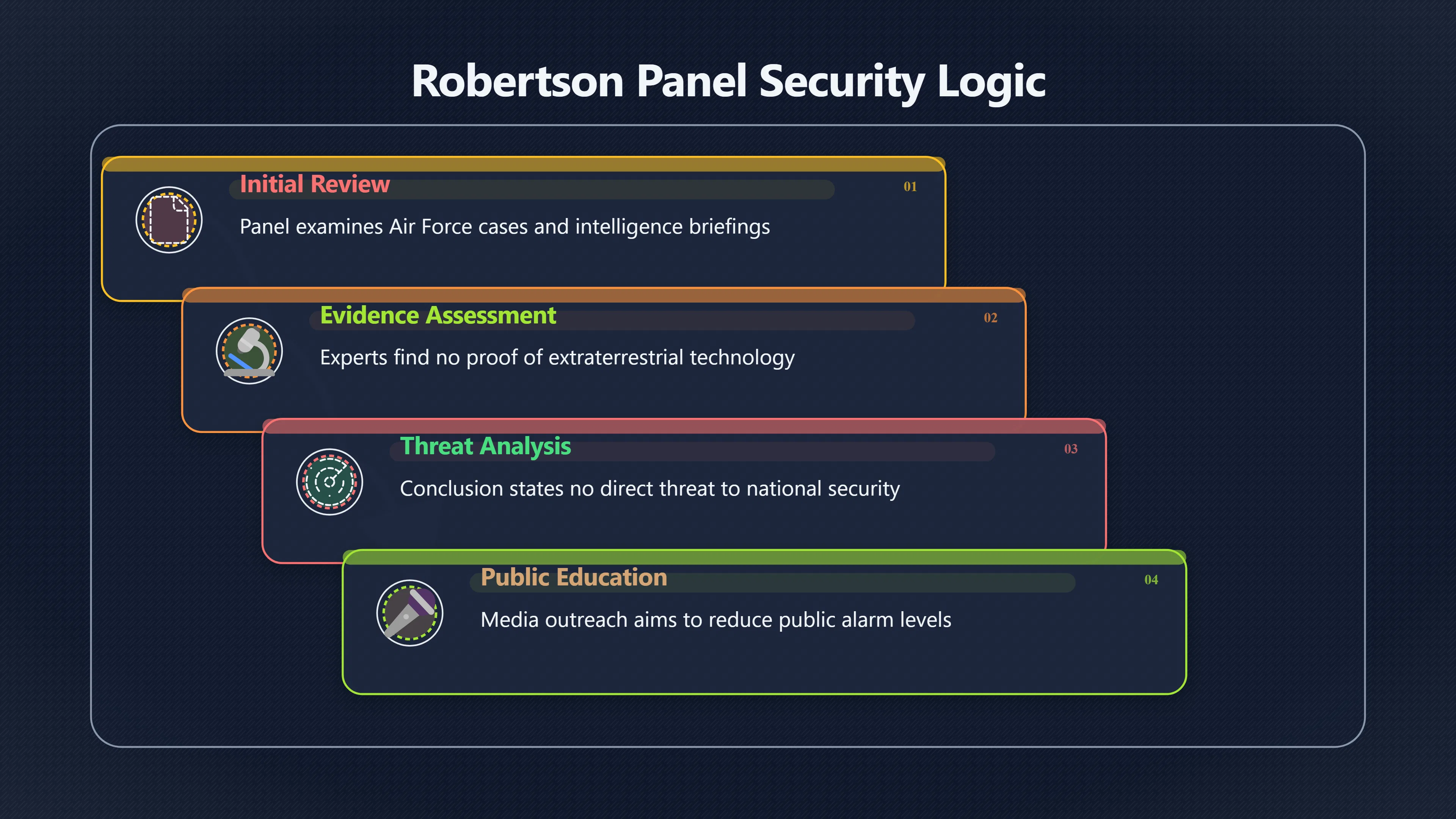
The Robertson Panel was convened by the Central Intelligence Agency in January 1953 after a surge of UFO reports, including the highly publicised Washington, D.C. sightings of 1952. Intelligence officials were concerned enough to seek scientific review, but their concern was broader than the possibility of alien craft. They wanted to know whether the reports represented a genuine defence threat, a foreign technological development, or a problem for military warning systems.[Wikipedia+2FAS Project on Government Secrecy]WikipediaRobertson PanelRobertson Panel
After reviewing selected Air Force cases and intelligence briefings, the panel concluded unanimously that it found no evidence of a direct threat to national security in the reported objects. It also rejected the idea that the cases reviewed demonstrated extraterrestrial technology. Importantly, the panel did not claim that every sighting had been explained; rather, it judged that the available evidence did not justify extraordinary conclusions. Raw reports, eyewitness testimony and unresolved cases were not considered sufficient proof of a hostile or non-human presence.[Wikipedia+2CIA]WikipediaRobertson PanelRobertson Panel
This approach created a high evidentiary threshold. For officials, an unidentified sighting remained merely unidentified unless corroborated by stronger technical evidence. That standard later shaped how military institutions evaluated reports associated with strategic facilities, including nuclear sites.[Wikipedia]WikipediaRobertson PanelRobertson Panel
Why public alarm mattered more than alien proof
One of the most revealing aspects of the Robertson Panel was that it identified the public reaction to UFOs as a larger security concern than the objects themselves. The panel warned that mass reporting of unusual lights and aerial events could clog military communications and reporting networks during a genuine emergency. In Cold War conditions, distinguishing a real Soviet attack from waves of mistaken reports was considered a practical defence problem.[CIA+2FAS Project on Government Secrecy]cia.govREPORT OF MEETING OF SCIENTIFIC ADVISORY…Subjectivity of public to mass hysteria and greater vul- verability to possible enemy psyc…
The panel specifically highlighted three indirect dangers:
- Misidentification of actual enemy aircraft or weapons.
- Overloading reporting and warning channels with false or mistaken information.
- Public susceptibility to mass hysteria or psychological warfare.[CIA]cia.govREPORT OF MEETING OF SCIENTIFIC ADVISORY…Subjectivity of public to mass hysteria and greater vul- verability to possible enemy psyc…
This logic reflected the strategic anxieties of the early Cold War. Intelligence officials worried that an adversary might exploit widespread UFO interest to create confusion, panic or reporting overload. In that framework, the key threat was not necessarily an unknown craft in the sky but the possibility that the phenomenon could interfere with air-defence decision-making.[FAS Project on Government Secrecy+2Reddit]fas.orgciaufoFAS Project on Government SecrecyCIA's Role in the Study of UFOs, 1947-90It chronologically examines the Agency's efforts to solve the my…
As a result, the panel recommended a public education effort designed to reduce the aura of mystery surrounding UFO reports. The goal was not simply scientific clarification. It was also to lower public alarm, improve identification skills and decrease the volume of reports entering security channels. Recommendations included using mass media and educational outreach to explain common misidentifications and encourage a more sceptical public response.[Wikipedia+2HISTORY]WikipediaRobertson PanelRobertson Panel

How the panel’s logic shaped later nuclear-UFO debates
The Robertson Panel’s influence extended far beyond its brief meetings in 1953. Its conclusions helped establish a policy culture in which unexplained sightings were treated primarily as an intelligence and reporting problem rather than evidence of a novel external threat. Subsequent investigations often began from the assumption that a report required substantial corroboration before it could justify security conclusions.[Wikipedia]WikipediaRobertson PanelRobertson Panel
This became significant in later controversies involving nuclear installations. Witnesses sometimes described unusual aerial objects near missile fields, weapons depots or strategic bases. Many believed the events demonstrated an unknown capability operating around sensitive military assets. Official reviews, however, generally applied the Robertson Panel’s evidentiary logic: unusual observations alone did not establish causation, hostile intent or technological superiority. A missile malfunction and a UFO report occurring in the same period were not considered proof that one caused the other.[Wikipedia]WikipediaRobertson PanelRobertson Panel
The result was a recurring disagreement between two different standards of judgement:
- Witness-centred reasoning: Credible military personnel reported extraordinary events near strategic systems, so the reports deserved serious security consideration.
- Institutional threat reasoning: Credibility of witnesses was important, but conclusions about threats required independent technical evidence, repeatable data and demonstrated causal links.[Wikipedia]WikipediaRobertson PanelRobertson Panel
Because the Robertson Panel had already defined the central issue as one of evidence and security management rather than alien visitation, later official investigations often evaluated nuclear-UFO claims through that same lens. The question became not whether something unusual had been observed, but whether the available evidence proved a threat that military planners could reliably act upon.[Wikipedia]WikipediaRobertson PanelRobertson Panel
Why the Robertson Panel remains controversial
The panel remains controversial because supporters and critics focus on different parts of its legacy. Supporters argue that it applied scientific scepticism during a period of intense public speculation and helped prevent defence systems from being distracted by unreliable reports. Critics argue that its emphasis on debunking and reducing public interest encouraged a culture of dismissal that discouraged serious investigation of difficult cases.[Wikipedia+2WIRED]WikipediaRobertson PanelRobertson Panel
For the specific debate over UFOs and nuclear weapons, the panel’s lasting importance lies less in any particular sighting than in the framework it established. It separated the existence of unexplained reports from the conclusion that those reports represented a proven hostile, extraterrestrial or strategically significant threat. That distinction became a defining feature of official UFO assessments for decades and remains central to understanding why government conclusions often differed from witness interpretations of events around nuclear facilities.[Wikipedia+2CIA]WikipediaRobertson PanelRobertson Panel

Amazon book picks
Further Reading
Books and field guides related to Why the Robertson Panel narrowed UFO threat claims. Use these as the next step if you want deeper reading beyond the article.
In Plain Sight: an Investigation Into UFOs and Impossible Sci...
Links historical policy debates to modern UAP discussions.

The Report on Unidentified Flying Objects
Provides direct Cold War context around official policy development.
eBay marketplace picks
Marketplace Samples
Example marketplace items related to this page. Use the search link to explore similar finds on eBay.

Endnotes
1.
Source: Wikipedia
Title: Robertson Panel
Link:https://en.wikipedia.org/wiki/Robertson_Panel
2.
Source: cia.gov
Link:https://www.cia.gov/readingroom/document/cia-rdp81r00560r000100030027-0
Source snippet
REPORT OF MEETING OF SCIENTIFIC ADVISORY...Subjectivity of public to mass hysteria and greater vul- verability to possible enemy psyc...
3.
Source: sgp.fas.org
Link:https://sgp.fas.org/library/ciaufo.html
Source snippet
FAS Project on Government SecrecyCIA's Role in the Study of UFOs, 1947-90It chronologically examines the Agency's efforts to solve the my...
4.
Source: cia.gov
Link:https://www.cia.gov/readingroom/docs/CIA-RDP79B00752A000300100010-4.pdf
Source snippet
n solving this problem of signal identification before service...Read more...
5.
Source: cia.gov
Title: DOC 0005516124
Link:https://www.cia.gov/readingroom/docs/DOC_0005516124.pdf
Source snippet
REPORT OF THE SCIENTIFIC PANEL ON UNIDENTIFIED...This report was prepared by a panel convened in January. 1953 at the direction of the f...
6.
Source: reddit.com
Title: cias role in the study of ufos 194790 by gerald k
Link:https://www.reddit.com/r/UFOs/comments/11bbz9x/cias_role_in_the_study_of_ufos_194790_by_gerald_k/
Source snippet
CIA'S ROLE IN THE STUDY OF UFO'S, 1947-90, BY...The group believed that the Soviets could use UFO reports to touch off mass hysteria and...
7.
Source: history.com
Link:https://www.history.com/articles/ufo-sightings-cia-robertson-condon
Source snippet
How the CIA Tried to Quell UFO Panic During the Cold WarJan 6, 2020 — The Robertson panel met for a few days in January 1953 to re...
Published: January 1953
8.
Source: wired.com
Title: how ufo sightings became an american obsession
Link:https://www.wired.com/story/how-ufo-sightings-became-an-american-obsession
Source snippet
The period following his sighting saw a surge in UFO sightings across the U.S. This surge, or "flap," is linked to societal fears of inva...
9.
Source: reddit.com
Link:https://www.reddit.com/r/UFOB/comments/1k6hdsj/the_robertson_panel_was_a_committee_established/
Source snippet
owever, in the U.S., they had a marked impact on the public...Read more...
10.
Source: war.gov
Link:https://www.war.gov/medialink/ufo/061226/release_03/documents/CIA-UAP-002_Scientific-Advisory-Panel-on-Unidentified-Flying-Objects_Report_1952-1953.pdf
Source snippet
light 1ntensi't7 ot...Read more...
Additional References
11.
Source: writebrightstation.com
Link:https://writebrightstation.com/wp-content/plugins/wonderplugin-pdf-embed/pdfjslight/web/viewer.html?disabledoc=1&disabledownload=1&disabletext=1&file=https%3A%2F%2Fwritebrightstation.com%2Fwp-content%2Fuploads%2F2023%2F06%2FUFOs.pdf&v=2
Source snippet
sightings have been reported throughout history in many parts of the world. It makes people wonder if extraterrestrials have ever visited...
12.
Source: espace.library.uq.edu.au
Link:https://espace.library.uq.edu.au/view/UQ%3A144778/UQ144778_OA.pdf
Source snippet
UQ eSpaceMaking It Unpopular:by A Dodd · Cited by 6 — The general aim of the Robertson Panel's recommendations, then, was to not only sto...
13.
Source: youtube.com
Link:https://www.youtube.com/watch?v=xuTgayiSdns
Source snippet
The CIA Cover-Up of the “UFO Problem” During the Cold WarThe CIA Cover-Up of the “UFO Problem” During the Cold War... Schoolyard witness...
14.
Source: en.wikisource.org
Link:https://en.wikisource.org/wiki/Report_on_the_Historical_Record_of_U.S._Government_Involvement_with_Unidentified_Anomalous_Phenomena/Volume_1/Section_4
Source snippet
Report on the Historical Record of US Government...10 May 2024 — Results: The committee's report stated that UFOs did not thre...
Published: May 2024
15.
Source: britannica.com
Link:https://www.britannica.com/question/How-have-governments-and-scientists-investigated-UFO-sightings
Source snippet
The first widely publicized UFO sighting occurred in 1947, when...Read more...
16.
Source: researchgate.net
Link:https://www.researchgate.net/publication/372849804_UFO_Sagas_and_Legends_from_Trinity_July_1945_Until_the_Robertson_Panel_January_1953
Source snippet
August 2023. DOI:10.1007/978-3-031-34398-8_2. In book: UFOs (pp.15-38)...
Published: July 1945
17.
Source: facebook.com
Link:https://www.facebook.com/vetshistoryproject/posts/its-a-bird-its-a-plane-its-dyk-that-from-1952-1970-the-united-states-air-force-l/2319143141485192/
Source snippet
obertson Panel, which recommended that UFOs needed debunking.Read more...
18.
Source: bleedingheartland.com
Title: notes on 75 years of flying saucers
Link:https://www.bleedingheartland.com/2022/06/18/notes-on-75-years-of-flying-saucers/
Source snippet
18 Jun 2022 — CIA representatives at panel meetings voiced concern that panic or other public reactions to flying saucer reports might se...
19.
Source: commons.wikimedia.org
Title: File:Robertson panel report
Link:https://commons.wikimedia.org/wiki/File%3ARobertson_panel_report.pdf
Source snippet
wikimedia.orgFile:Robertson panel report.pdfEnglish: Robertson panel report. Date, 1...
9
5
20.
Source: youtube.com
Link:http://www.youtube.com/watch?v=J8wEpSNLGIU
Source snippet
Ep. 7: The Robertson Panel | Chadwell, the CIA, and the Four Days That Classified UFOs for Sixteen Years...
Topic Tree