Within Nuclear UFOs
Why Mundane UFOs Can Still Matter
Even mundane explanations can matter if they expose surveillance gaps, reporting failures or equipment vulnerabilities.
On this page
- Security risks from unknown activity
- Readiness and reliability concerns
- Avoiding both panic and dismissal
Page outline Jump by section
Introduction
“UFOs and nuclear weapons” does not have to mean aliens disabling missiles. A more sober risk is that unknown activity near nuclear sites can reveal ordinary but serious weaknesses: gaps in surveillance, unclear reporting routes, drone detection limits, sensor ambiguity, maintenance fragility, or command confusion under pressure. In nuclear readiness, the question is not only “what was it?” but “did the system recognise, classify, report and respond to it fast enough?”
That framing matters because many modern UAP reports resolve to prosaic objects such as balloons, birds or drones, while other reports remain unresolved mainly because the data are incomplete. AARO’s 2024 annual report said it had 1,652 UAP reports in total as of 24 October 2024, and that 49 cases resolved during the reporting period were attributed to ordinary objects including balloons, birds and uncrewed aircraft systems.[U.S. Department of War]media.defense.govFY24 CONSOLIDATED ANNUAL REPORT ON UAP 508U.S. Department of WarFiscal Year 2024 Consolidated Annual Report on Unidentified Anomalous Phenomena… Yet mundane does not mean harmless. A drone near a missile field, a false alarm at a weapons storage area, or a sensor track that cannot be correlated can still affect readiness even if no extraordinary technology is involved.
Security risks from unknown activity
The most practical security concern is adversary collection. A small uncrewed aircraft, misidentified as a “UFO” in the first minutes of an incident, can observe patrol routes, camera coverage, alarm response times, entrances, convoys, communications nodes and lighting patterns. Those details are not cinematic, but they are exactly the kind of information that can make later intrusion, sabotage or harassment easier.
US official reporting already treats UAP in sensitive airspace as a possible safety and collection problem, without needing alien claims. The 2022 US intelligence annual report said UAP events continued to occur in restricted or sensitive airspace, raising possible concerns about safety of flight or adversary collection, while also warning that the pattern might partly reflect collection bias because military areas have more sensors and more personnel instructed to report anomalies.[Director of National Intelligence]dni.govUnclassified 2022 Annual Report UAPDirector of National Intelligence2022 Annual Report on Unidentified Aerial PhenomenaJanuary 10, 2023 — 25 Jun 2021 — UAP events continue… That caveat is important: more reports around military sites may mean more surveillance, not necessarily more intrusions. But from a readiness perspective, either interpretation matters. Heavy reporting around protected sites may indicate either real probes or a monitoring system that sees many things but cannot quickly sort them.
Nuclear power facilities show the same logic in a less classified setting. The US Nuclear Regulatory Commission says the availability and popularity of commercial drones have produced numerous sightings over critical infrastructure, including nuclear power plants, and that it updated its regulations in 2024 to require nuclear power plant licensees to report drone sightings over their facilities.[Nuclear Regulatory Commission]nrc.govfs drone pwr plant securityNuclear Regulatory CommissionDrones and Nuclear Power Plant SecurityThe Nuclear Regulatory Commission updated its regulations in 2024 to… The Federal Aviation Administration also says drones are prohibited over designated national security-sensitive facilities from the ground up to 400 feet above ground level.[FAA]faa.govcritical infrastructureOperations are prohibited from the ground up to 400 feet above ground…Read more… These rules would not exist if every low-altitude unknown could be safely dismissed as a hobbyist mistake.
A useful example is the 2019 Palo Verde Nuclear Generating Station incident in Arizona, where documents obtained under freedom-of-information laws described multiple drones around a restricted area near the plant. Reporting on those documents noted that security personnel could observe the drones, but the operators were not immediately identified.[Forbes]forbes.comdrone swarm invaded palo verde nuclear power plantForbes'Drone Swarm' Invaded Palo Verde Nuclear Power Plant…Jul 30, 2020 — A number of small drones flew around a restricted area at Pa… The point is not that Palo Verde proves a hostile nuclear plot. It shows a more ordinary readiness problem: seeing an object is not the same as identifying it, locating the operator, attributing intent, or having legal authority and technical means to stop it.
That distinction becomes sharper when drone activity is coordinated. Research from Sandia National Laboratories, hosted by the US Department of Energy’s Office of Scientific and Technical Information, notes that UAV incidents had already occurred around sensitive facilities, including French nuclear power plants, and argues that the UAV threat to nuclear facilities deserves focused assessment.[OSTI.gov]osti.govAnalyzing the Threat of Unmanned Aerial Vehicles (UAV)…by A Solodov · 2017 · Cited by 177 — Recently, several incidents occurred with… The Nuclear Threat Initiative similarly noted that incidents involving drones at nuclear facilities were increasing, citing the 2014 overflights of 13 French nuclear power plants as an example.[NTI Media]media.nti.orgTHE RISKS AND REWARDS OF EMERGING TECHNOLOGY IN NUCLEAR SECURITYNTI Mediathe risks and rewards of emerging technology in…February 6, 2020 — The number of security incidents at nuclear facilities inv… Even when no damage follows, repeated overflights can test whether a site’s security plan is written for yesterday’s threat.
Readiness and reliability concerns
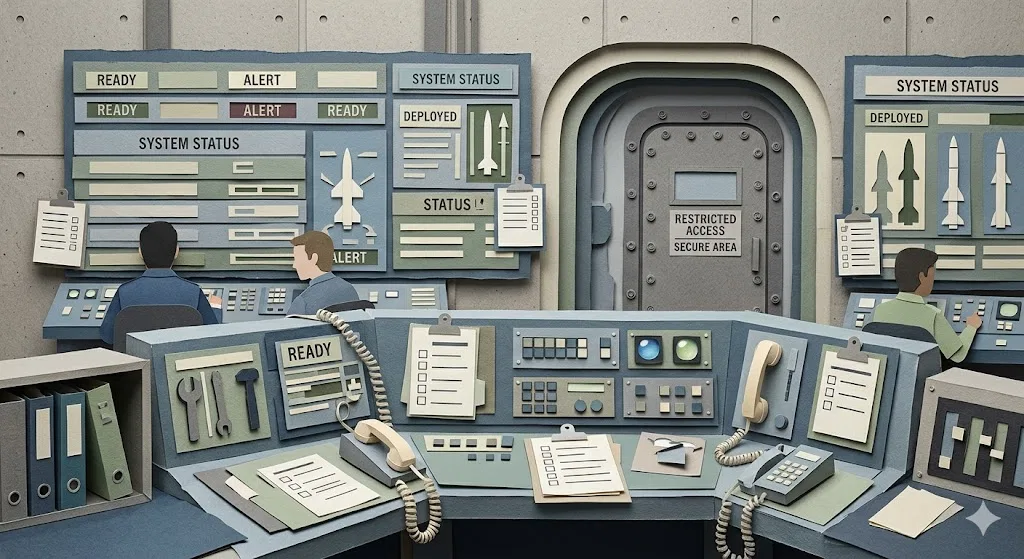
Readiness is not just physical security. For nuclear forces, it means the ability to maintain safe, controlled and authorised operations under stress. That includes reliable sensors, disciplined reporting, trained crews, resilient communications and weapon systems that remain secure in abnormal conditions.
The US Air Force’s nuclear surety doctrine makes this explicit. Its 2025 nuclear weapons surety instruction says the programme is intended to maximise surety throughout the nuclear weapon life cycle, prevent unauthorised or inadvertent activation of critical functions, and protect against inherent risks and threats.[E-Publishing]static.e-publishing.af.milE-Publishing DAFI91-101E-Publishing DAFI91-101 It also requires positive measures to prevent deliberate or inadvertent pre-arming, arming, launching or releasing of nuclear weapons, and to prevent unauthorised access or actions by physical or digital means.[E-Publishing]static.e-publishing.af.milE-Publishing DAFI91-101E-Publishing DAFI91-101 In that kind of system, a mysterious aerial report is not automatically a weapon danger, but it can become a readiness issue if it exposes uncertainty in the surrounding human and technical chain.
The Malmstrom Echo Flight case is useful precisely because it separates the real readiness issue from the disputed UFO interpretation. A declassified Air Force engineering report recorded that, on 16 March 1967, all Echo Flight launch facilities went into “No-Go” status nearly simultaneously; it also said rumours of UFOs in the area at the time of the fault were disproven.[documents.theblackvault.com]documents.theblackvault.comOpen source on theblackvault.com. Later witnesses and researchers disputed that conclusion, but the mundane lesson is already significant: a nuclear missile system suffered a serious simultaneous alert failure, and the surrounding story became tangled with rumour, memory and contested reporting. Even without accepting any UFO link, the case shows why nuclear incidents need clean timelines, technical logs, witness handling and prompt classification of what is known versus what is assumed.
A modern parallel is the problem of communications and monitoring failures. In 2010, reporting on an incident at F.E. Warren Air Force Base said launch officers temporarily lost reliable communication and monitoring capability for 50 Minuteman III missiles, with backup systems maintaining monitoring and a single hardware failure identified as the root cause.[WIRED]wired.comCommunication With 50 Nuke Missiles Dropped in ICBM SnafuCommunication With 50 Nuke Missiles Dropped in ICBM Snafu That episode was not a UFO case, but it belongs in this readiness discussion because it shows how much of nuclear confidence rests on ordinary infrastructure: hardware, networks, procedures and backup channels. A strange aerial report near such a system would be only one more input into an already complex operating picture.
There is also a cyber and equipment angle. The US Government Accountability Office reported in 2023 that the National Nuclear Security Administration’s efforts to identify, assess and mitigate cyber risks to specific nuclear weapons and manufacturing equipment were still in early stages, including efforts to inventory systems with potential vulnerabilities.[GAO]gao.govgao 23 106309gao 23 106309 That does not mean UFO reports are cyber incidents. It means that nuclear readiness increasingly depends on knowing what is connected, what is vulnerable, and what can be trusted when operators see ambiguous activity nearby.
The reporting gap is itself a readiness risk
A striking feature of UAP work is how often the strongest finding is not “we found something extraordinary” but “the data are too poor to conclude much”. NASA’s 2023 independent UAP study said analysis is hampered by poor sensor calibration, lack of multiple measurements, lack of sensor metadata and lack of baseline data.[NASA Science]science.nasa.govOpen source on nasa.gov. For nuclear sites, that is not a mere scientific inconvenience. It affects whether commanders can quickly decide whether an unknown is a bird, a balloon, a drone, a friendly aircraft, a sensor artefact, or a possible surveillance probe.
NASA also warned that stigma around UAP reporting creates data loss, saying negative perceptions are an obstacle to collecting information and almost certainly lead to “data attrition”.[NASA Science]science.nasa.govOpen source on nasa.gov. In nuclear environments, stigma can cut two ways. If personnel fear ridicule, they may delay or soften a report. If they fear punishment for misidentification, they may leave out uncertainty. If a sensational culture takes hold, ordinary lights and sensor quirks may be overreported in ways that bury genuinely important observations. Readiness requires a middle path: report fast, record carefully, and avoid turning uncertainty into either embarrassment or mythology.
The 2024 AARO annual report shows why this matters operationally. AARO received FAA civil and commercial aviation reporting logs during the period, and said weekly FAA reporting represented a significant increase and reflected strengthened relationships with reporting partners.[U.S. Department of War]media.defense.govFY24 CONSOLIDATED ANNUAL REPORT ON UAP 508U.S. Department of WarFiscal Year 2024 Consolidated Annual Report on Unidentified Anomalous Phenomena… Better reporting does not automatically mean more unusual objects; it can mean that previously hidden or scattered observations are finally entering a usable system. For nuclear sites, the same lesson applies: a robust reporting culture may initially make the problem look bigger, but it gives security teams a better chance of distinguishing routine noise from genuine probes.
Why drones make the old UFO problem more practical
The drone era has changed the meaning of “unknown object near a nuclear site”. In earlier decades, many reports involved distant lights, aircraft, stars, meteors, radar anomalies or classified military activity. Those still matter, but small uncrewed aircraft add a concrete, repeatable threat that can be bought, modified and flown by states, proxies, criminals, activists or careless hobbyists.
The practical challenges are well documented. GAO has warned that counter-drone technologies may help protect sensitive sites, including Department of Energy nuclear facilities, but they can also create unintended effects and face operational limits.[GAO]gao.govOpen source on gao.gov. Academic reviews of drone security describe a fast-growing field in which detection and defeat are technically difficult, especially because small drones can be confused with birds, affected by weather and lighting, or operate in environments where radio-frequency, acoustic and visual detection each has limitations.[arXiv]arxiv.orgarXiv So KarXiv So K
This makes the old UFO question less exotic and more actionable. A security team does not need to decide whether an object is alien before it decides whether to preserve video, alert airspace authorities, search for an operator, correlate radar and camera feeds, or adjust patrols. The first readiness question is whether the incident can be placed into a reliable chain of evidence.
The public record around nuclear power plants suggests that authorities have been moving in that direction. Earlier NRC guidance asked licensees to report drone sightings voluntarily and noted that plant security forces lacked authority to interdict or shoot down aircraft, including drones.[CSG Midwest]csgmidwest.orgCSG Midwest Drones and Nuclear Power Plant SecurityCSG Midwest Drones and Nuclear Power Plant Security The later 2024 rule requiring reporting is therefore significant because it turns a potentially ad hoc stream of observations into a more formal security dataset.[Nuclear Regulatory Commission]nrc.govfs drone pwr plant securityNuclear Regulatory CommissionDrones and Nuclear Power Plant SecurityThe Nuclear Regulatory Commission updated its regulations in 2024 to… The same principle applies to nuclear weapons sites, even when details are classified: unknown activity is less dangerous when it is captured consistently, escalated through known channels and reviewed against comparable incidents.

Avoiding both panic and dismissal
The worst public interpretations of nuclear UFO stories usually come in pairs. One side jumps from “unidentified” to “non-human intervention”. The other jumps from “probably mundane” to “not worth discussing”. Both are poor readiness habits.
A cautious approach starts with three distinctions. First, unidentified is a data status, not a cause. It means the available information has not produced a confident identification. Secondly, mundane explanations can still be security-relevant. A drone, balloon, aircraft, cyber-linked sensor error or confused report can reveal a real weakness. Thirdly, nuclear readiness depends on the response, not just the object. A harmless object can still expose bad procedures; a serious probe can be missed if it is prematurely dismissed.
This approach is also consistent with official UAP findings. AARO’s historical review reported no evidence that US government investigations, academic research or official review panels had confirmed extraterrestrial technology, while more recent annual reporting continues to resolve some cases to ordinary objects and hold others open for lack of sufficient data.[U.S. Department of War]media.defense.govDOPSR 2024 0263 AARO HISTORICAL RECORD REPORT VOLUMEDOPSR 2024 0263 AARO HISTORICAL RECORD REPORT VOLUME That does not make the subject irrelevant. It shifts the centre of gravity from extraordinary origin stories to ordinary institutional performance.
For nuclear sites, a sensible readiness checklist would ask:
- Was the object seen by one person, multiple people, or independent sensors?
- Were radar, optical, infrared, acoustic and radio-frequency data preserved with time stamps?
- Was the report escalated through security, aviation and intelligence channels without stigma or sensationalism?
- Could the event be correlated with known aircraft, satellite activity, weather, training, maintenance, drones or electronic interference?
- Did the incident reveal a procedural gap, such as unclear authority to respond, poor camera coverage, slow notification or weak interagency coordination?
Those questions do not solve every mystery, but they prevent both overreaction and complacency. They also turn ambiguous incidents into usable learning events.
What a mature readiness posture looks like
A mature nuclear readiness posture treats unknown aerial activity as a security and reliability signal before it treats it as a mystery story. That means improving the ordinary systems that determine whether a site can understand its environment: calibrated sensors, shared reporting standards, clear authorities, realistic drone exercises, preserved evidence, and after-action reviews that do not depend on public embarrassment or belief in extraordinary explanations.
The Air Force surety framework already emphasises correction and reporting of nuclear weapons surety deficiencies at installation level.[E-Publishing]static.e-publishing.af.milE-Publishing DAFI91-101E-Publishing DAFI91-101 The UAP and drone problem should be understood in that culture: not as proof of exotic interference, but as a recurring test of whether nuclear organisations can recognise abnormal conditions and respond without losing discipline.
The strongest conclusion is therefore restrained but not dismissive. Public evidence does not establish alien involvement in nuclear incidents. It does establish that unknown aerial activity, drone overflights, weak data, reporting stigma and equipment failures can all intersect with nuclear readiness. In a nuclear setting, the mundane explanation may be the one that matters most, because it points to risks that can actually be measured, drilled, fixed and audited.

eBay marketplace picks
Marketplace Samples
Example marketplace items related to this page. Use the search link to explore similar finds on eBay.




Endnotes
1.
Source: nrc.gov
Title: fs drone pwr plant security
Link:https://www.nrc.gov/reading-rm/doc-collections/fact-sheets/fs-drone-pwr-plant-security
Source snippet
Nuclear Regulatory CommissionDrones and Nuclear Power Plant SecurityThe Nuclear Regulatory Commission updated its regulations in 2024 to...
2.
Source: faa.gov
Title: critical infrastructure
Link:https://www.faa.gov/uas/critical_infrastructure
Source snippet
Operations are prohibited from the ground up to 400 feet above ground...Read more...
3.
Source: forbes.com
Title: drone swarm invaded palo verde nuclear power plant
Link:https://www.forbes.com/sites/davidhambling/2020/07/30/drone-swarm-invaded-palo-verde-nuclear-power-plant/
Source snippet
Forbes'Drone Swarm' Invaded Palo Verde Nuclear Power Plant...Jul 30, 2020 — A number of small drones flew around a restricted area at Pa...
4.
Source: osti.gov
Link:https://www.osti.gov/servlets/purl/1356834
Source snippet
Analyzing the Threat of Unmanned Aerial Vehicles (UAV)...by A Solodov · 2017 · Cited by 177 — Recently, several incidents occurred with...
5.
Source: media.nti.org
Title: THE RISKS AND REWARDS OF EMERGING TECHNOLOGY IN NUCLEAR SECURITY
Link:https://media.nti.org/documents/THE_RISKS_AND_REWARDS_OF_EMERGING_TECHNOLOGY_IN_NUCLEAR_SECURITY.pdf
Source snippet
NTI Mediathe risks and rewards of emerging technology in...February 6, 2020 — The number of security incidents at nuclear facilities inv...
Published: February 6, 2020
6.
Source: documents.theblackvault.com
Link:https://documents.theblackvault.com/documents/ufos/malmstromufo.pdf
7.
Source: wired.com
Title: Communication With 50 Nuke Missiles Dropped in ICBM Snafu
Link:https://www.wired.com/2010/10/communications-dropped-to-50-nuke-missiles-in-icbm-snafu
8.
Source: gao.gov
Title: gao 23 106309
Link:https://www.gao.gov/products/gao-23-106309
9.
Source: science.nasa.gov
Link:https://science.nasa.gov/wp-content/uploads/2023/09/uap-independent-study-team-final-report.pdf
10.
Source: gao.gov
Link:https://www.gao.gov/blog/counter-drone-technologies-could-enhance-safety-and-security-may-have-unintended-effects
11.
Source: arxiv.org
Title: arXiv So K
Link:https://arxiv.org/abs/1903.05155
12.
Source: aaro.mil
Title: UAP Records
Link:https://www.aaro.mil/UAP-Records/
13.
Source: aaro.mil
Link:https://www.aaro.mil/UAP-Cases/Official-UAP-Imagery/
14.
Source: aaro.mil
Link:https://www.aaro.mil/
15.
Source: aaro.mil
Title: AARO Historical Record Report Vol 1 2024
Link:https://www.aaro.mil/Portals/136/PDFs/AARO_Historical_Record_Report_Vol_1_2024.pdf
16.
Source: aaro.mil
Title: UNCLASSIFIED FY23 Consolidated Annual Report on UAP Oct 25 2023 1236
Link:https://www.aaro.mil/Portals/136/PDFs/UNCLASSIFIED-FY23_Consolidated_Annual_Report_on_UAP-Oct_25_2023_1236.pdf
17.
Source: nrc.gov
Link:https://www.nrc.gov/docs/ML2033/ML20332A109.pdf
18.
Source: gao.gov
Title: gao 23 105868
Link:https://www.gao.gov/products/gao-23-105868
19.
Source: gao.gov
Link:https://www.gao.gov/products/gao
20.
Source: gao.gov
Title: gao 23 105468
Link:https://www.gao.gov/products/gao-23-105468
21.
Source: gao.gov
Link:https://www.gao.gov/drone-operations
22.
Source: science.nasa.gov
Link:https://science.nasa.gov/uap/
23.
Source: science.nasa.gov
Link:https://science.nasa.gov/uap/faqs/
24.
Source: pantex.energy.gov
Link:https://pantex.energy.gov/about
25.
Source: regulations.gov
Link:https://www.regulations.gov/document/NRC
26.
Source: war.gov
Title: dr jon kosloski director aaro media roundtable on the fy24 consolidated annual
Link:https://www.war.gov/News/Transcripts/Transcript/Article/3965734/dr-jon-kosloski-director-aaro-media-roundtable-on-the-fy24-consolidated-annual/
27.
Source: war.gov
Title: department of defense releases the annual report on unidentified anomalous phen
Link:https://www.war.gov/News/Releases/Release/Article/3964824/department-of-defense-releases-the-annual-report-on-unidentified-anomalous-phen/
28.
Source: war.gov
Title: Presidential Unsealing and Reporting System for UAP
Link:https://www.war.gov/UFO/
29.
Source: media.defense.gov
Title: FY24 CONSOLIDATED ANNUAL REPORT ON UAP 508
Link:https://media.defense.gov/2024/Nov/14/2003583603/-1/-1/0/FY24-CONSOLIDATED-ANNUAL-REPORT-ON-UAP-508.PDF
Source snippet
U.S. Department of WarFiscal Year 2024 Consolidated Annual Report on Unidentified Anomalous Phenomena...
30.
Source: dni.gov
Title: Unclassified 2022 Annual Report UAP
Link:https://www.dni.gov/files/ODNI/documents/assessments/Unclassified-2022-Annual-Report-UAP.pdf
Source snippet
Director of National Intelligence2022 Annual Report on Unidentified Aerial PhenomenaJanuary 10, 2023 — 25 Jun 2021 — UAP events continue...
Published: January 10, 2023
31.
Source: static.e-publishing.af.mil
Title: E-Publishing DAFI91-101
Link:https://static.e-publishing.af.mil/production/1/af_se/publication/dafi91-101/dafi91-101.pdf
32.
Source: csgmidwest.org
Title: CSG Midwest Drones and Nuclear Power Plant Security
Link:https://csgmidwest.org/wp-content/uploads/2021/01/NRC-Drones-Memo.pdf
33.
Source: media.defense.gov
Title: DOPSR 2024 0263 AARO HISTORICAL RECORD REPORT VOLUME 1 2024
Link:https://media.defense.gov/2024/Mar/08/2003409233/-1/-1/0/DOPSR-2024-0263-AARO-HISTORICAL-RECORD-REPORT-VOLUME-1-2024.PDF
34.
Source: en.wikisource.org
Title: UAP Reporting
Link:https://en.wikisource.org/wiki/Fiscal_Year_2023_Consolidated_Annual_Report_on_Unidentified_Anomalous_Phenomena/UAP_Reporting
35.
Source: abcnews.com
Link:https://abcnews.com/International/multiple-waves-unauthorized-drones-spotted-strategic-us-air/story?id=131245527
36.
Source: dni.gov
Title: Prelimary Assessment UAP 20210625
Link:https://www.dni.gov/files/ODNI/documents/assessments/Prelimary-Assessment-UAP-20210625.pdf
37.
Source: hstoday.us
Link:https://www.hstoday.us/subject-matter-areas/intelligence/director-of-national-intelligence-submits-annual-report-on-unidentified-aerial-phenomena/
Additional References
38.
Source: youtube.com
Title: Director overseeing UAP sighting analysis testifies at hearing | The Hill
Link:https://www.youtube.com/watch?v=DJ4xiqeDOFo
Source snippet
LIVE: UFO Whistleblowers Testify on Pentagon Transparency, Accountability | House Oversight | N18G...
39.
Source: youtube.com
Link:https://www.youtube.com/watch?v=PwEr4hVConw
Source snippet
UFOs and Nukes: The Pentagon's Nuclear Secret...
40.
Source: youtube.com
Title: Pentagon Reveals 757 UAP Sightings With Near Miss Safety Concerns
Link:https://www.youtube.com/watch?v=lppkvUH19b8
Source snippet
Director overseeing UAP sighting analysis testifies at hearing | The Hill...
41.
Source: federalregister.gov
Link:https://www.federalregister.gov/documents/2026/05/06/2026-08943/designation-restrict-the-operation-of-unmanned-aircraft-in-close-proximity-to-a-fixed-site-facility
42.
Source: facebook.com
Link:https://www.facebook.com/TimesofIndia/videos/a-major-security-scare-has-unfolded-in-washington-after-unidentified-drones-were/1418579120069252/
43.
Source: aui.edu
Link:https://aui.edu/aaro-releases-report-on-unidentified-anomalous-phenomena-uap/
44.
Source: aiaa.org
Link:https://aiaa.org/wp-content/uploads/2025/08/AIAA-UAPIOC-Opinion-Paper-UAP-Occupational-Safety-Reporting_ForPublication_kb.pdf
45.
Source: reddit.com
Link:https://www.reddit.com/r/drones/comments/1h6tuxf/any_thoughts_on_the_recent_drone_incursions_over/
46.
Source: ans.org
Link:https://www.ans.org/news/tag-drones/
47.
Source: reddit.com
Link:https://www.reddit.com/r/UFOs/comments/1b9wlqy/calling_out_aaros_bullshit_in_detail/
Topic Tree