Within Readiness
Why Bad Data Can Be a Readiness Problem
Weak sensor data can turn a harmless object into an operational problem because crews cannot classify it fast enough.
On this page
- What missing sensor metadata changes
- Why baseline data matters near nuclear sites
- How uncertainty slows decisions
Page outline Jump by section
Introduction
Around nuclear infrastructure, the danger of a UAP report is often not the object itself but the quality of the information available about it. A harmless balloon, drone, bird flock or sensor artefact can become a readiness problem when operators cannot classify it quickly enough. In environments where commanders must make time-sensitive decisions, uncertainty carries operational costs. Poor-quality data can trigger unnecessary responses, divert security resources, delay threat assessment, and complicate command decisions at precisely the moment when clarity matters most.
 This issue fits within a broader understanding of nuclear readiness that does not require any assumption about extraterrestrial technology. The practical concern is that incomplete sensor records, missing metadata, uncorroborated sightings and weak reporting chains make it harder to distinguish routine events from genuine security threats. Official UAP assessments repeatedly identify insufficient or non-correlated sensor data as a major obstacle to resolving incidents, highlighting a problem that extends beyond the UFO debate and into the management of sensitive facilities and strategic forces. Director of National Intelligence+2U.S. Department of War[dni.gov]dni.govDirector of National IntelligencePreliminary Assessment: Unidentified Aerial Phenomena…June 25, 2021 — 25 Jun 2021 — This report provi…
What Missing Sensor Metadata Changes
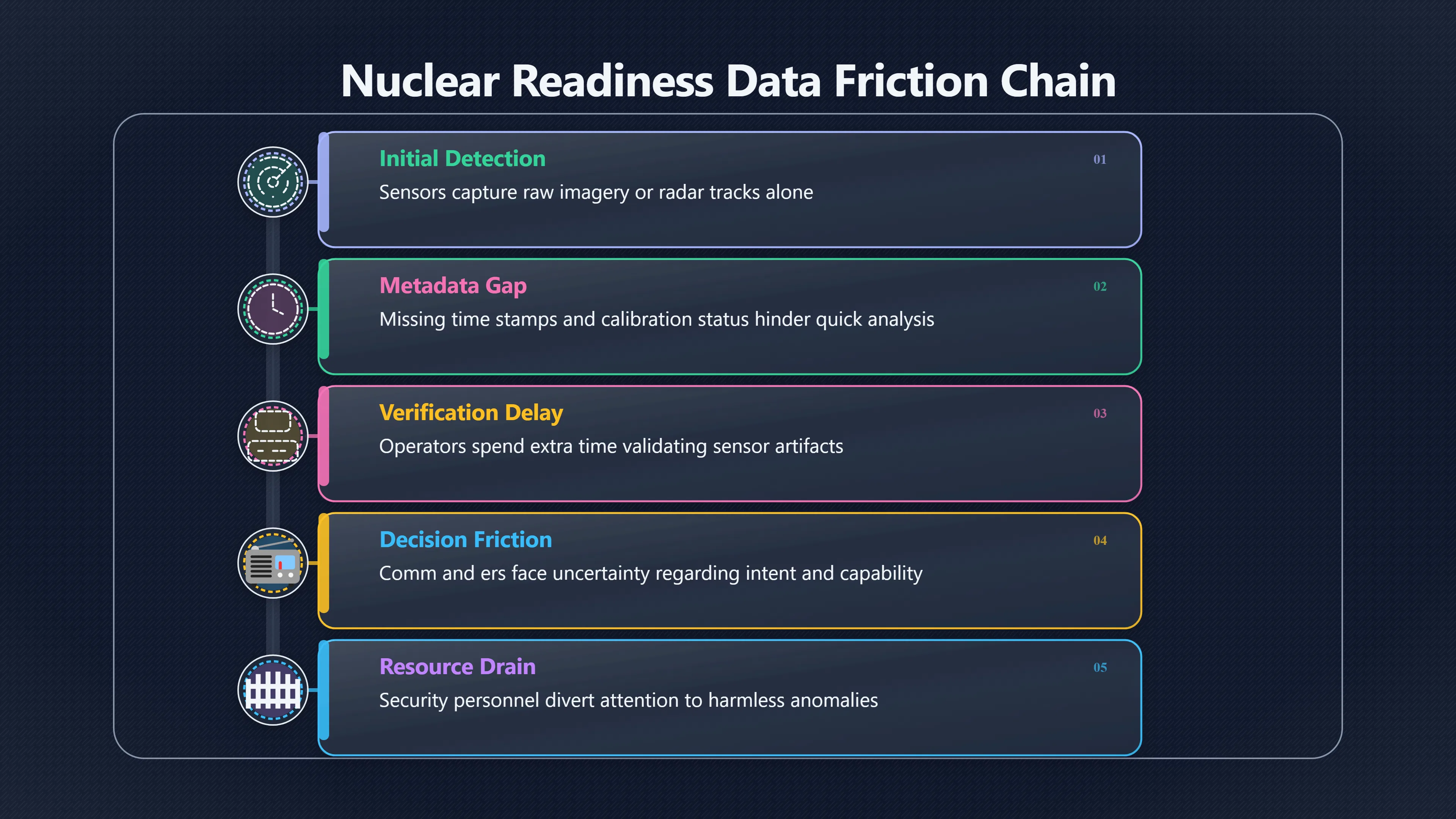
A sensor image or radar track is rarely useful on its own. Analysts normally need supporting information such as timestamp accuracy, sensor mode, altitude, range, viewing angle, weather conditions, platform location and calibration status. Without that context, even experienced operators can struggle to determine whether an apparent anomaly represents a physical object, a sensor effect or a data-processing error.
This problem appears repeatedly in official UAP investigations. The Office of the Director of National Intelligence noted that many reported incidents lacked sufficient data for attribution and analysis. More recently, the All-domain Anomaly Resolution Office (AARO) has stated that some unresolved cases remain unresolved because of insufficient technical information, missing corroboration or a lack of multi-sensor evidence. In several published examples, imagery alone was considered inadequate for determining whether an apparent object reflected a genuine target, a sensor artefact or another explainable phenomenon.[Director of National Intelligence+2AARO]dni.govDirector of National IntelligencePreliminary Assessment: Unidentified Aerial Phenomena…June 25, 2021 — 25 Jun 2021 — This report provi…
For nuclear readiness, the operational consequence is straightforward. If analysts cannot determine what an object is, they also cannot confidently assess intent, capability or risk. Commanders may therefore have to make decisions under conditions of uncertainty rather than evidence.
Why a single sensor can mislead
Single-sensor observations are particularly vulnerable to misinterpretation. Radar can generate false tracks. Infrared systems can produce unusual signatures. Optical sensors can be affected by perspective, atmospheric conditions and camera settings.
The defence and scientific communities increasingly emphasise sensor fusion—the combination of multiple independent data sources—as a way to reduce ambiguity. Research on drone detection similarly finds that identification improves when radar, optical, infrared and acoustic information are combined rather than treated separately. Without that fusion, ordinary objects can remain unidentified longer than they should.[arXiv]arxiv.orgarXiv A dataset for multi-sensor drone detectionA dataset for multi-sensor drone detectionNovember 2, 2021…
Why Baseline Data Matters Near Nuclear Sites
A readiness system works best when operators know what “normal” looks like. Baseline data includes expected air traffic patterns, weather effects, bird activity, maintenance operations, drone usage, sensor performance characteristics and recurring false-alarm signatures.
When baseline information is weak or fragmented, unusual observations become harder to evaluate. An object that would immediately stand out against a well-understood background may instead appear mysterious simply because there is insufficient reference data for comparison.
This challenge is especially relevant around nuclear facilities and strategic military installations. Such locations often employ numerous sensors, generate large volumes of security data and operate under strict reporting requirements. The result can be a paradox: more surveillance generates more detections, but not necessarily more understanding. The ODNI has cautioned that concentrations of UAP reports around military areas may partly reflect collection bias because these locations possess more sensors and more personnel trained to report anomalies.[Director of National Intelligence]dni.govDirector of National IntelligencePreliminary Assessment: Unidentified Aerial Phenomena…June 25, 2021 — 25 Jun 2021 — This report provi…
The distinction matters. A spike in reports near a sensitive site does not automatically indicate a spike in threats. It may instead reveal limitations in classification processes, data management or sensor integration.

The drone problem as a readiness example
Drone incidents illustrate why baseline information is critical. Nuclear regulators and security specialists increasingly treat unidentified drones as a practical security concern because they can be difficult to identify rapidly, especially at night or at long range. The US Nuclear Regulatory Commission updated reporting requirements for drone sightings over nuclear facilities partly because such events occur often enough to require systematic tracking and assessment.[Nuclear Regulatory Commission]nrc.govfs drone pwr plant securityNuclear Regulatory CommissionDrones and Nuclear Power Plant SecurityThe Nuclear Regulatory Commission updated its regulations in 2024 to…
Security studies of drone threats to nuclear facilities have reached similar conclusions. Detecting an object is only the first step. Determining what it is, who controls it and whether it poses a threat is substantially harder. A detection without reliable classification still leaves decision-makers facing uncertainty.[OSTI.gov]osti.govAnalyzing the Threat of Unmanned Aerial Vehicles (UAV)…by A Solodov · 2017 · Cited by 177 — Recently, several incidents occurred with…

How Uncertainty Slows Decisions
Nuclear organisations place a premium on disciplined decision-making. Procedures exist precisely to prevent hurried judgements during ambiguous situations. Yet poor data can slow those procedures by forcing operators to spend additional time validating information before acting.
An unidentified object near a nuclear installation can generate a chain of questions:
- Is the object real or a sensor error?
- Is it entering restricted airspace?
- Is it a drone, balloon, aircraft or bird?
- Does it pose a surveillance threat?
- Does it require interception or escalation?
- Which organisation has jurisdiction?
Each unanswered question adds friction to the response process. Even when the event ultimately proves harmless, personnel may have devoted significant attention and resources to resolving it.
Official UAP reporting reflects this challenge. AARO has repeatedly stated that its ability to resolve cases is constrained by the lack of timely and actionable sensor data. The office has consequently prioritised improvements in data collection, retention and sensor development because higher-quality information reduces uncertainty and accelerates analysis.[New York Post]nypost.comThe "all-domain anomaly resolution office" (AARO) identified 21 reports as "true anomalies" needing further investigation. Most sightings…
In a nuclear readiness context, this is not merely an analytical inconvenience. Delayed classification can affect patrol deployments, command attention, reporting chains and security postures. The object itself may be insignificant, but the uncertainty surrounding it consumes operational capacity.
The Real Readiness Risk Is Information Quality
One consistent finding across official UAP investigations is that unresolved does not necessarily mean extraordinary. Many cases remain open because the available information is incomplete rather than because the observed behaviour defies explanation. AARO’s historical reviews have noted that some long-standing UAP stories contain very little actionable data, while contemporary investigations continue to encounter cases limited by poor-quality or insufficient records.[U.S. Department of War+2AARO]media.defense.govDOPSR 2024 0263 AARO HISTORICAL RECORD REPORT VOLUMEU.S. Department of WarAARO Historical Record Report Volume 18 Mar 2024 — AARO Investigating Unresolved Historical… Like all historical…
From a readiness perspective, that distinction is crucial. The operational lesson is not that unidentified objects represent unknown technologies. It is that sensitive systems become harder to manage when information quality falls below the level required for confident decisions.
Near nuclear infrastructure, bad data imposes an uncertainty tax. It increases investigation time, complicates threat assessment, encourages precautionary responses and leaves commanders operating with less confidence than the situation demands. Improving sensor metadata, preserving complete records, integrating multiple sensor types and establishing strong baseline datasets are therefore not merely analytical improvements. They are readiness measures designed to reduce ambiguity before it becomes an operational problem.
Amazon book picks
Further Reading
Books and field guides related to Why Bad Data Can Be a Readiness Problem. Use these as the next step if you want deeper reading beyond the article.
Thinking, Fast and Slow
Useful for understanding uncertainty and judgment under ambiguity.
eBay marketplace picks
Marketplace Samples
Example marketplace items related to this page. Use the search link to explore similar finds on eBay.




Endnotes
1.
Source: war.gov
Title: dr jon kosloski director aaro media roundtable on the fy24 consolidated annual
Link:https://www.war.gov/News/Transcripts/Transcript/Article/3965734/dr-jon-kosloski-director-aaro-media-roundtable-on-the-fy24-consolidated-annual/
Source snippet
Department of WarDr. Jon Kosloski, Director, AARO, Media Roundtable on the...14 Nov 2024 — AARO has taken meaningful steps to improve da...
2.
Source: aaro.mil
Link:https://www.aaro.mil/UAP-Cases/Official-UAP-Imagery/
3.
Source: arxiv.org
Title: arXiv A dataset for multi-sensor drone detection
Link:https://arxiv.org/abs/2111.01888
Source snippet
A dataset for multi-sensor drone detectionNovember 2, 2021...
Published: November 2, 2021
4.
Source: osti.gov
Link:https://www.osti.gov/servlets/purl/1356834
Source snippet
Analyzing the Threat of Unmanned Aerial Vehicles (UAV)...by A Solodov · 2017 · Cited by 177 — Recently, several incidents occurred with...
5.
Source: war.gov
Title: department of defense releases the annual report on unidentified anomalous phen
Link:https://www.war.gov/News/Releases/Release/Article/3964824/department-of-defense-releases-the-annual-report-on-unidentified-anomalous-phen/
Source snippet
Department of Defense Releases the Annual Report on...14 Nov 2024 — The remaining 272 reports featured UAP incidents that occurred betwe...
6.
Source: war.gov
Title: the department of defense launches the all domain anomaly resolution office web
Link:https://www.war.gov/News/Releases/Release/Article/3513171/the-department-of-defense-launches-the-all-domain-anomaly-resolution-office-web/
Source snippet
The Department of Defense Launches the All-domain...Aug 31, 2023 — The All-domain Anomaly Resolution Office's new website provides the p...
7.
Source: aaro.org
Link:https://aaro.org/
Source snippet
Association of Americans Resident Overseas: AAROThe Association of Americans Resident Overseas (AARO), founded in 1973 is a global, non-p...
8.
Source: aaro.mil
Title: AARO Historical Record Report Vol 1 2024
Link:https://www.aaro.mil/Portals/136/PDFs/AARO_Historical_Record_Report_Vol_1_2024.pdf
Source snippet
AARO_Historical_Record_Repor...6 Mar 2024 — SECTION I: Introduction. This report represents Volume I of the All-domain Anomaly Resolution...
9.
Source: aaro.mil
Link:https://www.aaro.mil/UAP-Cases/UAP-Case-Resolution-Reports/
10.
Source: aaro.com
Title: Your Partner in Group Reporting | CPM software & more
Link:https://aaro.com/en/
Source snippet
Complete software, wide range of services, online support...
11.
Source: osti.gov
Link:https://www.osti.gov/biblio/5874499
Source snippet
Work-a-day world of NPRDS: the working sideThe Nuclear Plant Reliability Data System (NPRDS) data base currently contains more than 200,0...
12.
Source: dni.gov
Link:https://www.dni.gov/files/ODNI/documents/assessments/Prelimary-Assessment-UAP-20210625.pdf
Source snippet
Director of National IntelligencePreliminary Assessment: Unidentified Aerial Phenomena...June 25, 2021 — 25 Jun 2021 — This report provi...
Published: June 25, 2021
13.
Source: nypost.com
Link:https://nypost.com/2024/11/14/us-news/pentagon-says-nearly-two-dozen-ufo-sightings-cant-be-explained-true-anomalies/
Source snippet
The "all-domain anomaly resolution office" (AARO) identified 21 reports as "true anomalies" needing further investigation. Most sightings...
14.
Source: nrc.gov
Title: fs drone pwr plant security
Link:https://www.nrc.gov/reading-rm/doc-collections/fact-sheets/fs-drone-pwr-plant-security
Source snippet
Nuclear Regulatory CommissionDrones and Nuclear Power Plant SecurityThe Nuclear Regulatory Commission updated its regulations in 2024 to...
15.
Source: media.defense.gov
Title: DOPSR 2024 0263 AARO HISTORICAL RECORD REPORT VOLUME 1 2024
Link:https://media.defense.gov/2024/Mar/08/2003409233/-1/-1/0/DOPSR-2024-0263-AARO-HISTORICAL-RECORD-REPORT-VOLUME-1-2024.PDF
Source snippet
U.S. Department of WarAARO Historical Record Report Volume 18 Mar 2024 — AARO Investigating Unresolved Historical... Like all historical...
16.
Source: pwkinternational.com
Title: uap unidentified anomaly or demand signal
Link:https://pwkinternational.com/2025/11/11/uap-unidentified-anomaly-or-demand-signal/
Source snippet
UAP | An Uncertainty Tax & Demand Signal |11 Nov 2025 — The DoD emphasizes AARO's role in consolidating UAP reporting, improving data qua...
17.
Source: zenodo.org
Link:https://zenodo.org/records/20137882
Source snippet
sensor platforms (e.g., radar resolution limits). However, the UAP...Read more...
Additional References
18.
Source: gao.gov
Link:https://www.gao.gov/products/gao
Source snippet
DOE Could Improve Aspects of Nuclear Security ReportingGAO's review of the annual security status reports and interviews with agency offi...
19.
Source: reddit.com
Link:https://www.reddit.com/r/UFOs/comments/1ccnj6t/aaro_does_not_have_a_100_confidence_in_its_report/
Source snippet
AARO does not have a 100% confidence in its report, so...According to the Key Findings section of the report, "AARO has moderate confide...
20.
Source: unscear.org
Link:https://www.unscear.org/unscear/en/publications/scientific-reports.html
Source snippet
Scientific ReportsUNSCEAR assesses and reports levels and effects of exposure to ionizing [radiation]({{ 'radiation/' | relative_url }}). These reports are highly regarded as...
21.
Source: evidence-standards.vercel.app
Link:https://evidence-standards.vercel.app/
Source snippet
Sensor Data StandardsSensor data plays a critical role in analyzing UAP encounters. Various sensors, ranging from radar to electromagneti...
22.
Source: onr.org.uk
Link:https://www.onr.org.uk/publications/publication-search?type=researchReportPublication
Source snippet
Publication searchThis research explores how the UK's climate may evolve under plausible high‑end future scenarios, assessing the potenti...
23.
Source: ief.org
Link:https://www.ief.org/_resources/files/events/nuclear-small-modular-reactors-smrs-key-considerations-for-deployment/smr-report.pdf
Source snippet
ower capacity of up to 300 MWe per unit, though most SMR designs currently under...Read more...
24.
Source: iaea.org
Link:https://www.iaea.org/events/evt2005113
Source snippet
regarding nuclear security countermeasures for Uncrewed Aerial Vehicles.Read more...
25.
Source: kns.org
Link:https://www.kns.org/files/pre_paper/42/19A-202-%EA%B9%80%EC%9E%AC%EC%82%B0.pdf
Source snippet
However, this can cause a major panic among the personnel of the...Read more...
26.
Source: uapradar.com
Link:https://uapradar.com/articles/generated/aaro-publishes-uap-case-resolution-reports-with-videos-and-technical-assessmen
Source snippet
UAP Radar9 May 2026 — AARO's case resolution page lists official assessments for several UAP cases, including Al Taqaddum, Mt. Etna, Pu...
Published: May 2026
27.
Source: rev.com
Title: senate hearing on unidentified aerial phenomena
Link:https://www.rev.com/transcripts/senate-hearing-on-unidentified-aerial-phenomena
Source snippet
UAP UFO Senate Hearing Unidentified Aerial Phenomena23 Jan 2026 — These public documents help highlight the challenges still facing this...
Topic Tree