Within Radar
When Should a Radar Unknown Trigger Security?
Near nuclear facilities, the key question is when an unexplained return should trigger an intrusion response.
On this page
- Intruder, misidentification or sensor artefact
- Why nuclear sites need a higher resolution standard
- How logs and communications shape after action review
Page outline Jump by section
Introduction
Near a nuclear facility, the key question raised by an unexplained radar return is not whether it represents a UFO. The operational question is whether the return crosses a threshold that justifies a security response. Security personnel must decide quickly whether they are seeing an intruder, a conventional aircraft, a drone, a radar artefact, weather-related clutter, or a system malfunction. That decision is made under uncertainty, often before the nature of the target is known.
 For this reason, nuclear-related radar anomalies are fundamentally governance and risk-management problems. The response threshold is designed to balance two competing dangers: reacting aggressively to false targets and failing to react to a genuine threat. Nuclear sites generally resolve this tension by treating unexplained returns as security events that must be investigated, while requiring multiple forms of confirmation before escalating to the highest response levels. This approach reflects both the known limitations of radar systems and the exceptional consequences of overlooking a real intrusion.[Federal Aviation Administration+2IAEA]faa.govFederal Aviation AdministrationSection 5. Surveillance SystemsThe bending of radar pulses, often called anomalous propagation or ducting…
When Should a Radar Unknown Trigger Security?
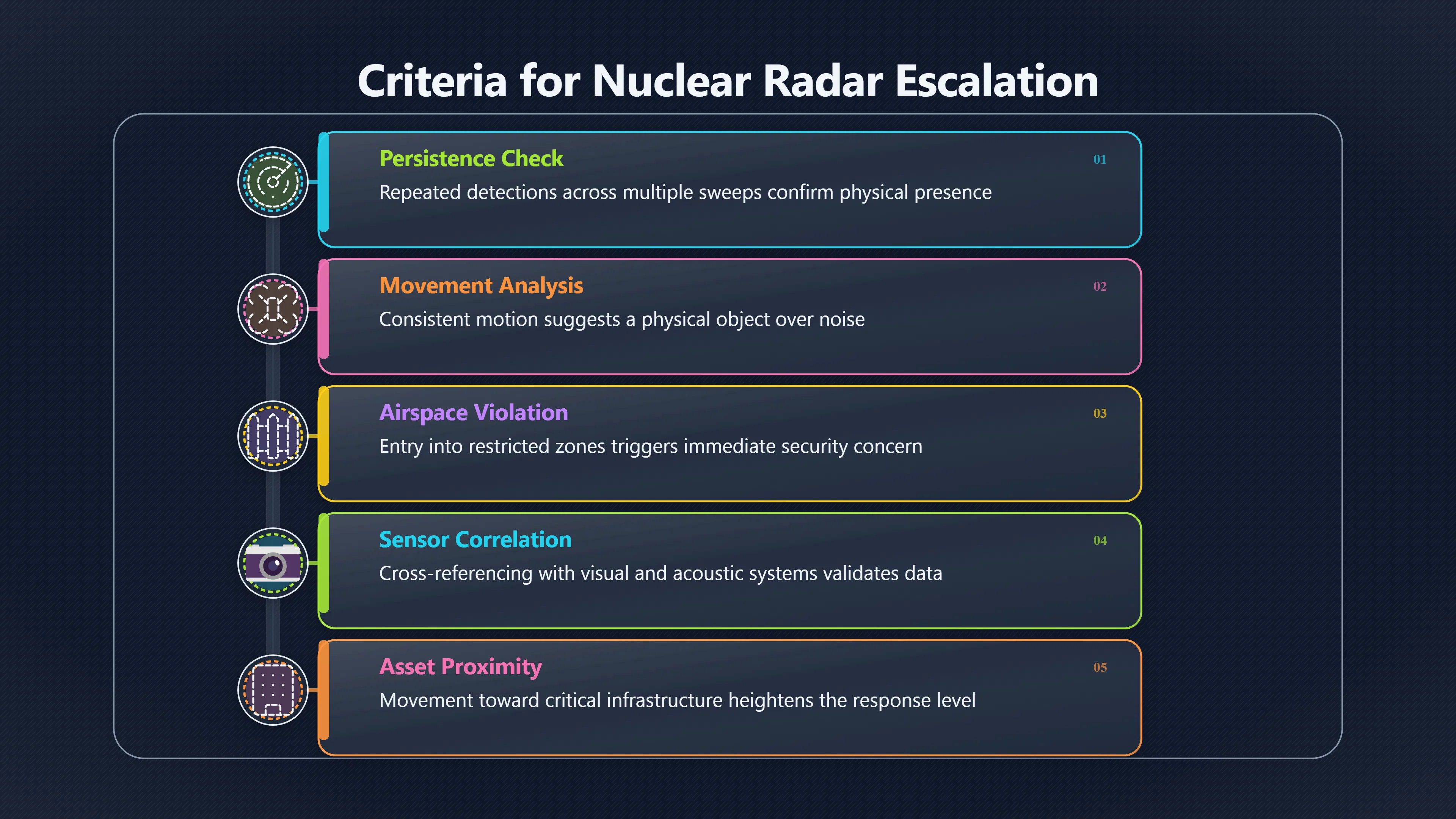
In most security environments, a single unexplained radar contact does not automatically prove that an intrusion is occurring. Instead, operators evaluate whether the contact satisfies a set of escalation criteria.
Typical indicators that raise concern include:
- Repeated detection over multiple radar sweeps rather than a single isolated blip.
- Consistent movement suggesting a physical object rather than random noise.
- Entry into restricted or protected airspace.
- Correlation with visual observations, electro-optical sensors, acoustic systems, or other radars.
- Behaviour inconsistent with authorised aircraft operations.
- Movement towards protected assets or critical infrastructure.
The practical threshold is therefore not “unknown equals threat”. It is closer to “unknown plus sufficient evidence of persistence, location and behaviour equals security concern”.
This distinction is important in discussions of UFO reports near nuclear installations. A radar operator may honestly report an unidentified target, yet security commanders still require additional information before treating the event as a confirmed intrusion. The unknown status of a contact is often the beginning of the assessment process rather than the end of it.[OSTI.gov+2IAEA]osti.govNuclear Power Plant Security Assessment Technical ManualNovember 8, 2007 — by SL O'Connor · 2007 · Cited by 3 — This document provides a set of best practices that incorporates knowledge gained…
Intruder, Misidentification or Sensor Artefact
A security response framework attempts to separate three possibilities.
Potential intruder. The return appears persistent, enters a protected area, and behaves like a genuine object. In this case, additional sensors and response forces may be activated.
Misidentification. The target exists but is later identified as a legitimate aircraft, helicopter, drone, bird flock, weather phenomenon or other ordinary object.
Sensor artefact. The contact originates from the radar system itself or from environmental conditions affecting it.
The third category receives less public attention but is critical. Aviation and radar authorities have long documented mechanisms that create false targets. Temperature inversions and anomalous propagation can bend radar beams and generate extraneous returns. Ground clutter, terrain reflections, weather effects and signal-processing limitations can also create misleading tracks. False targets are recognised operational hazards rather than rare curiosities. EUROCONTROL+3Federal Aviation Administration+3Federal Aviation Administration[faa.gov]faa.govFederal Aviation AdministrationSection 5. Surveillance SystemsThe bending of radar pulses, often called anomalous propagation or ducting…
Consequently, a responsible security threshold cannot be based solely on radar detection. Operators must determine whether the return behaves like a real object before committing scarce security resources or initiating higher-level responses.
Why Nuclear Sites Need a Higher Resolution Standard
Nuclear facilities operate under security models that assume the possibility of deliberate attack, sabotage or unauthorised surveillance. International nuclear-security guidance uses the concept of a Design Basis Threat (DBT), a formal description of adversary capabilities that security systems are expected to detect and counter.[IAEA+2STUKlex]iaea.orgDesign Basis Threat (DBT) | IAEAA DBT describes the capabilities of potential insider and external adversaries who might attempt unau…
This framework changes how unknown radar returns are interpreted.
At an ordinary airport, an unexplained contact may primarily be a flight-safety issue. At a nuclear facility, the same contact can raise questions about reconnaissance, hostile probing, drone activity or preparation for a future attack. Because the potential consequences are greater, facilities often adopt lower thresholds for investigation but higher thresholds for confirmation.
In practice, that means:
- More willingness to investigate ambiguous detections.
- Greater emphasis on sensor fusion and corroboration.
- More extensive documentation of the event.
- Stronger requirements for post-incident analysis.
The challenge is that nuclear facilities cannot simply assume every anomaly is hostile. Excessive false alarms consume personnel, reduce confidence in warning systems and may create complacency. Security planners therefore seek systems that maximise detection while minimising false alarms. Modern radar design places significant emphasis on suppressing false targets and distinguishing genuine objects from clutter for exactly this reason.[RTX+2Preprints]rtx.comPrimary (Non-Cooperative) Surveillance Radar (NCSR)ASR-XM delivers exceptional aircraft detection with low false target rates – even i…
Why Radar Alone Rarely Settles the Question
Public discussions of nuclear-UFO cases often treat radar confirmation as decisive evidence. Security organisations generally do not.
A radar return may indicate that something reflected radio energy, but it does not automatically reveal what produced the reflection. Experienced operators know that apparent targets can arise from environmental effects, signal-processing issues or unusual propagation conditions. The Federal Aviation Administration specifically notes that anomalous propagation can create extraneous radar blips and alter detection performance. Similar concerns appear in aviation and surveillance-radar literature across multiple operational contexts. NOAA+3Federal Aviation Administration+3Federal Aviation Administration[faa.gov]faa.govFederal Aviation AdministrationSection 5. Surveillance SystemsThe bending of radar pulses, often called anomalous propagation or ducting…
For that reason, higher-confidence assessments usually require corroboration. Security personnel look for agreement among independent systems rather than relying on a single sensor.
A contact that appears on one radar but nowhere else may remain unresolved. A contact observed simultaneously by multiple radars, visual observers and communications logs is far more likely to trigger elevated concern.
This explains why some famous nuclear-era UFO incidents remain debated decades later. Reports may describe radar involvement, but without preserved track data, sensor metadata, environmental information and communications records, it can be difficult to determine whether the event crossed the threshold from anomaly to confirmed intrusion.
How Logs and Communications Shape After-Action Review
The most important decisions about an unknown radar return are often made after the event rather than during it.
Security investigations rely heavily on operational records:
- Radar recordings and track histories.
- Controller or operator logs.
- Security-force dispatch records.
- Airspace coordination communications.
- Maintenance and equipment-status reports.
- Weather and atmospheric data.
These records allow investigators to reconstruct the event and determine whether response thresholds were appropriate.
For example, a return initially treated as a possible intrusion may later be linked to atmospheric conditions known to generate false targets. Conversely, a seemingly minor anomaly may gain significance if communications logs show simultaneous visual sightings or sensor correlations.
This documentation function is particularly important near nuclear facilities because regulators and security managers must demonstrate that anomalies were evaluated systematically rather than ignored. Security effectiveness is judged not only by whether a threat was detected but also by whether decision-makers followed defensible procedures when evidence was uncertain.[Office for Nuclear Regulation+2OSTI.gov]onr.org.ukOffice for Nuclear Regulation The ThreatOffice for Nuclear RegulationThe ThreatApril 12, 2022 — ONR has established its assessment principles, which apply to the assessment by O…
The Value of a Documented Decision Trail
A well-documented event answers questions that often emerge years later:
- What exactly was detected?
- Which systems detected it?
- How long did the contact persist?
- What actions were ordered?
- Why was escalation approved or rejected?
- What alternative explanations were considered?
Without those records, later narratives can exaggerate or minimise the significance of an incident. In the context of UFO claims around nuclear facilities, this is one reason historical cases frequently remain unresolved. The surviving story may focus on the mystery, while the operational details needed to evaluate the response threshold have been lost.
The Real Response Line
The most important lesson from nuclear-related radar anomalies is that security systems are designed around uncertainty rather than certainty. An unknown radar return does not need to be identified as a hostile craft before action begins, but it does need to meet defined criteria before a major response is justified.
The practical response line sits between scepticism and alarmism. Security organisations cannot dismiss every unexplained contact as a sensor error, because genuine threats may first appear as unexplained contacts. They also cannot treat every unexplained contact as evidence of intrusion, because radar systems inevitably generate false and ambiguous returns. The governing principle is therefore escalation through corroboration: investigate early, verify through multiple sources, and increase the response only as confidence in the reality of the target grows.[Federal Aviation Administration+3IAEA+3STUKlex]iaea.orgDesign Basis Threat (DBT) | IAEAA DBT describes the capabilities of potential insider and external adversaries who might attempt unau…

Amazon book picks
Further Reading
Books and field guides related to When Should a Radar Unknown Trigger Security?. Use these as the next step if you want deeper reading beyond the article.


Stimson's Introduction to Airborne Radar
First published 2014. Subjects: Radar in aeronautics.
eBay marketplace picks
Marketplace Samples
Example marketplace items related to this page. Use the search link to explore similar finds on eBay.




Endnotes
1.
Source: iaea.org
Link:https://www.iaea.org/topics/security-of-nuclear-and-other-radioactive-material/design-basis-threat
Source snippet
Design Basis Threat (DBT) | IAEAA DBT describes the capabilities of potential insider and external adversaries who might attempt unau...
2.
Source: stuklex.fi
Title: DBT 2020en
Link:https://www.stuklex.fi/en/DBT_2020en.pdf
Source snippet
Design basis threat for the use of nuclear energy and...28 Feb 2020 — A DBT defines the threat to be used as a basis for the requirement...
3.
Source: osti.gov
Title: Nuclear Power Plant Security Assessment Technical Manual
Link:https://www.osti.gov/servlets/purl/921722
Source snippet
November 8, 2007 — by SL O'Connor · 2007 · Cited by 3 — This document provides a set of best practices that incorporates knowledge gained...
Published: November 8, 2007
4.
Source: eurocontrol.int
Link:https://www.eurocontrol.int/sites/default/files/publication/files/surveillance-standard-document-for-radar-surveillance-in-en-route-airspace-and-major-terminal-areas199703.pdf
Source snippet
er reflecting objects...
5.
Source: rtx.com
Link:https://www.rtx.com/collinsaerospace/what-we-do/industries/air-traffic-management/surveillance/non-cooperative-surveillance-radar
Source snippet
Primary (Non-Cooperative) Surveillance Radar (NCSR)ASR-XM delivers exceptional aircraft detection with low false target rates – even i...
6.
Source: preprints.org
Link:https://www.preprints.org/manuscript/202408.1907
Source snippet
Radar False Alarm Suppression Based on Target Spatial...26 Aug 2024 — To suppress false alarms while retaining the target, this paper an...
7.
Source: noaa.gov
Link:https://www.noaa.gov/jetstream/anomalous-propagation
Source snippet
JetStream Max: Anomalous Propagation9 Aug 2023 — False echoes are known as anomalous propagation (AP) - an echo that is not precipita...
8.
Source: www-pub.iaea.org
Title: TE 2123web
Link:https://www-pub.iaea.org/MTCD/publications/PDF/TE-2123web.pdf
Source snippet
Incident Analysis in Computer Security at Nuclear...The coordinated research project titled Enhancing Computer Security Incident Analysi...
9.
Source: osti.gov
Link:https://www.osti.gov/servlets/purl/1356834
Source snippet
Analyzing the Threat of Unmanned Aerial Vehicles (UAV)...by A Solodov · 2017 · Cited by 177 — Summary of technological needs to improve...
10.
Source: faa.gov
Link:https://www.faa.gov/air_traffic/publications/atpubs/aim_html/chap4_section_5.html
Source snippet
Federal Aviation AdministrationSection 5. Surveillance SystemsThe bending of radar pulses, often called anomalous propagation or ducting...
11.
Source: faa.gov
Title: Federal Aviation Administration4-5-2
Link:https://www.faa.gov/air_traffic/publications/atpubs/aim/aim0405.html
Source snippet
Air Traffic Control Radar Beacon System (ATCRBS)8 Jan 2015 — (b) The bending of radar pulses, often called anomalous propagation or ducti...
12.
Source: federalregister.gov
Title: design basis threat
Link:https://www.federalregister.gov/documents/2007/03/19/07-1317/design-basis-threat
Source snippet
19 Mar 2007 — The Nuclear Regulatory Commission (NRC) is amending its regulations that govern the requirements pertaining to the design b...
13.
Source: onr.org.uk
Title: Office for Nuclear Regulation The Threat
Link:https://www.onr.org.uk/publications/regulatory-guidance/regulatory-assessment-and-permissioning/technical-assessment-guides-tags/nuclear-security-tags/cns-tast-gd-1142-the-threat
Source snippet
Office for Nuclear RegulationThe ThreatApril 12, 2022 — ONR has established its assessment principles, which apply to the assessment by O...
Published: April 12, 2022
14.
Source: Wikipedia
Title: Anomalous propagation
Link:https://en.wikipedia.org/wiki/Anomalous_propagation
Source snippet
Anomalous propagationAnomalous propagation includes different forms of radio propagation due to an unusual distribution of temperature...
15.
Source: ukhpr1000.co.uk
Link:https://ukhpr1000.co.uk/the-uk-hpr1000-technology/security/
Source snippet
UK HPR1000 ~ SecuritySecurity. Nuclear security is a fundamental part of the Generic Design Assessment (GDA) and a key area of assessment...
Additional References
16.
Source: researchgate.net
Link:https://www.researchgate.net/publication/228898226_P10_11_AUTOMATIC_DETECTION_AND_REMOVAL_OF_GROUND_CLUTTER_CONTAMINATION_ON_WEATHER_RADARS
Source snippet
11 automatic detection and removal of ground clutter...Anomalous propagation can cause the radar beam to increase contact or overshoot t...
17.
Source: quizlet.com
Link:https://quizlet.com/419475825/block-1-section-7-radar-flash-cards/
Source snippet
Block 1: Section 7: Radar FlashcardsFalse targets (primary radar) are spurious targets produced as a result of temperature inversion or a...
18.
Source: ans.org
Link:https://www.ans.org/pubs/proceedings/article-45905/
Source snippet
IAEA Coordinated Research Project on Enhancing Incident...The objective of this CRP is to conduct activities which support improved comp...
19.
Source: sahasec.org
Link:https://sahasec.org/tracker/
20.
Source: researchgate.net
Link:https://www.researchgate.net/publication/332254869_Surveillance_Radar_System_Limitations_and_the_Advent_of_the_Automatic_Dependent_Surveillance_Broadcast_system_for_Aircraft_Monitoring
Source snippet
Surveillance Radar System Limitations and the Advent of...Apr 7, 2019 — In this paper, the limitations of the surveillance radar system...
21.
Source: youtube.com
Link:https://www.youtube.com/watch?v=ps_xsbXuUHM
Source snippet
LIVE | IDF Shocked by Sudden Radar Alert! Interceptors...LIVE | Tensions soar in Israel after a possible radar glitch triggered air raid...
22.
Source: youtube.com
Link:http://www.youtube.com/watch?v=9YePD7fCj7k
Source snippet
NORAD radar tracking unidentified objects military response Expert on NORAD's response of identifying flying objects across US | Morning...
23.
Source: opennuclear.org
Title: linus holler discusses nuclear facility risks during armed conflict new
Link:https://opennuclear.org/en/open-nuclear-network/news/linus-holler-discusses-nuclear-facility-risks-during-armed-conflict-new
Source snippet
Linus Höller Discusses Nuclear Facility Risks During...2 Jun 2026 — In a recent article for The New Arab, ONN Assistant Analyst Linus Hö...
24.
Source: medium.com
Title: ufos and radar targets clutter safety and false certainty c3eab7a878ad
Link:https://medium.com/%40timventura/ufos-and-radar-targets-clutter-safety-and-false-certainty-c3eab7a878ad
Source snippet
UFOs and Radar: Targets, Clutter, Safety, and False CertaintyFrom Washington 1952 to the Nimitz encounter, this story explores UFOs, rada...
25.
Source: support.foreflight.com
Title: 203801509 What causes a false or non existent radar return to appear
Link:https://support.foreflight.com/hc/en-us/articles/203801509-What-causes-a-false-or-non-existent-radar-return-to-appear
Source snippet
causes a false or non-existent radar return to appear?4 Feb 2025 — False or non-existent radar returns may appear in areas where no preci...
Topic Tree